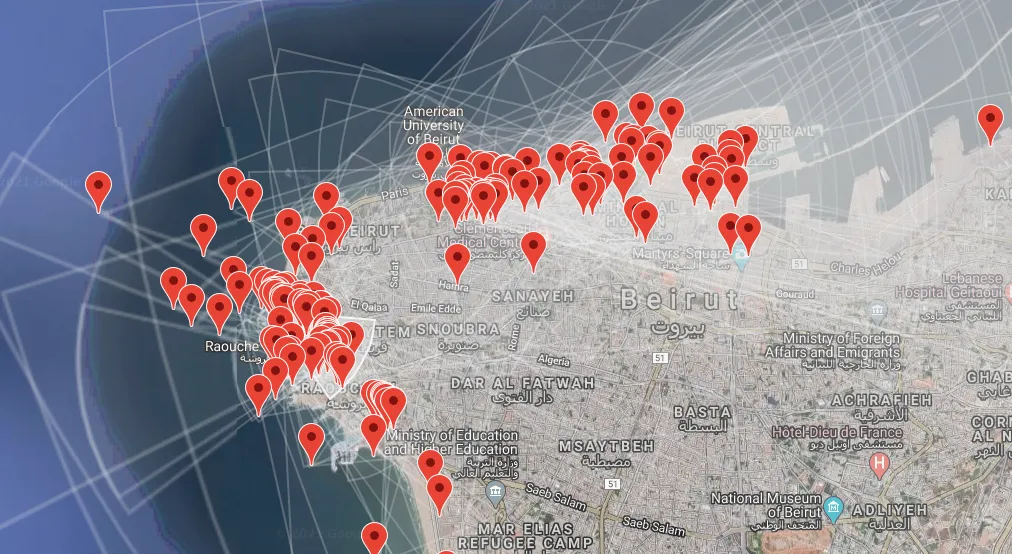




الانتهاكات بحقّ الصحافيّين خلال الأشهر الأربعة الأخيرة.
Violations of journalists' rights over the past four months.
Swipe for English ➡️
Digital Data Forays Frictions Disrupt Futures Disinformation Foundations Dislodge

Kevorkian Center for Near Eastern Studies
New York University
a year long series of workshops
2020-2021
This year-long series starts from a simple premise:
What does it look like to think, engage, and do
research in this digital age?
This question cuts across the ways we consume culture, digest news, carry out politics, and craft ourselves. This series is a call for researchers to account for the ever increasingly digital world in which we live. In order to better activate our scholarship we must reimagine our methods, modes of collaboration, and how to participate in these quickly changing digital landscapes.
Many junior scholars are now working across a digital multimedia landscape and they are pushing the genres of storytelling, engagement, augmentation—thus changing the scales and shapes of their scholarship. Digital Forays addresses threads from the Digital Humanities (DH), but also from an array of other ambiguous buzzwords: "Digital Scholarship," "Public Humanities," "Digital Publishing,” “Big Data.” At stake in changing methodologies are a range of interconnected issues that amount to seismic shifts in how we deepen, develop, and disseminate our research. Indeed, at present, the perils/promise of our digital age are exemplified by the COVID-19 pandemic—which has forced the most basic scholarly activities of teaching and research into online-compatible modalities—and ongoing dissent and protest in the Middle East (and globally), where digital devices become appendages of how we capture, circulate, and remake the world.
Digital Forays in Middle Eastern Studies is an invitation to explore these changes with scholars, journalists, archivists, and activists who have been engaged in unorthodox & cutting-edge work. In planning this series a colleague suggested a foray (defined as: “an initial attempt into a new activity or area”) as a way to account for the provisionality and process of working digitally. As such, these conversations will assemble panelists to shed light on ways we narrate our present, produce and gather information, and how we might better understand & utilize digital infrastructures around us.
What is “data” today? “Data” from where, created by whom? How do we access, sift, sort, sample this information? How can one be critical of data, but also use it at the same time?
How to make sense of the different archives, databases, and digitization projects that emerge across the region every year? How do they allow for new means of collaboration, crowdsourcing, and community?
How might one begin to develop aspects of digital directions in research already underway?
How are we teaching the “Middle East” with changing technologies? To whom? With what resources? What is the future of area studies in a digital age?
In a changing professional landscape, how can we deepen the skills and scholarship of our students that will go on to carry out cutting edge PhD research, while also helping students broaden their imaginations beyond the university?
How can our students engage and produce work that blurs disciplines - but also scholarly/journalistic/artistic boundaries?
What type of new digital projects are Junior Scholars/Phd Candidates struggling to imagine and produce that are integral components to their projects? (databases, interfaces/websites, and archives)
What are future directions of “Middle Eastern Studies” in an increasing digital world?
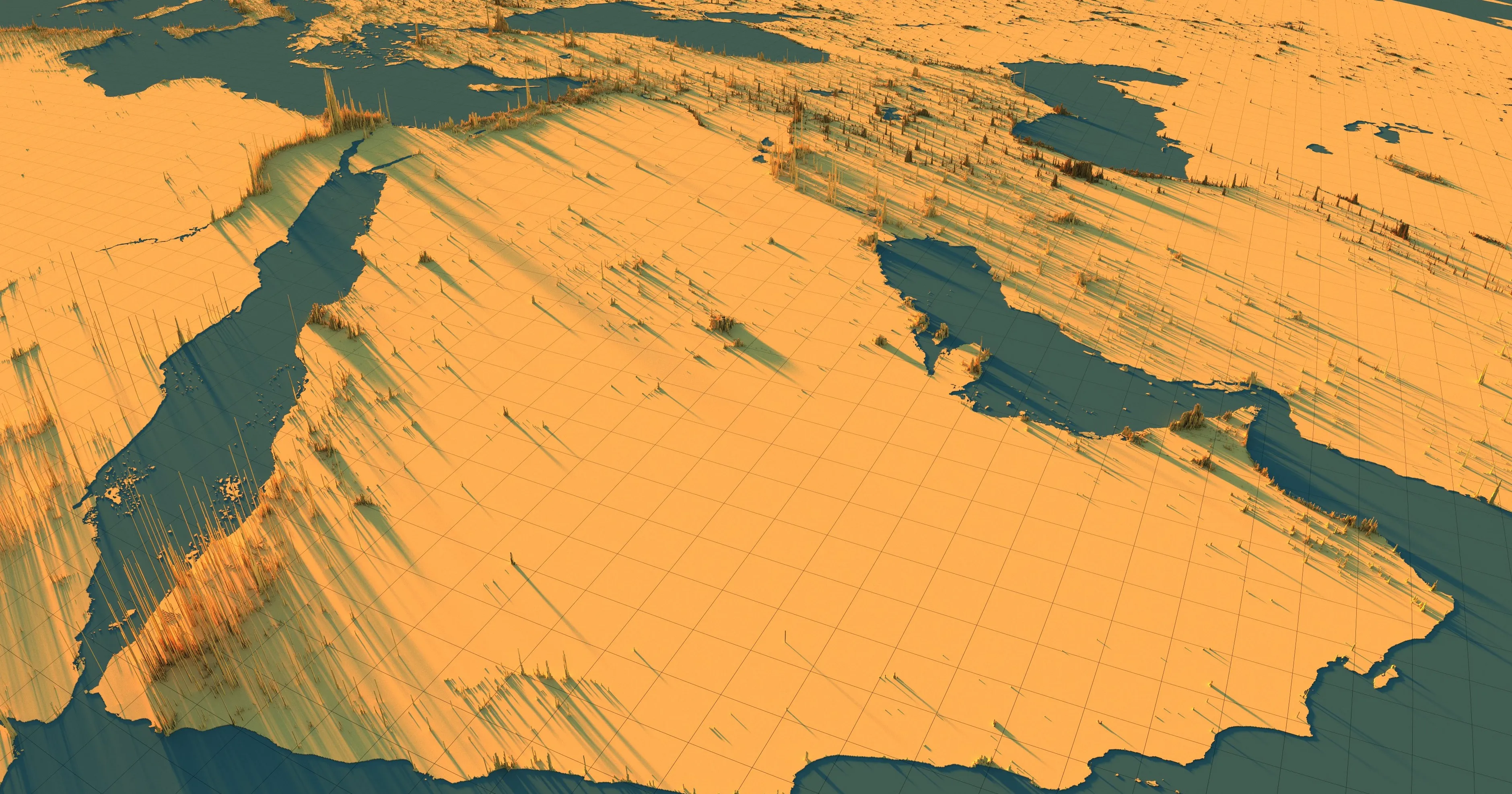
Population Desnsity
- @undertheraedar
This website is built off of the 2020–2021 series at NYU's Hagop Kevorkian Center for Near Eastern Studies:
Digital Forays in Middle Eastern Studies & Global Uprising.
All of the events in these series are our attempt to address public programing in this moment of remote instruction and distance - but they were also built directly into the classroom.
This platform is the result of student group work through our required core course for incoming graduate students: Problems and Methods in Middle Eastern Studies.
The 22 students faced a difficult task: to enter the program & begin their degrees studying remotely. To meet this challenge, we designed the course so that students could work in smaller groups to think through the events in each series. We view this as a novel way for cohort building, a way to integrate asynchronous material into the classroom, and a unique opportunity to model public scholarship!
The 4 groups (Apple, PAH, Saffron Vesper, Octopus) were charged to work together to EXTEND the events to which they were assigned. This was realized through:
This was their prompt for the extension:
We asked the students to map out what the event aimed to achieve, what transpired in the conversation, and then develop a meaningful extension that synthesizes new directions! We know that working in groups is difficult - but it’s the real world. These assignment are in the spirit of thinking & working collectively.
Fall 2020
1
2
3
4
5
6
Spring 2021
7
8
9
10
11

12
Event posters: Hagop Kevorkian Center for Near Eastern Studies, New York University, 2020-2021.
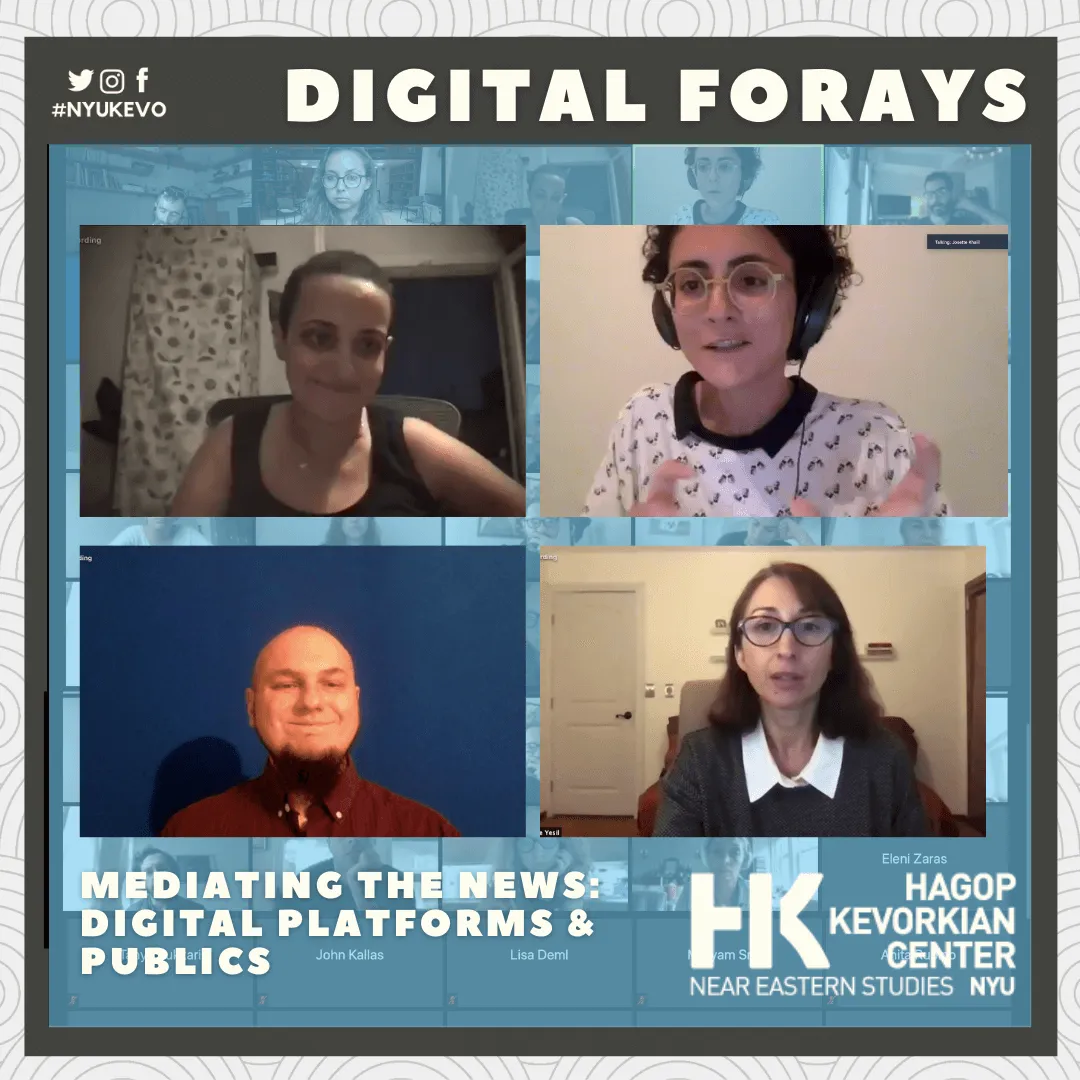
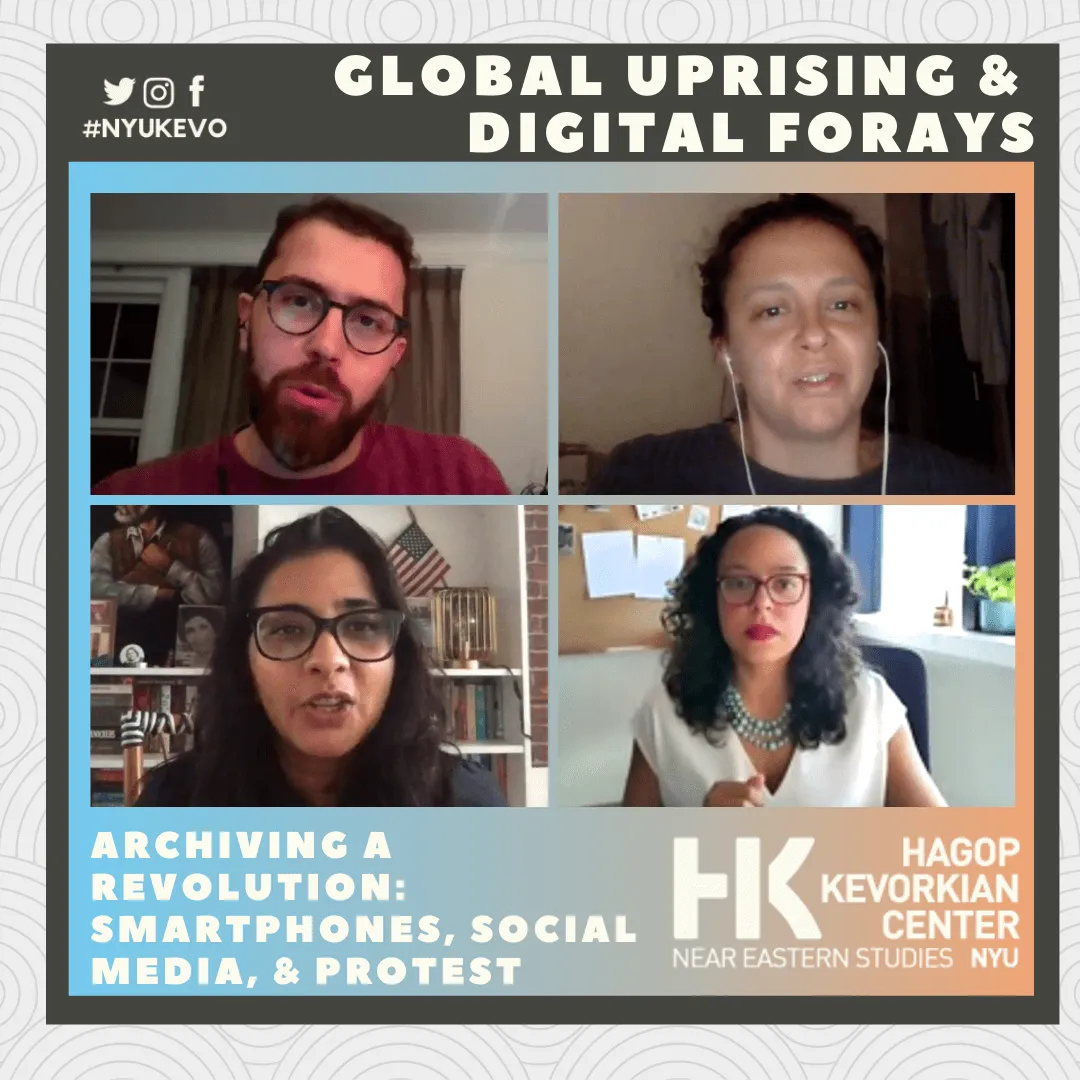
Many dynamic “alternative” news portals & collaboratives have developed during/since the Arab Spring. How do they spread information and create publics beyond the traditional news cycle? Most often this happens through websites, social media and by creating dynamic content across various apps.
Yet how do they mobilize their messages across different platforms specifically? Why?
What is the larger media landscape in the contexts in which they operate and how do various platforms allow different modes of engagement? For instance, why Instagram videos vs tweets / Youtube channels versus Facebook - what is some of the logic behind how they engage their publics through digital practices?
This week questions the role of the app/medium/phone in how these organizations reach, disseminate and engage with their publics.
Lina Attalah is an Egyptian media figure and journalist. She is co-founder and chief editor of Mada Masr, an independent online Egyptian newspaper and was previously managing editor of the Egypt Independent prior to its print edition closure in 2013. She is active in the fight against the restriction of honest journalism.
Gürkan Özturan is the executive manager of rights-focused independent citizen journalism platform dokuz8news. He was trained in the field of European Studies as a researcher on radicalization during his two masters degrees at Centre International de Formation Europeenne and Istanbul Bilgi University. Mr. Özturan now works as a journalist and executive manager at dokuz8NEWS and from time to time appears on international media as a commentator on Turkey. Previously he contributed to several publications in Turkey and Europe, writing on digital rights & liberties, commenting on populist movements and increasing radicalization & polarization. He has served as a board member for various anti-racism and human rights NGOs and social movements, currently, he is a board member for Turkey-European Foundation and Media Research Association. Özturan is a registered member of the Journalists Union of Turkey and the International Federation of Journalists.
Josette Khalil leads the product development and R&D effort at Megaphone, a social media native news platform covering Lebanese politics. With a 10-year experience in design and design entrepreneurship, she specializes within the Megaphone team in user engagement and media design. In addition to being on the editorial board, her day-to-day involves analyzing audience engagement with the published material, story-editing of videos, and content optimization. Josette’s personal research and art practice revolves around the intersection of subjectivity, agency, and history with technology and more specifically social media.
Bilge Yeşil is an Associate Professor of Media Culture at the College of Staten Island and Doctoral Faculty of Middle Eastern Studies at The Graduate Center. Yesil's research interest is in global media and communication with a particular focus on Turkey and the Middle East, global internet policies, online surveillance and censorship. Her book, Media in New Turkey: The Origins of an Authoritarian Neoliberal State (University of Illinois Press, 2016) examines Turkey’s media system as the byproduct of the tensions between longstanding authoritarian state forms and the country’s experiences with globalization in the post-1980 era.
This event was part of the Fall 2020 course: Problems and Methods in Middle Eastern Studies
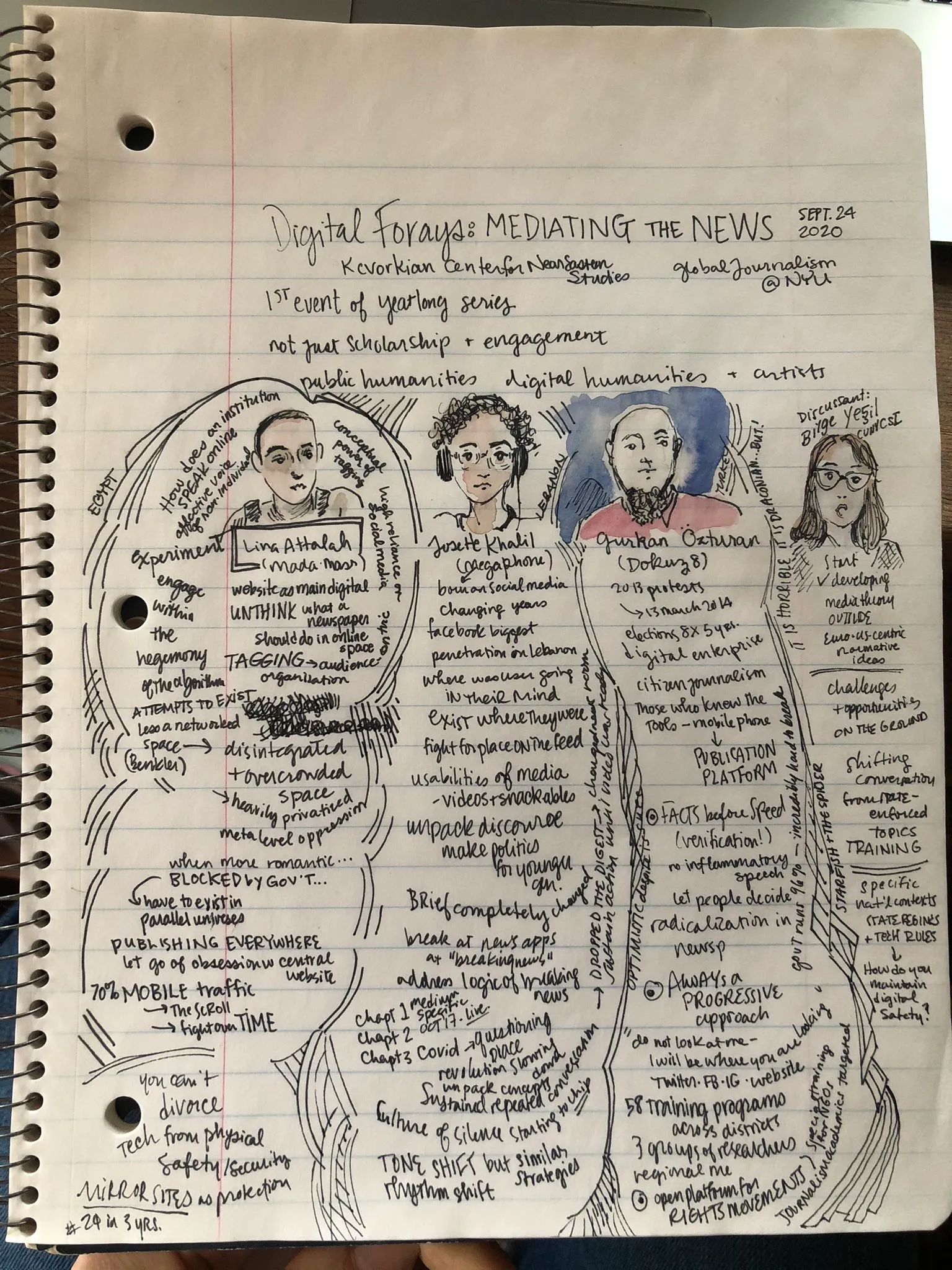
Digital Forays from @nyukevo kicked off today with “Mediating the News,” a fascinating discussion of media models across contexts @MadaMasr @Linaattalah @megaphone_news @josettekhalil @GurkanOzturan @dokuz8news #jojodoodles #nyudh
Group Octopus
EVENT EXTENSION
In beginning to analyze Mada Masr, Megaphone, and dokuz8, we found it helpful to center a number of guiding questions: What does it mean to be an “alternative” media source? What are we talking about when we discuss “alternative” media in the MENA region? What lacunae or problems in “mainstream” or “official” media outlets are these independent platforms addressing? What drives the work of the journalists and organizers behind these platforms? How does their digital format change the way they communicate and engage in dialogue with local and international audiences? How do these media platforms challenge ‘traditional’ methodologies in media studies? What boundaries does each media platform push up against? How do they position themselves or work within and across digital and physical spaces? How do they both adapt to and influence, mediate, and incite societal changes in their respective contexts? In short, what is it that brings these outlets together?
When analyzing the three platforms featured in the event, we noticed a number of approaches and strategies which were common between them. Above all, these platforms and other “alternative” media outlets in the MENA region maintain a critical bent in their coverage, both local and global. By this we mean that all three organizations maintain a critical distance from and skepticism of power, in all its forms. This necessitates an independent editorial line and commitment to concerted anti-authoritarian, anti-elitist, anti-sexist, and anti-racist work. Because of the challenges these organizations often face in their day-to-day operations, whether brought on by the state or pro-government detractors, they often rely on networks beyond themselves. They often co-publish and interact with each other, producing what the language of the event organizers have called “digital entanglements.” These platforms have inevitably changed their approaches as the technologies they use have proliferated. Yet, crucially, when discussing their various sites, these organizations have not fallen prey to facile embraces of technological determinism – “social media as the ‘great democratizer,’” and the like. Rather, these “alternative” media outlets are bound by a “politics that is not only obsessed with critiquing power, but also with imagining other possibilities.”
Where does Mada Masr fit into this larger network of “alternative” media organizations in the MENA region? Mada Masr shares a certain critical disposition with a number of other media organizations in its network. Rather than seeking to proffer a particular political ideology per se – beyond a critical distance from power and secular/religious opportunists – Mada Masr seeks to cultivate an ethic of “bearing witness.” Mada Masr was founded in June 2013 in the wake of the English-language newspaper, Egypt Independent, shutting down. Former Egypt Independent contributors built Mada Masr to provide a source of independent, investigative journalism. Immediately after Mada Masr’s founding, the organization took a keen interest in “bearing witness” to police abuse, protest killings, and abuses of power more broadly.
In the context of contemporary Egypt, where authorities encroach on press freedoms regularly and self-censorship runs rife, this effort to document, testify, and “bear witness” plays an immensely vital role. And, despite Mada Masr’s aversion to endorsing a particular political vision for Egypt, this ethic of “bearing witness” is undoubtedly a political ethic and it is one which is anti-authoritarian in nature. This is in many respects a solitary, thankless, and even dangerous task but it is one that is bolstered by a network of organizations with a similar ethical guiding principle: Syrian-based Al-Jumhuriya and Jordanian-based 7iber to name just two. A critical distance from power (both state and corporate) comes with baggage in the form of financial precarity and international funding which puts Mada Masr under political scrutiny. This precarity is evident when analyzing some of the institutional specificities of the organization.
In order to maintain its independence, Mada Masr uses a hybrid model of revenue. It draws on the support of the readership and provides editorial services for non-governmental organizations and universities. This structuring allows them to publish its articles free of charge to its readers, without making use of a paywall. As Mada Masr has grown, it has received grants and included advertisements on its website as well. In 2017, Mada Masr established a membership program. This program solicits financial contributions from its readership in return for access to extra content, sponsored events, and other limited services. One-third of Mada Masr’s registered members live outside of Egypt. This international dimension of support has drawn some criticism from the Egyptian state, but Mada Masr’s leadership undeterred.
Deviating from many other digital platforms and the oft-touted “media as message” maxim, Mada Masr prefers the long-form article as its medium of choice. Due to Mada Masr’s criticism of the Egyptian state, its central website is often blocked. To circumvent these restrictions, Mada Masr often posts its articles on a variety of platforms including Facebook and mirror sites. But despite these methods of dissemination, the Mada Masr website remains the central hub for its media, also acting as an archive for everything it has reported on and witnessed.
In “ Our Bodies and Enmity: A Personal Introduction ,” Alaa Abd El Fattah, a political activist, details his experience in the Egyptian justice system and specifically his experience of incarceration in the infamous Tora prison complex, outside of Cairo, Egypt. In his detailed and intimate account of arrest and incarceration, he focuses on the physical experience of incarceration and torture. Published in Mada Masr in late August 2019, Abd El Fattah describes witnessing a routine beating called the “Parade,” to which new detainees are subjected upon their arrival in prison. Shortly after the article was published, Abd El Fattah was arrested and subjected to the beating and stripping procedure, the “Parade.”
Indeed, this long and detailed account of one’s own bodily experience of incarceration is breaching “traditional” media notions of objectivity, distance from the object of reporting, and distilled news information. Rather than a brief title which succinctly summarizes the news content, such as, “Prisoners in Tora Prison Subjected to Torture Practices,” the writer takes the reader on a long and detailed account, a subjective account no doubt. How does such a form shape the subjective experience of the reader? How does such a detailed and intimate description transgress normative notions of media as necessarily objective? Does such a form have potential to upend the reader’s desensitization and apathy to the overwhelming exposure to traumatic news titles?
Towards the end of his essay Abd El Fattah calls not only for the release of detainees but also for an imaginative vision of the erasure of prisons. However, this article could not be squarely fit into the category of an opinion piece, nor just a testimonial piece, nor only reporting. This is an alternative form of knowledge production which holds in it the ethic of “bearing witness.” Here, we see how this ethic becomes linked to Mada Masr’s longform emphasis. In holding the importance of witnessing paramount, the organization has different aims than vying for the split-second attention of the reader with “breaking news” headlines or a series of Tweets. Instead, as in the case of the article by Abd El Fattah, it requires readers to be exposed to more longform testimonies which may balk the trend of more fast-paced social media engagement. The reader is forced to slow down and engage with the intensely corporeal nature of Abd El Fattah’s writing in a way that would perhaps seem inappropriate in the other above mentioned forms. Disrupting the idea that publications’ priorities should be driven by the immediacy of the news cycle, Mada Masr reposted the essay on its platforms one year later to emphasize its enduring significance.
Abd El Fattah was arrested shortly after writing this essay. In the year since, Mada Masr’s editor-in-chief Lina Attalah has also been detained by authorities. The threats and challenges state authorities have made against Mada Masr also highlight one aspect of alternative media’s critical politics that is often overlooked in the turn to the digital: its enduring connection to physical worlds as well. During the event, Attalah highlighted how, for Mada Masr’s staff, digital security is intimately linked to physical security. One might wonder more broadly how online “critical knowledge production as a form of resistance” intersects with the power of place and physical protest. How can we talk about the digital in a way that does not cleave it from the realities of the physical world?
In the event, Lina Attalah mentioned that one of Mada Masr’s leading principles is to “unthink what newspapers should do.” While delving into Abd El Fattah’s account of his imprisonment, one might ask, what does it mean for a news platform to post a prisoner’s account of his experience of torture? How does an intimate description of the corporeal subjugation to the justice system such as this article “unthink” the normative notion of media? And what potentialities does this exercise of “unthinking” open up? In this article, the detailed account of the prisoner’s place in the world as a son, a husband, a friend, with a material hurting body, allows for the obstruction of the normative image of the prisoner as an “object that [needs] to be eliminated, destroyed, disappeared, negated, excluded… a symbol or a bogeyman, without a material, physical presence.” Furthermore, the detailed account of the inner workings of the Tora Prison Complex demystifies not just the prison but the Egyptian justice system in general. Yet, it also might serve as one iteration of a broader mission to demystify power itself. And, perhaps this is among the most striking aims of the notion of “bearing witness.”
In moving to think about the Beirut based news organization Megaphone, we began by thinking about the context of contemporary Lebanese “mainstream” media. The Lebanese mainstream media are not funded nor directly controlled by the state, but are backed financially by sectarian and politically-aligned individuals and groups who dictate the editorial agenda. “Each media institution,” explains Nabil Dajani, “came to be looked upon as a representative and spokesperson for [a sectarian] group.” The media in Lebanon has thus suffered from biased, imbalanced coverage, serving the interests of divisive institutions, rather than those of the people.
Megaphone was founded in 2017 to address this lack of media independence and the subsequent “alienation” of the people, particularly the younger generation, from political discourse. Starting as a volunteer-based organization, they side-stepped dependence on politically-affiliated financiers and set their own agenda for news coverage. As their platform has expanded in scope and audience, Megaphone sought out and secured grants from international organizations, including the European Endowment for Democracy, Canal France International and Denmark-based International Media Support. By financially bypassing the Lebanese political elites, Megaphone has been able to harness the relative freedom of the press in Lebanon and affect public and youth political engagement.
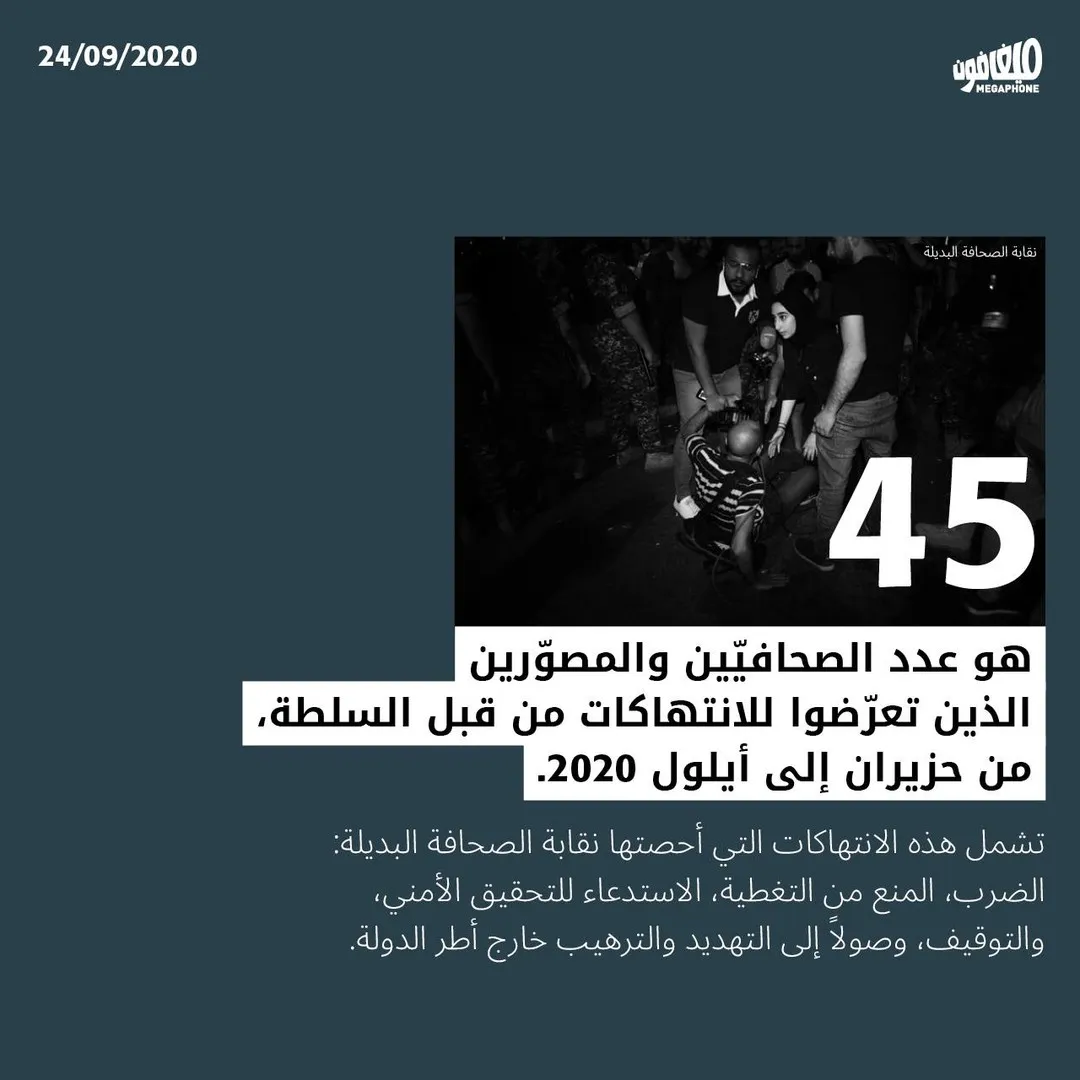
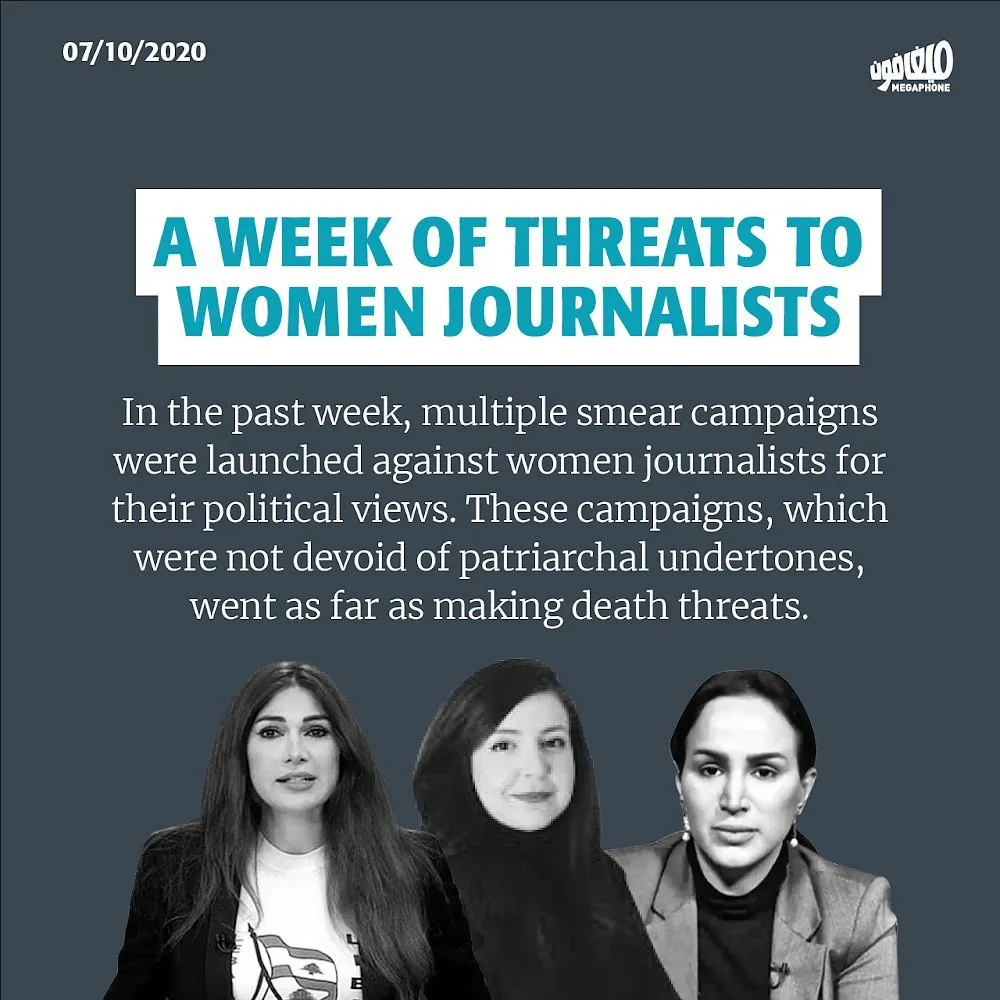
However, the circumstances since the October 2019 uprising have heightened security issues for formal and citizen journalists. In the midst of the pandemic lockdown and economic meltdown, Megaphone highlighted death threats and other forms of intimidation on women journalists. These attacks did not shy away from sexism against these women because of their political views. On social media (primarily Twitter), these digital attacks were propagated by the political parties’ apparatuses themselves.
الانتهاكات بحقّ الصحافيّين خلال الأشهر الأربعة الأخيرة.
Violations of journalists' rights over the past four months.
Swipe for English ➡️
The regime’s tails incite and threaten female journalists.
#journalism #politics #feminism #lebanon #beirut
In the “Digital Forays” webinar event, Josette Khalil talked about three problems which the founding team wanted to target in the establishment of Megaphone back in 2017. The first, was that “people were not interested in politics, and hence we [had] to make it interesting to them” (18:50). The second, “A lot of the younger generation was completely excluded from the conversation because they felt alienated by the discourse and hence we needed to unpack this discourse, take the big words and big concepts and make them more available, more ready for them to dissect themselves” (19:07). And the third, “Have the conversation about the things that mattered, and more importantly the things that mattered to us and mattered politically. It had to do mostly with destroying the state discourse in politics, but most importantly starting to have the right conversation about liberties, rights, marginalized group rights…” (19:34). Indeed, in looking closely at some of Megaphone’s reporting posts on the Beirut blast, we see that they put an emphasis on formatting posts that are not only engaging (one has to pause their feed scrolling and move through the photos of each post), but that also dissect and critique the official political discourse with the combination of succinct phrasing and visuals. It is not an “objective” kind of knowledge production (questionably presuming such a thing exists), but a loud and unyielding disavowal of the media establishment and the ruling class.
Furthermore, Khalil emphasized Megaphone’s efforts to bring voices from the street into the platform. For example, in their reporting of the day after the Beirut Port blast, Megaphone published a raw video in the style of international news agencies like AFP, AP, or Reuters. These videos are made without narration, featuring eyewitnesses and capturing street sounds. For Megaphone this form is consistent with the thematic segment they have called “ḥaky shawāriaʿ” or “street talk” where they bring street voices to the medium, uninterrupted by commentators or filters. In a way, Megaphone’s use of Instagram as their main platform, unapologetically appealing to the younger generation and providing a critique of the establishment’s political discourse, amplifies those voices and gives them a solid place within the realm of social media and the realm of political discourse, and thus expands the political discourse to include the voice of the younger generation.
Media’s priorities and toxins
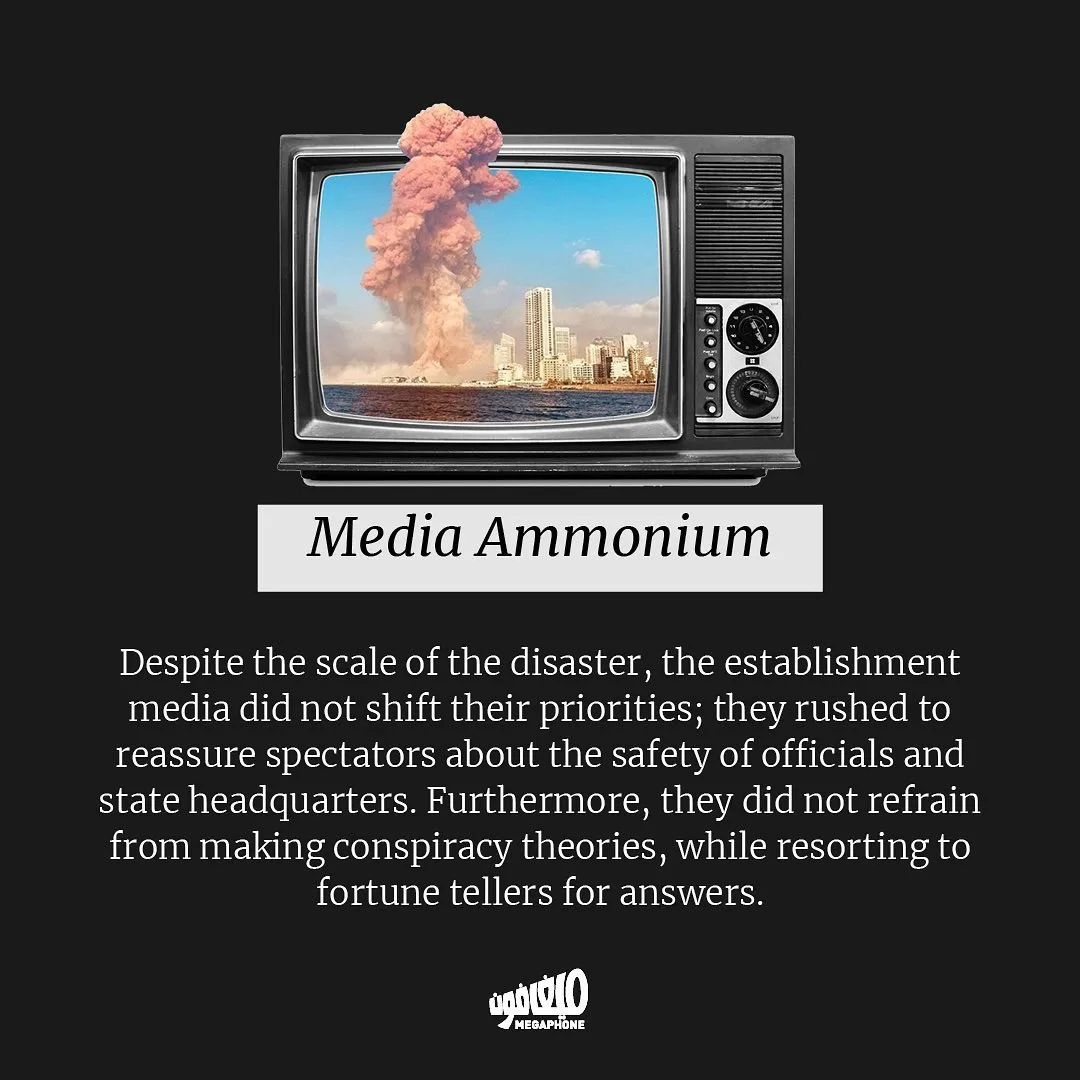
In order to engage the younger generation in politics, Megaphone adapts their content to better fit social media, especially to Instagram. On their website, Megaphone uses longform articles as their preferred medium; on Instagram the content emphasizes eye-catching graphics. While Instagram is an image-sharing platform that encourages and facilitates the aestheticization of photographic images, Megaphone stands out for their minimalist designs and direct messaging. With a single symbol, cropped image or photo montage, they punctuate negative space, draw the viewer’s eye to a focal point, and convey their message as simply as possible. In their August 5, 2020 post addressing the Beirut port explosion, titled “Media Ammonium,” they position an old TV set against a black background in the center, top third of the page. On the screen is a color image of the port of Beirut with the explosion’s flames and plume of smoke spilling out of the TV set’s frame and into the black negative space. Below the image, the text explains that the mainstream media’s coverage of the blast only addressed the well-being of the political elites and possible conspiracy theories behind it. Without sensationalizing the destruction, the image emphasizes the magnitude of the blast and its real-life consequences, as the smoke penetrates the realm beyond the TV’s screen, or beyond what the media is conveying. The image is a sharp jab at the mainstream media and is eye-catching because of its simplicity and activation of space.
On Megaphone’s Instagram we notice how they utilize and sculpt the content to politicize the medium itself bringing politics in the form they have been producing. In this active visual engagement it differentiates itself vocally, creating a “digital accent.” Every mainstream channel on Instagram reports on the news, accidents, and entertainment. Alternatively, Megaphone speaks with a distinguished accent by using satire and pop-art posts, creating a consistent language in contrast to the established media narrative in the Lebanese political and media environment. After a cursory search of Instagram, we noticed that established, mainstream channels have more followers and significantly higher budgets, but the products are almost identical to each other giving the space for Megaphone to thrive.
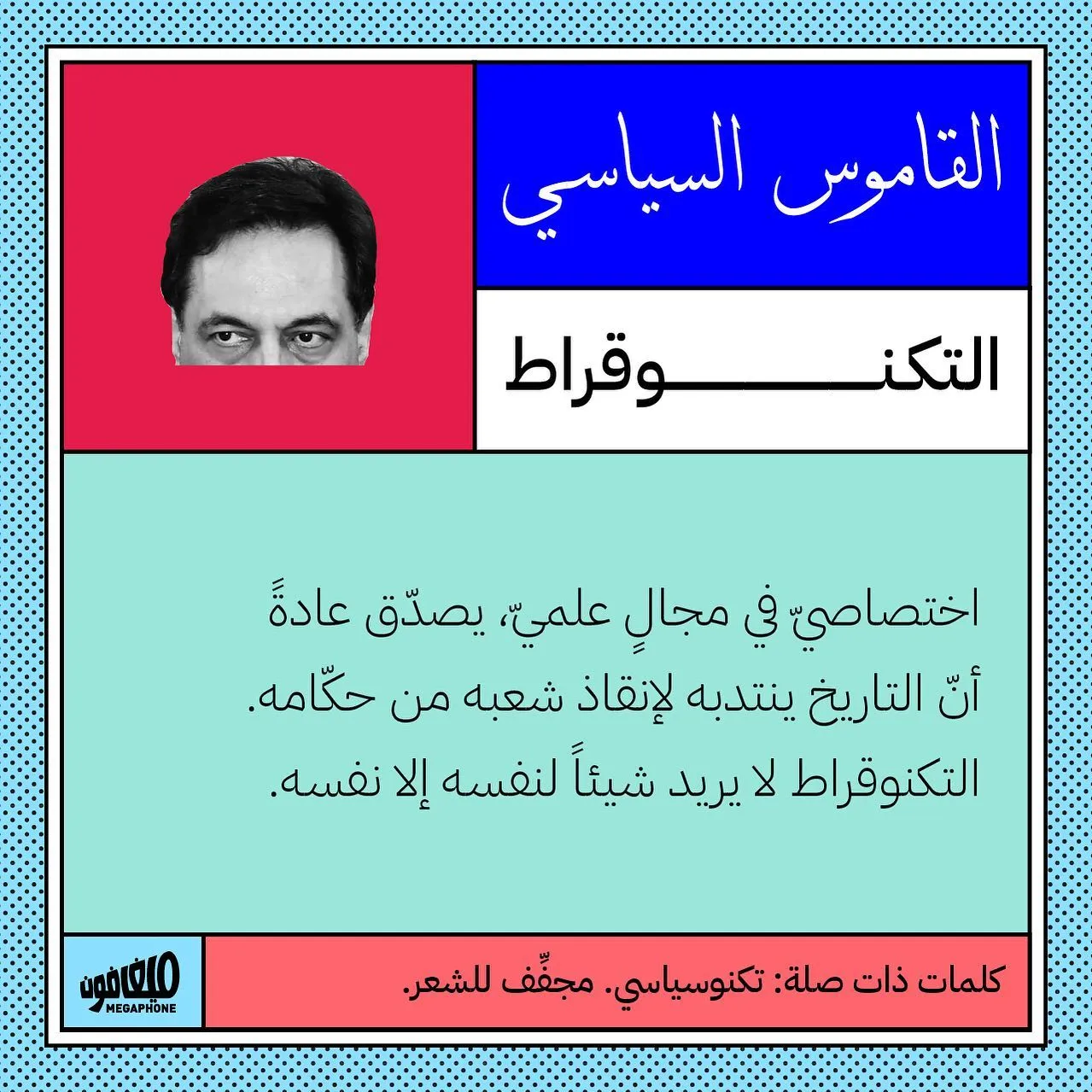
A specifically interesting rhetorical tool we’ve noticed in Megaphone’s reporting on Instagram is their use of political sass. For example, in this post from October 17th, 2020, they write: “The Political Dictionary, The Technocrat: A specialist in a scientific field. He believes that history has chosen him to save his people from their rulers. The technocrat wants nothing for himself but himself. Related words: techno-political, hairdryer.”
Using humor to dissect the political discourse of the establishment is undoubtedly one of the most appealing aspects about Megaphone’s methods of knowledge production. Again, we see here an effective tool of making political critique accessible, engaging, and thought provoking. The unapologetic goal of “having a conversation of what mattered to us,” as Khalil put it, points to a shift away from normative notions of “objective” news reporting. It is a shift that points to the use of the media to shape the political reality and not just to witness it. It is a shift that points to a new ethic of reporting which engages the community in a political reality rather than merely informing it of it.
القاموس السياسي من ميغافون: ما معنى "التكنوقراط"؟
#لبنان_ينتفض #١٧_تشرين #بيروت #ثورة #لبنان
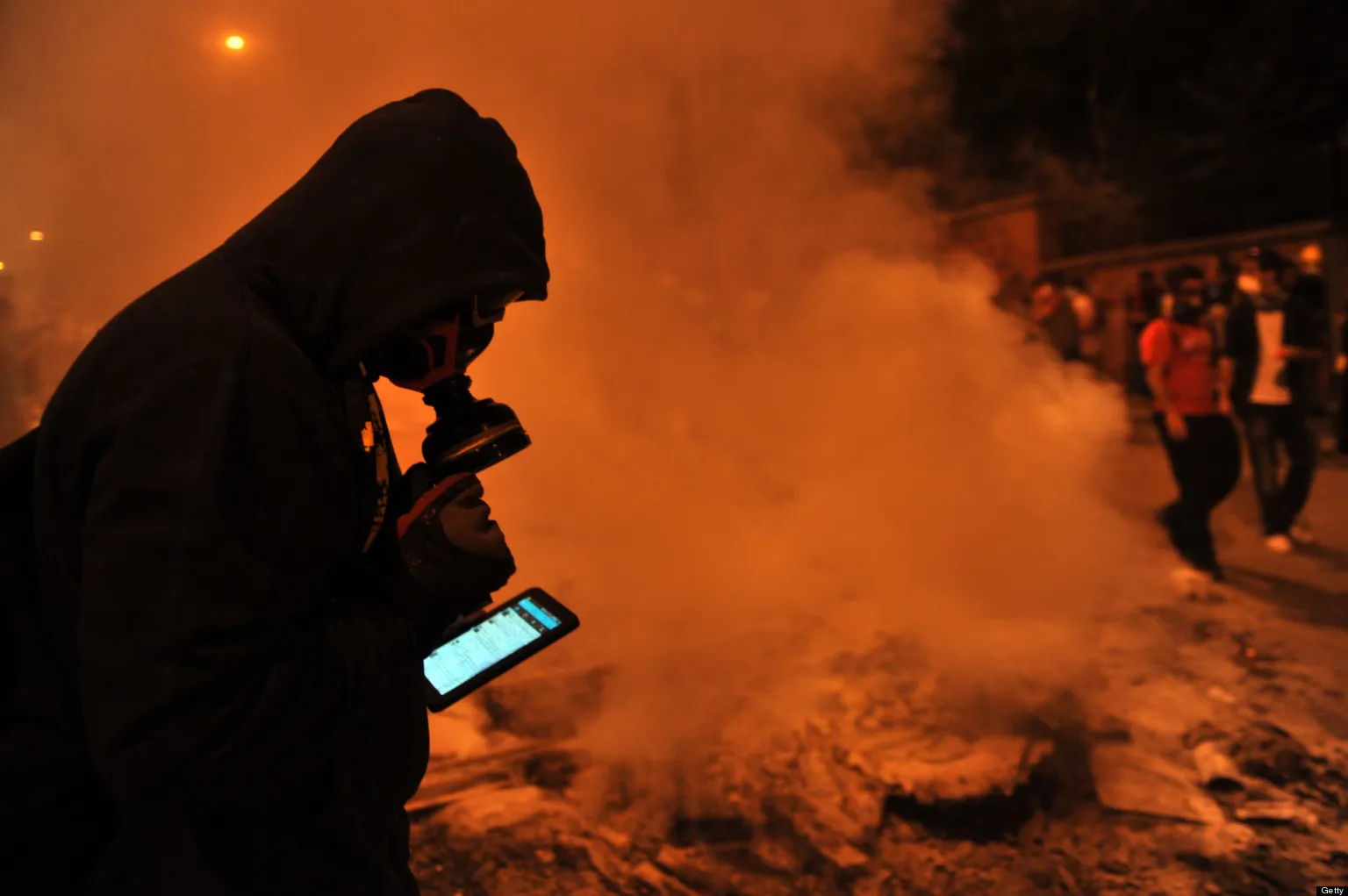
Central to the dokuz8 project is the idea of “citizen journalism.” In their estimation, social media has been the catalyst in this shift to network-based citizen reporting. This confidence in the enduring power of social media harkens back to dokuz8’s roots in the 2013 Gezi Park protests where citizen journalists gathered in unofficial working groups to discuss new methods and tools of digital dissent. “This tool will be incredibly influential,” dokuz8’s Gurkan Özturan stated while gesturing with his smartphone, remembering his predictions at the time. Indeed, the digital sphere is not only a space for dissent, but also for collaboration. These collaborations gave rise to the dokuz8 organization as a “digital entity” with a “social first” approach.
Following the events of the July 15, 2016 attempted coup, the AK Parti (AKP) targeted the media, shutting down organizations and arresting journalists. Many newly unemployed professional journalists turned to Twitter and digital platforms as “their initial refuge.” This reconfiguration of the media field has thus blurred the lines between professional and citizen journalism, as professionals and non-professionals increasingly train and work together.
For dokuz8, citizen journalism serves “as a tool of better expression of social opposition” with increasing import in “academic and practical debates.” Placing this emphasis on the “citizen journalist” at once adds more voices to spaces overly saturated by state and corporate entities and heightens a critical tendency among interested consumers of news, and similarly falls in line with what Lina Attalah has described as an ethic of “bearing witness.” dokuz8’s citizen journalist network is not just confined to major cities. Instead, it consists of a three-tiered network system operating in dozens of provinces. The highest tier includes daily contributors, followed by subject-matter researchers, with the most inclusive tier comprising citizens whose participation is only activated during mass protests or elections.
In explaining dokuz8’s structure, Özturan relies on Brafman and Beckstrom’s analogy of the starfish and spider. Within this schema, the starfish is a decentralized organization where the conscience and decision making expands to the ends. By contrast, the spider represents the centralized organization; the head serves as the headquarters for the decision making process. For dokuz8, the “sweet spot” of citizen journalism exists in a hybrid organization with decentralized and centralized aspects existing at once. Through its ongoing network-building and training citizens around Turkey, dukoz8 seeks to actualize this notion of a hybrid organization.
Along this citizen-focused line of thinking, dokuz8 has a clear pedagogical bent by sponsoring training for student journalists. This is especially crucial during a time in which self-censorship is rife in academia and universities are subject to purges in journalism departments and other faculties. A 2018 dokuz8 article detailed the founding of a new Data Journalism Project through which the organization led a series of pedagogical workshops, bridging “the news center and civil society organisations, unions, platforms, activists and journalists.”
Because of dokuz8’s pedagogical approach, research studies on the press, inclusion of citizen journalists, and prevailing coverage of freedom of press issues, it is clear that they are invested in the long-term development of a healthier mediascape in Turkey. In short, dokuz8’s interests and aims lie far beyond reporting the news. Their long-term strategy is further exemplified through the neutral tone in their reporting: an effort to avoid sensationalism and to avoid alienating a wider audience. This is opposed to the mainstream Turkish press, which in the 1980s, “destroyed itself by turning into opinion providers/shapers and abandoning its news-making role.” Despite the challenges of standing out on social media, Gurkan Özturan explains that they have secured an audience beyond Twitter and across the political spectrum.
Even without explicitly antagonizing the Turkish state, the dokuz8 website and Twitter account are often targeted by the Turkish state for their internationally-sourced funding and commitment to amplifying progressive voices and shedding light on problematic government actions. The website is digitally attacked an average of 1600 times per day. This slows the website down to the degree that readers become frustrated and close the webpage, effectively censoring dokuz8’s journalism. When those censorship efforts are not enough, the government will take legal measures to take down articles or suspend the dokuz8 Twitter page. Their Twitter has been suspended five times between April and October 2020.
In addition to these issues of online censorship, digital security is of great concern to dokuz8. A failure to take precautions online can put both the journalist and their sources in danger. As such, digital safety is one of the primary focuses in dokuz8’s training programs. The Turkish state’s emphasis on digital surveillance dramatically increased after the 2013 Gezi Park protests. Internet Service Providers (“ISPs”) cooperate with the security services to monitor and censor online content. They also assist the state by providing personal information on both individuals and organizations. The information collected by the Turkish security apparatus often leads to the detention of journalists or even physical intimidation and violence. While dokuz8’s digital security seminars provide the knowledge that journalists need to protect themselves, many more people are not aware of the risks they face when publishing and reporting online. Despite the political challenges dokuz8 faces in the Turkish mediascape, emphasis on citizen journalism and providing the resources and knowledge necessary to report the news safely have had and continue to have a marked impact on issues of freedom of the press in Turkey.

RESOURCES
See YouTube video of this event.
Lina Attalah, "Innovative Arab Media and the New Outlines of Citizenship," The Century Foundation. May 7, 2019
“ About Us ,” Mada Masr.
Ramsey Tesdell, “Mada Masr, Egypt’s poster child for digital news, begins its foray into a reader-funded model,” Nieman Lab, June 7, 2017.
“ Mada Masr Membership Program ,” Mada Masr
Tesdell, 2017.
Marshall McLuhan, Understanding Media: The Extensions of Man (New York: McGraw-Hill), 1964.
Published in Arabic as Alaa Abd El Fattah, “Madkhal shakhṣi lil-fajr fī al-khasūma,” Mada Masr, August 28, 2019.
Alaa Abd El Fattah, Our Bodies and Enmity: A Personal Introduction, Mada Masr, September 29, 2019.
Alaa Noha Mellor, “News Is Objective,” in The Making of Arab News (Lanham: Rowman & Littlefield Publishers, 2005), 87–94.
The idea, not just of critiquing power, but of proposing imaginative alternatives is also at the heart of Lina Attalah’s analysis of “innovative Arab media.” See: Lina Attalah, “Innovative Arab Media and the New Outlines of Citizenship,” The Century Foundation. May 7, 2019.
Lina Attalah, "Innovative Arab Media and the New Outlines of Citizenship," The Century Foundation. May 7, 2019; Helga.Tawil-Souri, “It’s Still About the Power of Place,” Middle East Journal of Culture and Communication 5(1) (2012): 86–95.Alaa Abd El Fattah, Our Bodies and Enmity: A Personal Introduction, Mada Masr, September 29, 2019.
Lina Attalah, Josette Khalil, Gürkan Özturan, and Bilge Yeşil, Digital Forays: Mediating the News | Digital Platforms & Publics, New York University, September 24, 2020.
Alaa Abd El Fattah, Our Bodies and Enmity: A Personal Introduction, Mada Masr, September 29, 2019.
Nabil Dajani, “The Myth of Media Freedom in Lebanon.” Arab Media and Society, Issue 18, Summer 2013, 2.
Ibid., 2.
Timour Azhari, “ Megaphone: The voice of Lebanon’s uprising ” Al-Jazeera. December 8, 2019.
See the posts embedded below.
See YouTube video of this event.
Aestheticization here is used to describe the process by which photographs may be framed or manipulated in such a way that renders an image artistic. Used in the context of images of war, “aestheticization of what we see in the media emotionally and morally insulates viewers from the suffering of others.” [Meryl Alper, “War on, “Instagram: Framing conflict photojournalism with mobile photography apps” new media & society 2014, vol. 16(8), 1236]. Elaborating on the risks of this, Judith Butler explains: “[Sontag in Regarding the Pain of Others] continues to fear that photography has lost its capacity to shock, that shock itself has become a kind of cliché, and that photography tends to aestheticize suffering to satisfy a consumer demand” [Judith Butler, “Photography, War, Outrage” PMLA, vol. 120, no. 3. May, 2005. 824].
See the post embedded above.
See the post embedded to the right of the text.
“ Hakkımızda ,” dokuz8 Haber.
Burak Doğu, “Political Use of Twitter in Post-Gezi Environmental Protests,” Middle East Journal of Culture and Communication 12 (2019): 187.
Altug Akin, “Does Journalism Exist in Turkey? Constraints on and Struggles in the Field of Journalism in the Post-coup Context.” Middle East Journal of Culture and Communication, vol. 12 (2019). 214.
“Alternative Media & Citizen Journalism Active Followers’ Perception Research in Turkey 2016,” dokuz8 Haber, July 14, 2016.
Lina Attalah, "Innovative Arab Media and the New Outlines of Citizenship," The Century Foundation. May 7, 2019.
Brafman, Ori and Rod. A Beckstrom. The Starfish and the Spider: The Unstoppable Power of Leaderless Organizations. New York: Penguin Group, 2006.
Muzaffer Kaya, “Turkey’s Purge of Critical Academia,” Middle East and Information Project 288 (2018).
“dokuz8NEWS starts ‘Data Journalism Project’,” dokuz8 Haber, January 29, 2018.
Nilgün Toker cited in Altug Akin, “Does Journalism Exist in Turkey? Constraints on and Struggles in the Field of Journalism in the Post-coup Context.” Middle East Journal of Culture and Communication, vol. 12 (2019): 215.
See the YouTube video of this event.
See the YouTube video of this event.
See YouTube video of this event.
Lina Attalah, "Innovative Arab Media and the New Outlines of Citizenship," The Century Foundation. May 7, 2019
“ About Us ,” Mada Masr.
Ramsey Tesdell, “Mada Masr, Egypt’s poster child for digital news, begins its foray into a reader-funded model,” Nieman Lab, June 7, 2017.
“ Mada Masr Membership Program ,” Mada Masr
Tesdell, 2017.
Marshall McLuhan, Understanding Media: The Extensions of Man (New York: McGraw-Hill), 1964.
Published in Arabic as Alaa Abd El Fattah, “Madkhal shakhṣi lil-fajr fī al-khasūma,” Mada Masr, August 28, 2019.
Alaa Abd El Fattah, Our Bodies and Enmity: A Personal Introduction, Mada Masr, September 29, 2019.
Alaa Noha Mellor, “News Is Objective,” in The Making of Arab News (Lanham: Rowman & Littlefield Publishers, 2005), 87–94.
The idea, not just of critiquing power, but of proposing imaginative alternatives is also at the heart of Lina Attalah’s analysis of “innovative Arab media.” See: Lina Attalah, “Innovative Arab Media and the New Outlines of Citizenship,” The Century Foundation. May 7, 2019.
Lina Attalah, "Innovative Arab Media and the New Outlines of Citizenship," The Century Foundation. May 7, 2019; Helga.Tawil-Souri, “It’s Still About the Power of Place,” Middle East Journal of Culture and Communication 5(1) (2012): 86–95.Alaa Abd El Fattah, Our Bodies and Enmity: A Personal Introduction, Mada Masr, September 29, 2019.
Lina Attalah, Josette Khalil, Gürkan Özturan, and Bilge Yeşil, Digital Forays: Mediating the News | Digital Platforms & Publics, New York University, September 24, 2020.
Alaa Abd El Fattah, Our Bodies and Enmity: A Personal Introduction, Mada Masr, September 29, 2019.
Nabil Dajani, “The Myth of Media Freedom in Lebanon.” Arab Media and Society, Issue 18, Summer 2013, 2.
Ibid., 2.
Timour Azhari, “ Megaphone: The voice of Lebanon’s uprising ” Al-Jazeera. December 8, 2019.
See the posts embedded below.
See YouTube video of this event.
Aestheticization here is used to describe the process by which photographs may be framed or manipulated in such a way that renders an image artistic. Used in the context of images of war, “aestheticization of what we see in the media emotionally and morally insulates viewers from the suffering of others.” [Meryl Alper, “War on, “Instagram: Framing conflict photojournalism with mobile photography apps” new media & society 2014, vol. 16(8), 1236]. Elaborating on the risks of this, Judith Butler explains: “[Sontag in Regarding the Pain of Others] continues to fear that photography has lost its capacity to shock, that shock itself has become a kind of cliché, and that photography tends to aestheticize suffering to satisfy a consumer demand” [Judith Butler, “Photography, War, Outrage” PMLA, vol. 120, no. 3. May, 2005. 824].
See the post embedded above.
See the post embedded to the right of the text.
“ Hakkımızda ,” dokuz8 Haber.
Burak Doğu, “Political Use of Twitter in Post-Gezi Environmental Protests,” Middle East Journal of Culture and Communication 12 (2019): 187.
Altug Akin, “Does Journalism Exist in Turkey? Constraints on and Struggles in the Field of Journalism in the Post-coup Context.” Middle East Journal of Culture and Communication, vol. 12 (2019). 214.
“Alternative Media & Citizen Journalism Active Followers’ Perception Research in Turkey 2016,” dokuz8 Haber, July 14, 2016.
Lina Attalah, "Innovative Arab Media and the New Outlines of Citizenship," The Century Foundation. May 7, 2019.
Brafman, Ori and Rod. A Beckstrom. The Starfish and the Spider: The Unstoppable Power of Leaderless Organizations. New York: Penguin Group, 2006.
Muzaffer Kaya, “Turkey’s Purge of Critical Academia,” Middle East and Information Project 288 (2018).
“dokuz8NEWS starts ‘Data Journalism Project’,” dokuz8 Haber, January 29, 2018.
Nilgün Toker cited in Altug Akin, “Does Journalism Exist in Turkey? Constraints on and Struggles in the Field of Journalism in the Post-coup Context.” Middle East Journal of Culture and Communication, vol. 12 (2019): 215.
See the YouTube video of this event.
See the YouTube video of this event.

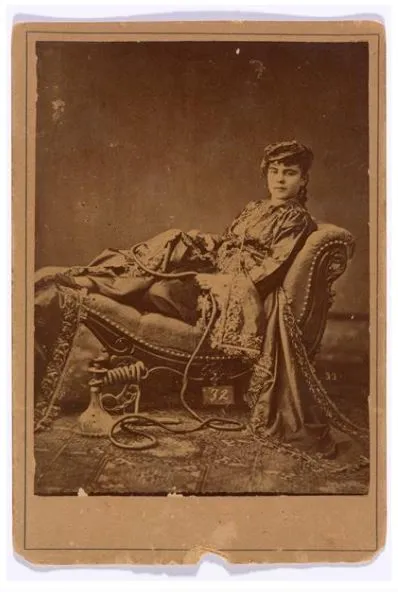
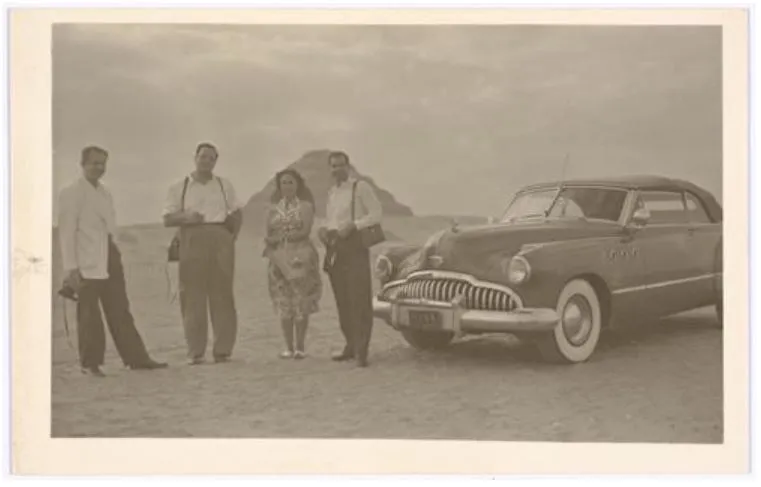
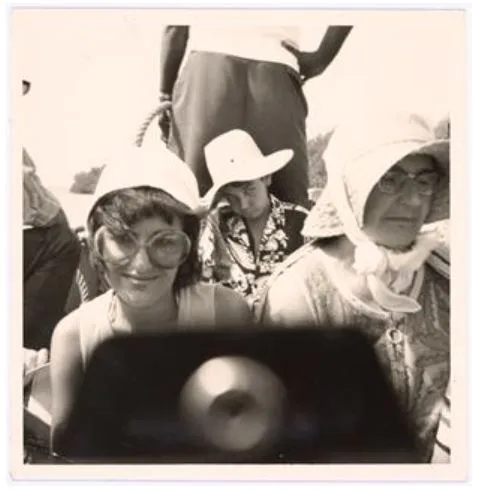
More materials (photographic, ephemera, and otherwise) are becoming available via platforms of regional archives and personal projects. Yet, how do they become framed, activated, and enlivened on a website or platform?
Many smaller projects abound ( Middle East Archive / Middle East Archive Project / Arab Film Archive / Arabic Book Cover Archive / Pure Nostalgia ) that dump new and often unseen material into the larger public domain - but how do we take this further? What logics become guiding principles of how you create a portal to house and serve as doors into larger collections? In essence, how do you create inroads and digital infrastructures to connect with various communities and build new publics?
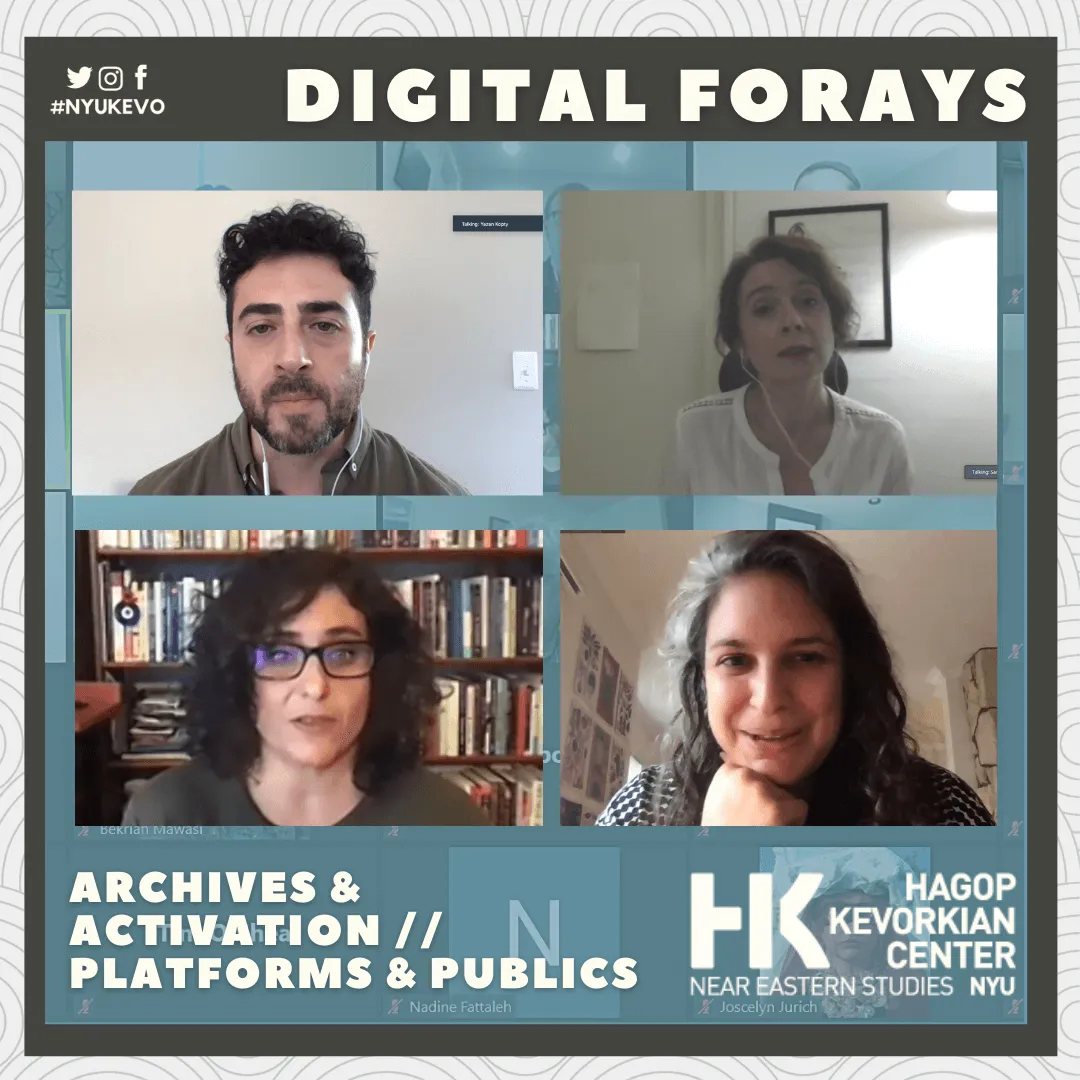
This week, three projects present various levels of institutional backing and practitioners spoke about their projects through the digital platforms they are creating.
Kristine Khouri is a researcher and writer whose research interests focus on archives and knowledge dissemination as well as the history of arts circulation and infrastructure in the Arab world. She is also a member of the Arab Image Foundation . She is the co-organizer/researcher/curator of the long term research project, Past Disquiet, with Rasha Salti which took the form of a documentary and archival exhibition in Barcelona, Berlin, Santiago and Beirut, and were coeditors of the publication, Past Disquiet: Artists, International Solidarity, and Museums in Exile (Museum of Modern Art in Warsaw, 2018).
Yazan Kopty is a writer, oral historian, and National Geographic Explorer. His work centers around the acts of listening and narrating, focusing especially on memory as resistance and community-sourced history. He is the lead investigator of Imagining the Holy, a research project that seeks to examine and connect thousands of images of historic Palestine from the National Geographic Society archive with Palestinian community elders, cultural heritage experts, and field researchers to add new layers of indigenous narrative and knowledge to the images.
Sana Yazigi is a graphic designer, graduated from the faculty of fine arts at Damascus University, 1993. She is the founder and editor in chief of the project " The Creative Memory of the Syrian Revolution ", a website that documents all types of creative expressions produced since the beginning of the revolution in 2011 until the present day. In 2013 she founded the initiative “ALWAN” therapy (for Syrian refugees in Lebanon). She was the founder and editor in chief of the Syria's first monthly cultural agenda "The Cultural Diary" that covered the cultural and artistic activates in Damascus and the other cities of Syria 2007-2012.
Laila Shereen Sakr is known for creating R-Shief software and performing as VJ Um Amel. She is an Assistant Professor of Media Theory & Practice at University of California, Santa Barbara. At UCSB, she co-founded Wireframe, a new digital media studio that supports critical game design and digital arts practice.
This event was part of the Fall 2020 course: Problems and Methods in Middle Eastern Studies
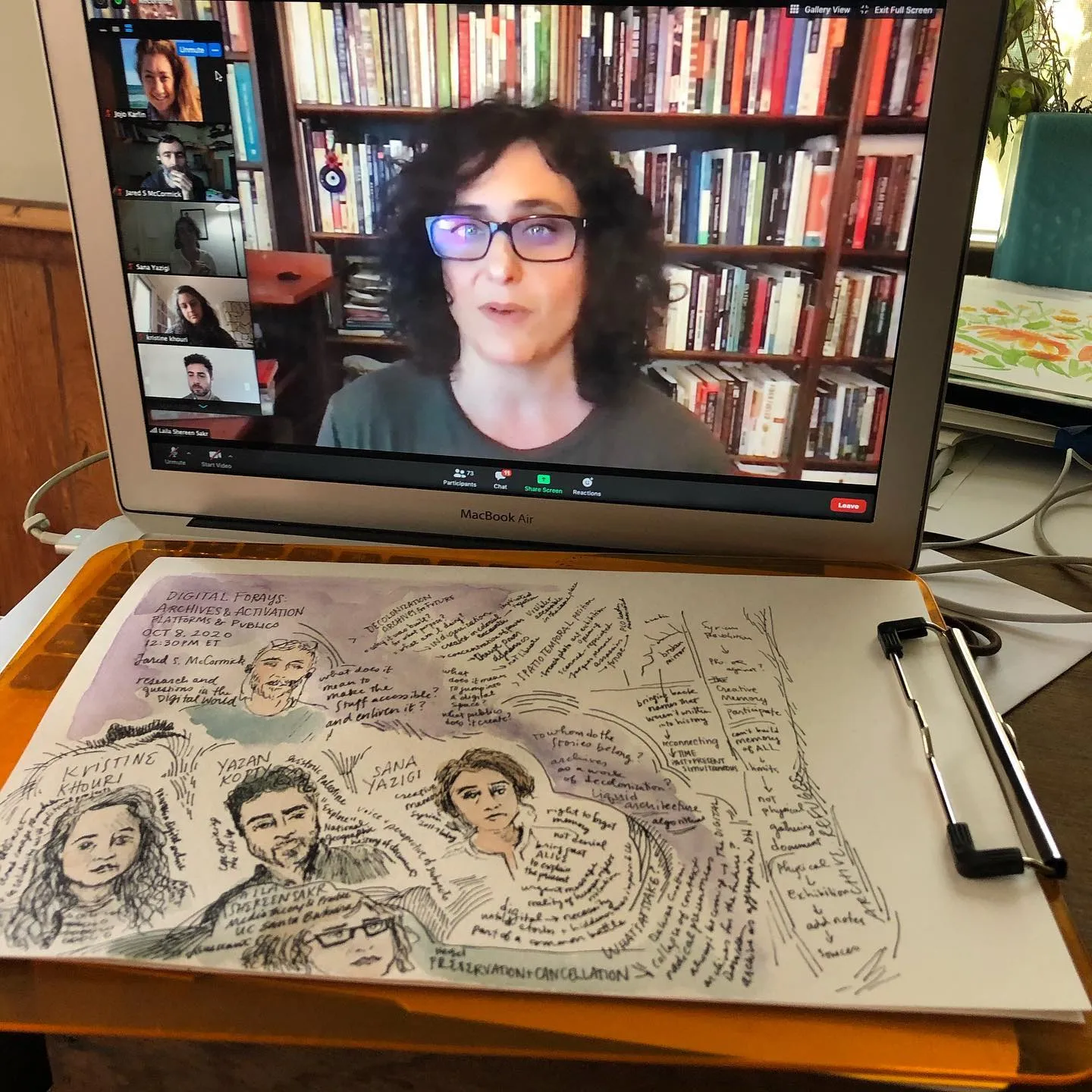
Thank you, @nyuniversity @nyukevo for today’s Digital Forays: Archives and Activation: platforms and publics.
An expansive panel investigating the spatiotemporal sites of memory, imagining, and remembering.
@yazankopty Kristine Khouri, Sana Yazigi, @vjumamel, Jared S McCormick.
#jojodoodles #nyudh #eventsketch #penandink #pendrawing #watercolorillustration
Group Apple
EVENT EXTENSION
The second event of the Digital Forays series at the Kevorkian Center brought together Kristine Khouri ( Arab Image Foundation ), Yazan Kopty ( Imagining the Holy ), Sana Yazigi ( Creative Memory of the Syrian Revolution ) & Discussant Laila Shereen Sakr (University of California, Santa Barbara) to present their respective archive projects. While each project is distinctive from the others featured in the webinar (as well as other digital archive projects not mentioned in the webinar), the discussion and speeches from the panelists and audience members presented many intersections between their works.
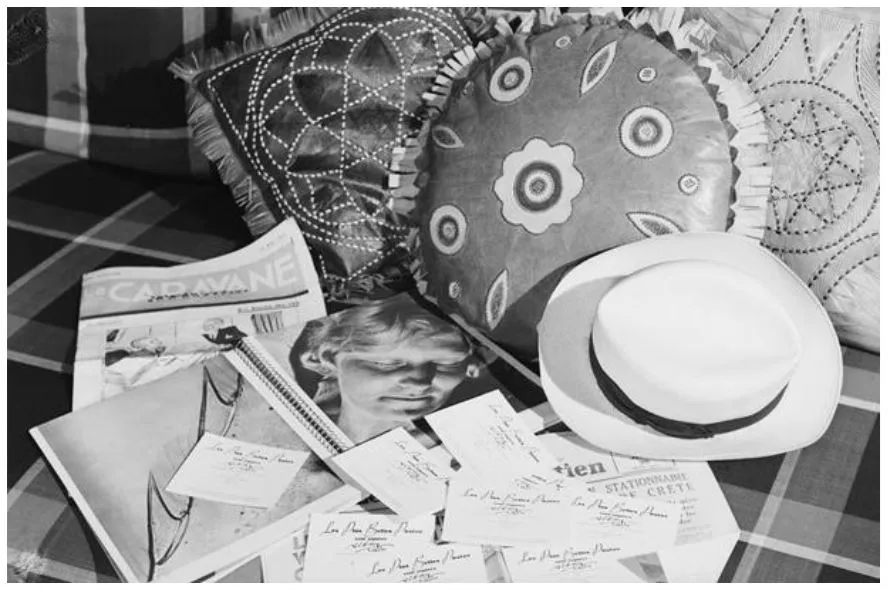
In the work below, we aim to build upon some of the emerging themes from the discussion as well as relevant issues and topics that are associated with contemporary digital archival practices. To begin with, we explore further the practice of ‘decolonizing the archive’ as during the webinar Yazan Kopty helpfully explained the distinction between projects of ‘decolonization’ and projects of ‘indigenization’, of which he described Imagining the Holy as the latter. The first section below considers the close relationship between the traditional archive and colonization and what it means to go against the colonial grain of the traditional archive.
Moving forward, we consider some of the spatial and temporal dimensions of the digital archive and how this enables the work of the archivist and the users of the archive. This section also takes into account the possibility of the ‘radical present’ mentioned by Laila Shereen Sakr during the webinar, and how this is offered and shaped by digital archives in their various forms.
In the third section, we consider some of the ethical issues associated with digital archives and the subject of the archive or the living participants associated with the material: this was touched upon by Kristine Khouri who discussed the relationship between the Arab Image Foundation and the individuals or families providing material to this archive.
The penultimate section considers the question ‘What is worth preserving in the digital age?’: the vast amount of material available online problematizes exactly what we decide to preserve in our contemporary times, although the internet in itself seems like an endless depository for storage, at what point do we draw the border for digital archiving projects?
Lastly, we close this work by taking our readers to South Asia, where we explore some of the many archival projects that engage with South Asians on the subcontinent as well as those in the diaspora. The highlight of this section is an interview with Sadia Gardezi, one of the Co-Founders of Project Dastaan .
The Archive as a record-keeping place, where information is collected and stored, is produced and sustained by an authority that has the power to shape knowledge. Since the French Revolution, the archive as a modern institution has been created by nation states to legitimize the nation’s history and establish the nation’s social order. From that departure point, existing archives, ‘collectively known as memory institutions’ are deeply entwined with Western consciousness for political order. Furthermore, the colonial period of Western capitalism also ties into this as ‘the political realities of colonization are interdependent with displacement of Indigenous epistemologies and ontologies. Colonizers did not only occupy territories but also colonized knowledge to maintain and legitimate such occupation’. Thus, the memory institutions of colonized land or so-called archives are shaped by occupiers. For example, we can see this in the colonization of Algeria by the French, which resulted in Algeria spending almost 30 years to rescue itself from the French impact on their values and history.
Nevertheless, it is evident that the post-colonial period, from the mid-20th century onwards, created a new world order in which more than one hundred states emerged from the anti-colonial period. But archives in the context of the modern state have continued to be maintained from a colonial perspective. Clearly, colonizers have transmitted their consciousness to native authorities. Archives are institutions of local governments and have the power to produce knowledge for their own political projects and expectations. For instance, the state of Israel intervened when its state secrets, detailing targeted assassinations, were released to the public: Anat, who released the digital documents, was sentenced to prison. The documents released by Kam went against the grain of the narrative presented by the Israeli state, their existence in the public sphere interrupted the hegemonic state narrative. Evidently, a modern nation-state is able to bury aspects of reality for its own purpose and benefit. Furthermore, it encompasses the epistemological dimension of its own national history. While this is one example, it raises the following questions: how might historical knowledge be produced without restriction of colonialism? How might historical processes be represented for public good without post-colonialism?
To reiterate, traditional-modern archives emerged from the French Revolution, and became part and parcel of colonial practices of self-legitimization. Then, new nation states in the post-colonial era were able to borrow from colonial practices of framing political and social order. As a result, archives as memory institutions facilitate the narrative of the nation; they are produced by this power and enable it. However, as the projects of Kristine Khouri, Yazan Kopty, and Sana Yazigi show, there is a possibility that archives have the opportunity to arrive at a new condition without pragmatic politics of powers that come from a colonial perspective or post-colonial movements. But this new condition requires ‘a radical movement’ as Frantz Fanon pointed out in his masterpiece, The Wretched of the Earth, in 1961. New conditions in the practice of archives are possible with ‘decolonization in alignment and solidarity with Indigenous sovereignty movements’. It can be said that this describes the digitization of archival practices and movements in the Middle East, which in some ways offer a radical space for decolonization to take place. Perhaps, at the center of these projects and future projects we should continue to ask ourselves the question ‘To whom do these stories belong?’ as posed by Laila Shereen Sakr during this webinar.
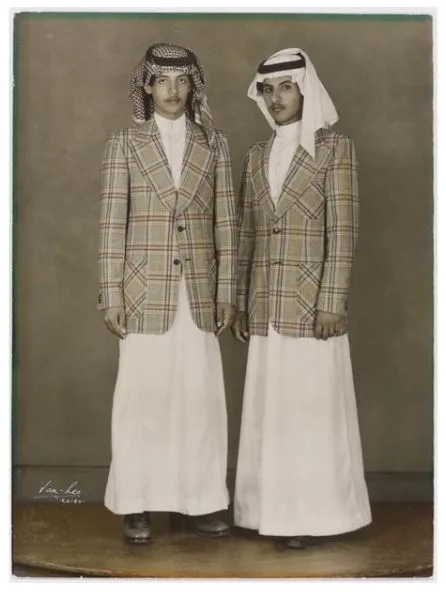
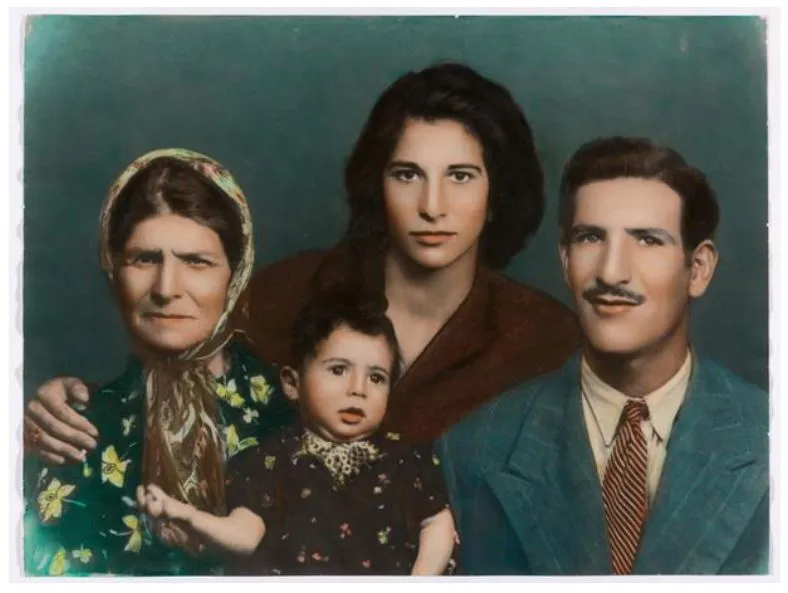
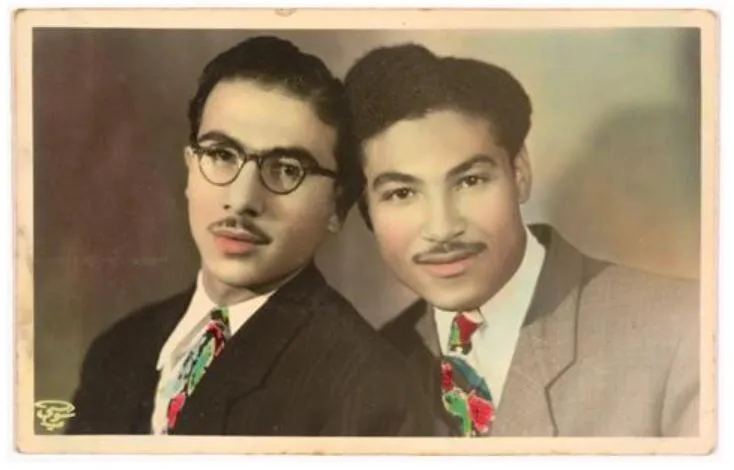
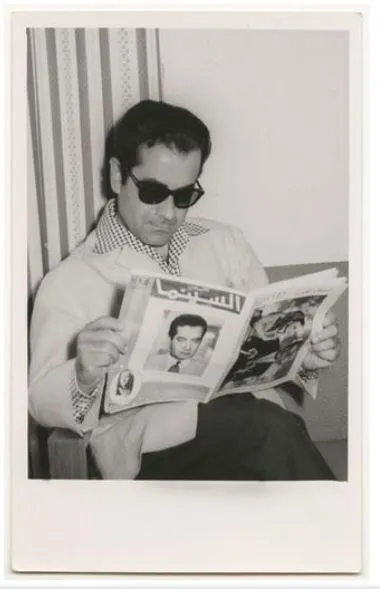
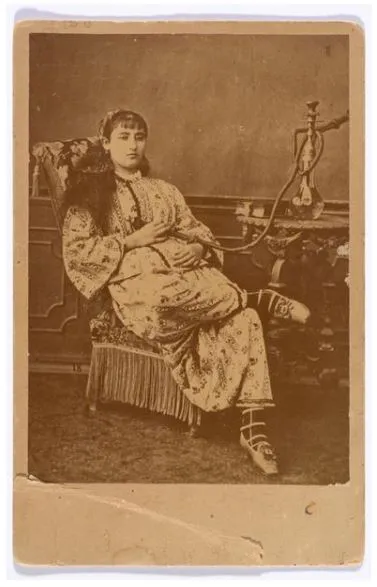
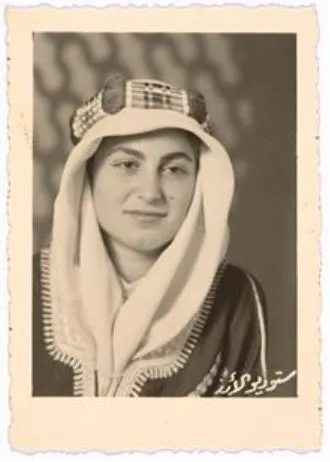
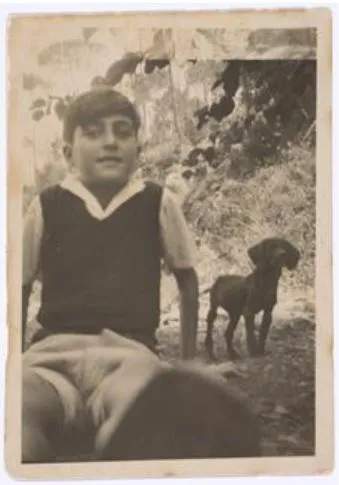
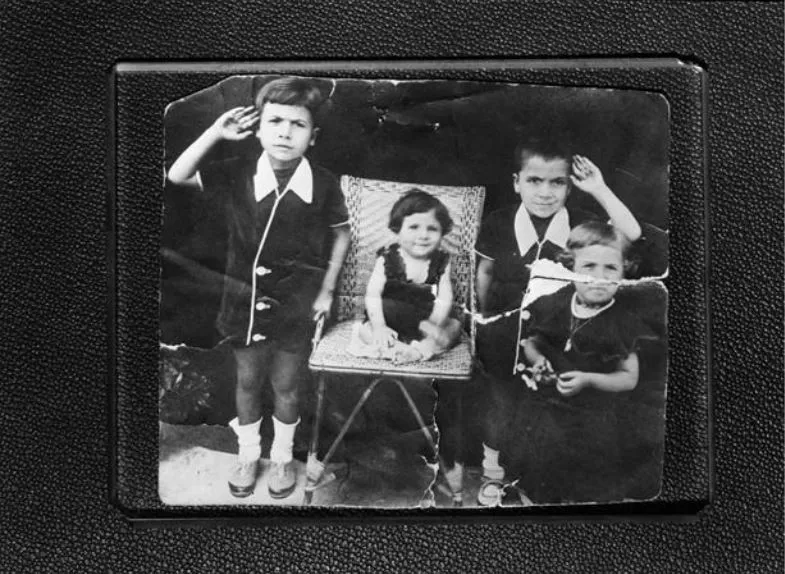
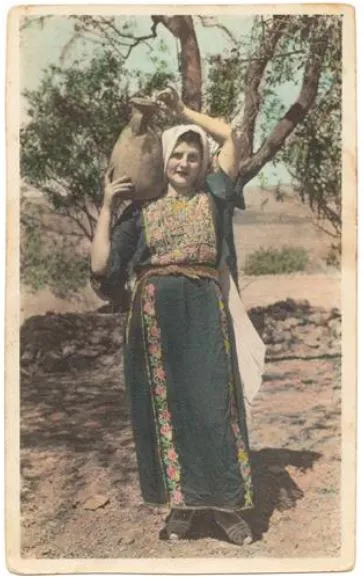
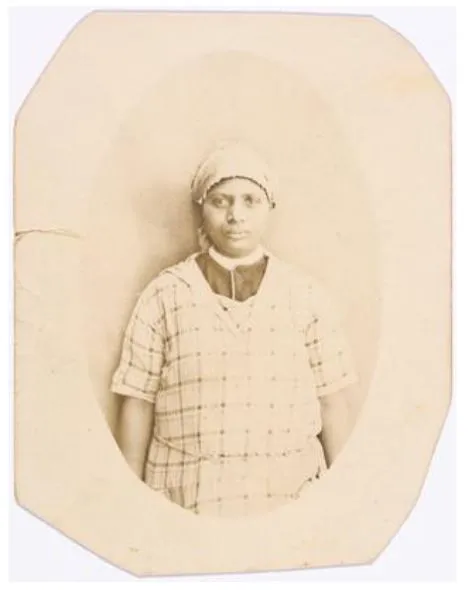
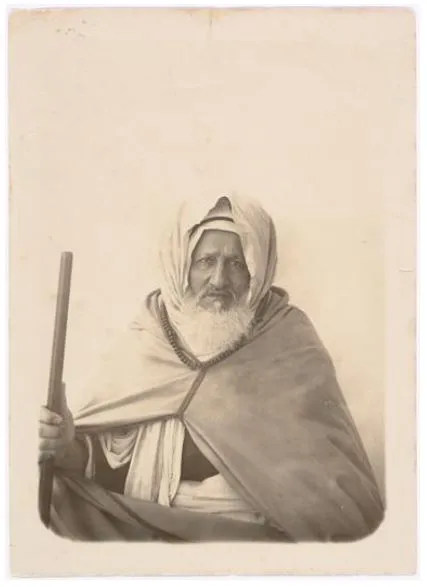
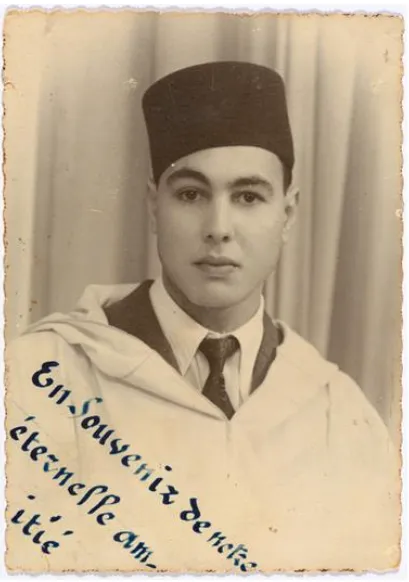
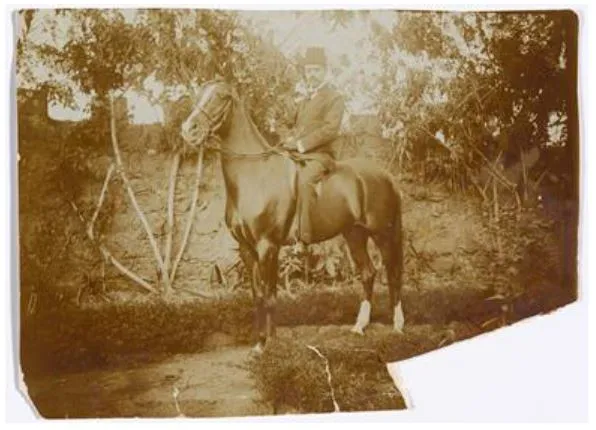
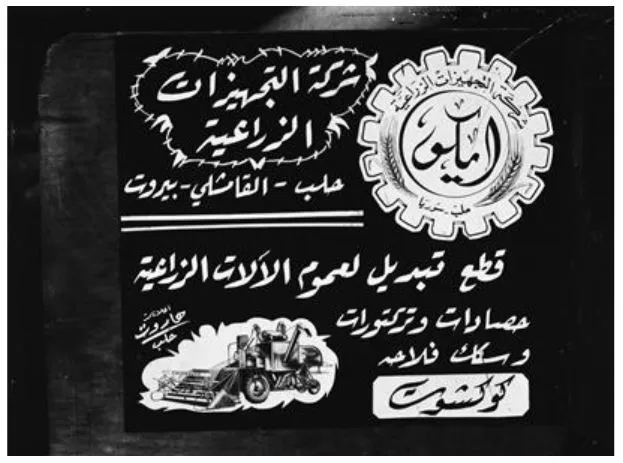
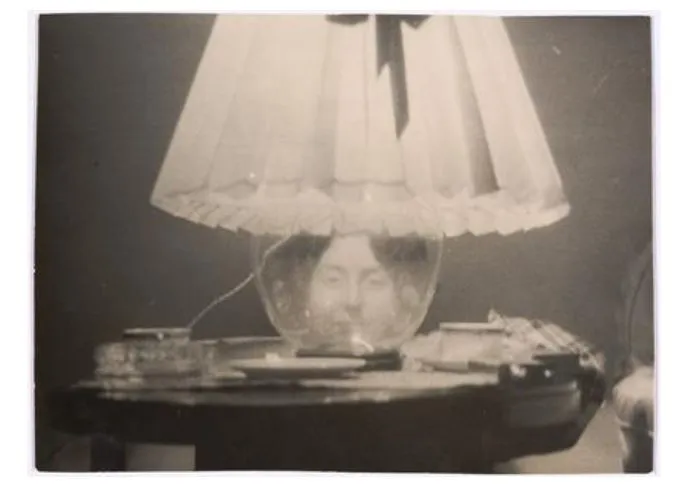
The increasing formations and curations of digital archives has also triggered questions of space and time in relation to the archive: how can we understand the spatial and temporal nature of a digital archive? How does one decide the borders of this archive? Does the digital nature of this archive provide a counter-space? What does it mean for this archive to build a bridge between the past and the present (as well as the future)? Both the possibilities and questions are endless; indeed, each digital archive is a universe of its own while arising out of a longer, historical practice of traditional archives. However, by building upon and simultaneously disrupting the practices of the traditional archive, the digital archive has, in all its multifarious forms, disrupted the rigidness of tradition and provided us with what Laila Shereen Sakr referred to as ‘a radical present’ during the event.
It is worth considering exactly what constitutes this present as ‘radical’. To some extent, it could be the content of these archives in which we are able to hear and see those who the traditional archives may have silenced or erased. However, it is also the fact that the nature of the digital archive means how we are able to interact with the past is radically different. Wolfgang Ernst suggests that:
The fundamental difference, though, between a classical print-based archive and multimedia storage is interaction—which at the same time increases the memory capacities of the user, in contrast to just reading or looking at things and commemorating them. The traditional archive has, so far, been a read-only memory—printed texts reproduced through inscription, not rewritten by reading (…). In multimedia space, however, the act of reading, that is, the act of re-activating the archive, can be dynamically coupled with feedback.
Within a matter of minutes, or a couple of mouse-clicks online, we are able to pull out those silenced and erased figures from the past and see them in the present through our digital screens, thanks to projects such as those featured in this event. The heightened and increasingly personal level of interaction means that images of the past can also be shared in a matter of minutes with those on the other side of the planet. In a sense, digital archives cut through the physical borders that have distanced some from their own history: instead of posing an obstacle, the transformed spatio-temporal dimensions of the archive provide an avenue to reconnection and reclamation. As we hear from Yazan Kopty, sharing his research project via the Instagram account, Imagining the Holy , meant that he was able to connect with audiences across the world and provide them with a doorway to entering a world of Palestinian history that was mostly inaccessible and physically distant for Palestinians in all corners of the planet. What is also equally as important is the dialogue that opened between him as an archivist and his visitors through the digital medium of Instagram, every double-tap on his posts acts not only as an affirmation from his viewers but also a sign of how much this type of interactive, open archive was needed in the community: the value of this was something that neither Yazan or his audience could have known until the archive itself came to fruition. While with the traditional archive the act of responding and providing feedback is not necessarily something that is possible, or necessarily welcomed, it is actually part and parcel of the digital archive. Aside from the commenting, liking and sharing functions that are used in relation to archives housed on Instagram, we hear from Kristine Khouri that the Arab Image Foundation is also attempting to increase interactions with users by ‘offering image tagging and commenting options’. Quite clearly then, one dimension of this ‘radical present’ is that it allows the users of the archive to inscribe themselves into the present and future of the archive. The data which stores these likes, comments, tags and shares is a literal part of the user that builds onto the content of the archive to become part of the archive itself as future users are able to see how past visitors of the archive have reacted to and utilized the content. We therefore see this space of the archive expand with each activity and interaction, and the bridge between the past and present is constantly in use as we reflect on the subjects of the archive and as others reflect on our reflections on these subjects.
In a traditional archive, a visitor may be fearful of leaving behind remnants of themselves; in fact, rituals and procedures, such as wearing gloves, are put in place to prevent visitors of the archive damaging the materials they come to observe and to give the illusion that the archive remains unchanged and unaffected by what goes on outside its walls and what or whom passes through its borders. However, the digital archive welcomes these remnants and opens up the space to endless possibilities of visitors and interactions: those fingerprints (albeit digital fingerprints) that we are so fearful of leaving behind on treasured and precious materials are actually welcomed in the space of the digital archive as they add to its value.
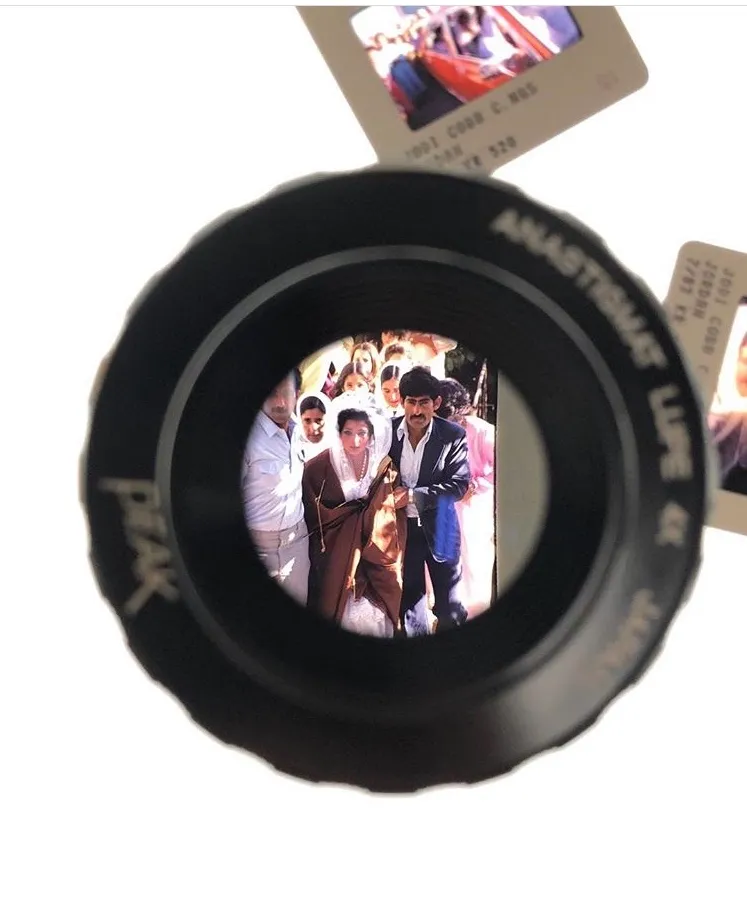
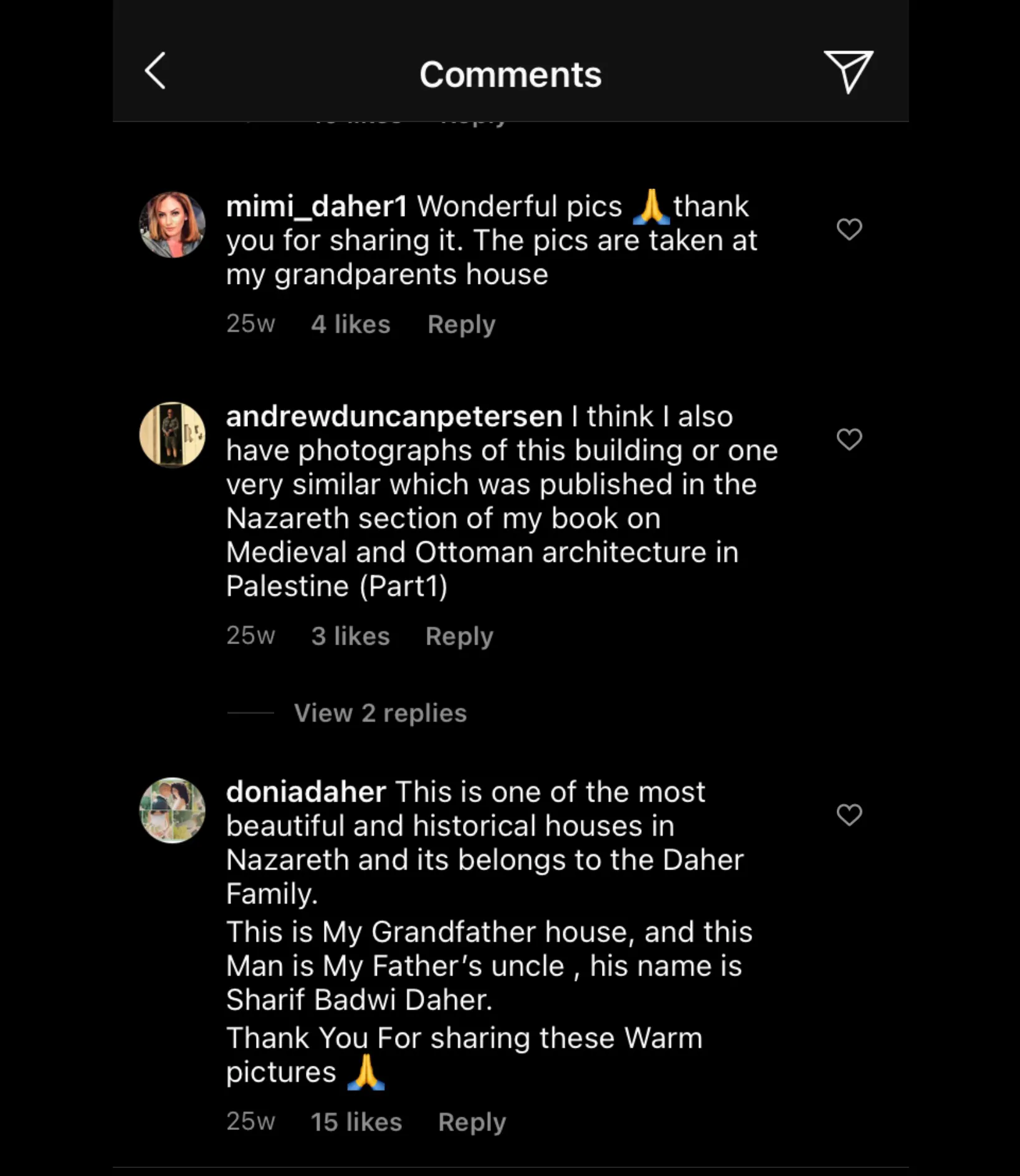
Can anyone help us identify this gentleman? 📿 Photos of Palestinians at home and in the diaspora by National Geographic foreign editorial staff writer and photographer Thomas Abercrombie (1974-1975).
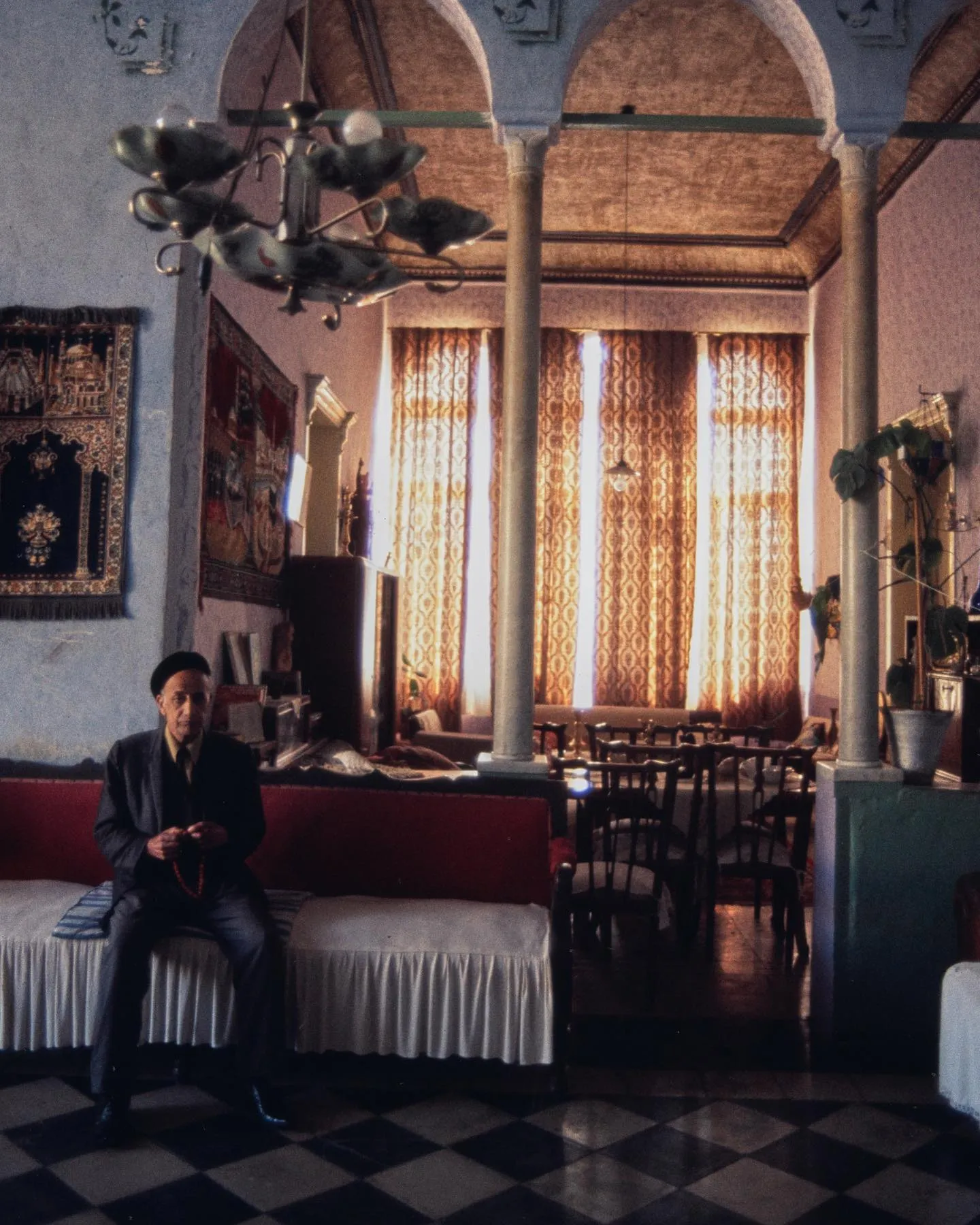
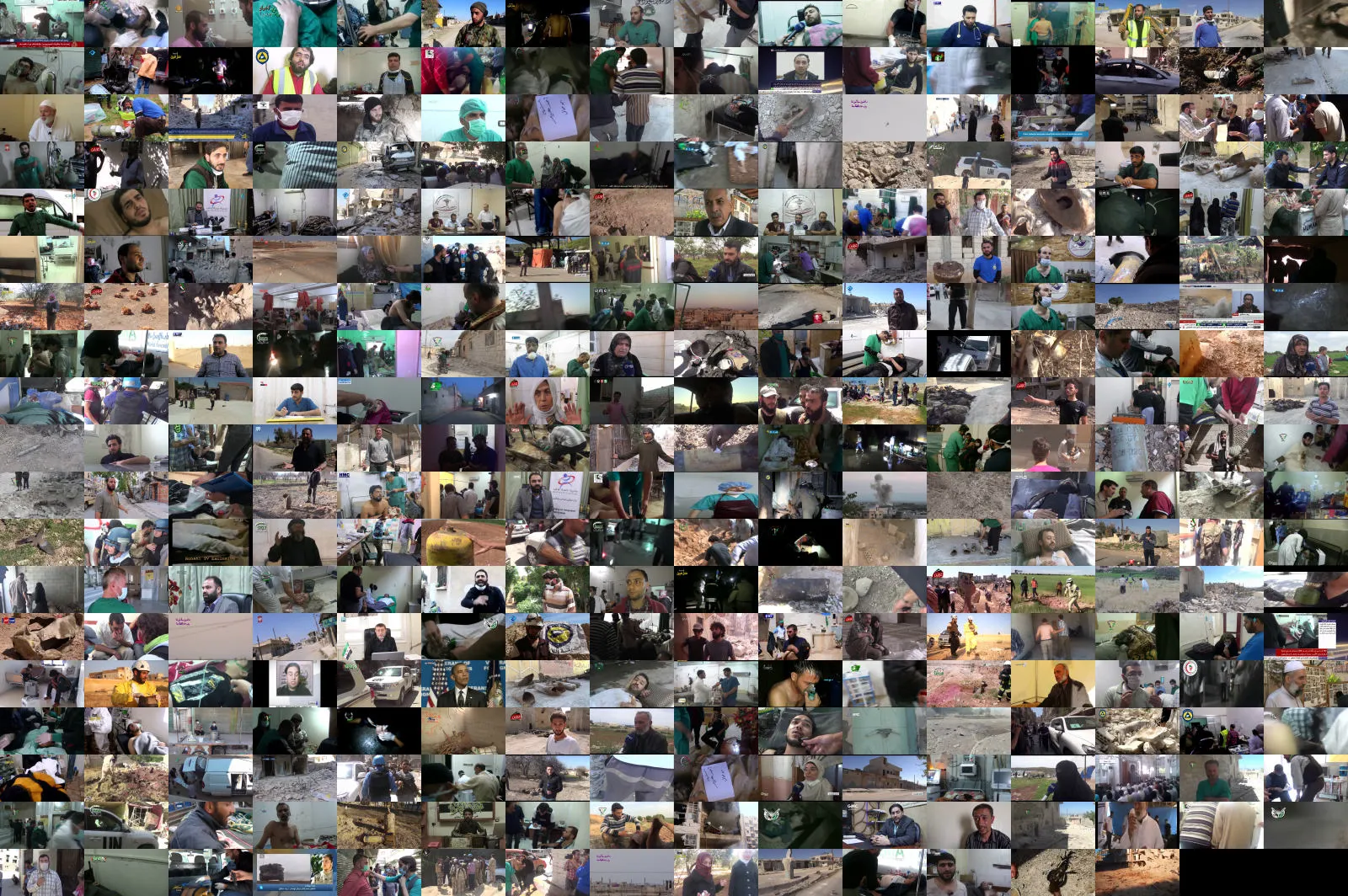
Every type of research must follow specific ethical standards when working on human or non-human subjects. Like other fields, archival research needs to account for the expected benefits and the damages resulting from data collection, be it a traditional or digital project. For instance, in Sana Yazigi’s The Creative Memory of the Syrian Revolution , we see men, women, and countless families who have been displaced by the war in Syria. Thus, the paramount question is what potential harms and benefits this research will have on relevant human subjects? As Klerk (2018) puts it, researchers have the responsibility to preserve and protect the privacy of their subjects:
Archivists must be vigilant about privacy when digitizing archival collections, processing born-digital materials, or capturing Web content. For example, someone who wrote a letter in the 1960s could not have anticipated that letter being available online, so is it okay for us to put it there? Creators’ expectations of privacy, as well as the people who may be mentioned in the materials, are something worth thinking about when deciding whether or not to provide online access.
Another related ethical issue is the extent to which it is possible to ensure that digital materials are not isolated from the context in which they were taken? As Agarwal (2016) states, researchers can address this concern by, for instance, documenting the offline activism that made a social media hashtag possible, and, in other cases, to engage with community activists to learn how they want their online activism to be remembered. Also, ‘take-down policies’ should be implemented to request removal of ‘objectionable materials’.
Therefore, control of archival context is of paramount importance in the archival profession; however, archival research will have to give more access to digital content in digital archival collections. Zhang (2012) argues that this representation imposes several ethical questions as to whether it is ‘an ethical practice that digital content in digital archives is deeply embedded in its contextual structure and generally underrepresented in digital archival systems?’ and if ‘[it is] ethical for archivists to detach digital items from their archival context in order to make them more “digital friendly” and more accessible to meet changing use expectations?’
Other ethical concerns that relate to using or creating digital archives are the rights of what Crossen-White (2015) calls the ‘forgotten individual’ in historical research. With the technological advancement and the possibility of digitizing archival materials, more can be found out about ‘neglected areas of the past’, and subsequently the act of putting together missing pieces of history. Therefore, digital archivists should establish a connection with individuals residing in the past, similar to the way they do when extracting data from living participants. This is paramount when researching the recent past that involves individuals who continue to live in the memories of their family and loved ones:
It is to these very ‘personal identities’ that a researcher should observe a duty of care and ensure they do not produce a researcher-created life-narrative that can harm those that care for the memory of that individual. It is important to remember that for an individual it may not always be good to throw ‘a shaft of brilliant light’ over what had been (and might have remained without digital archives) ‘in historical darkness’.
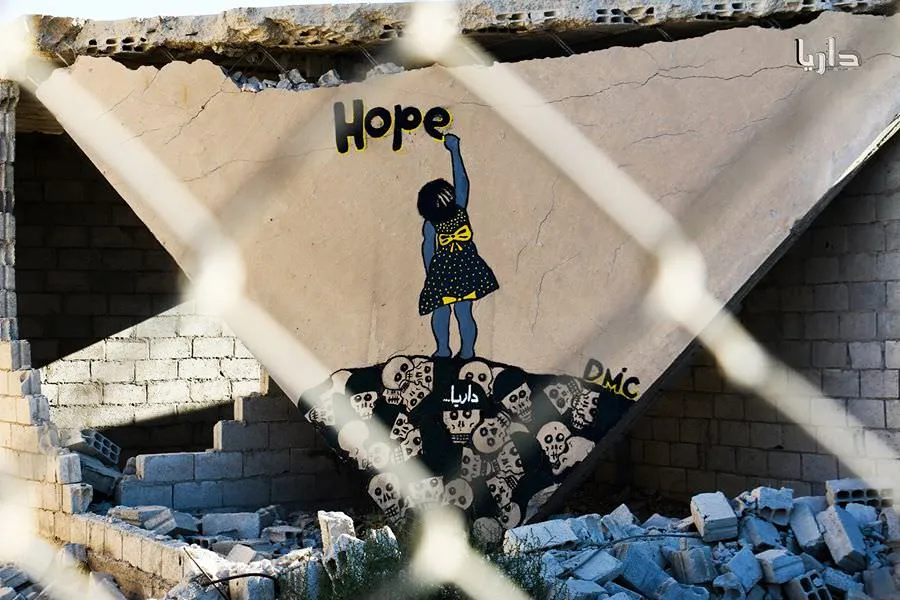
Another point that must be touched upon when discussing some of the issues that arise from working in digital archives is the notion of preservation and the question: What is worth preserving? The questions of what to preserve and what to discard emerges in our daily lives all the time. The decision on whether to preserve some items such as objects, photographs, postcards, old notebooks or get rid of them for various reasons is made by ourselves as part of our daily routines. Yet, what if we take this issue from a personal level to an institutional level, in the realm of the professional and the archival stage. Then, who is there to make that decision on the preservable items? What kinds of power relations or various legal procedures emerge in this case? Is it the decision of the state, the digital owner or project managers - who is allowed to decide what is brought to our attention and what is silenced?
Archives have been considered as the places of preservation for too long and different points have been made on the issue. For example, the Hegelian concept of Aufhebung implied both preservation as well as cancellation. Moreover, Ariella Azoulay argues that ‘instead of regarding the archive as an institution that preserves the past as though its contents do not directly impact us, I propose to see archive as a shared place, a place that enables one to maintain the past incomplete, or to preserve what Walter Benjamin referred to as the “incompleteness of the past”’. Although the idea of preservation in archives has occupied scholars thus far, with the advent of digital technologies we have to start discussing new aspects of archival practices and decision-making processes. Thus, the idea of preservation and our questions about this issue are subject to change in our digital age given the number of data that is produced and made available in contemporary times. Written physical documents (notebooks, books, newspapers) are replaced by materials in digital platforms. Accordingly, much of our preservation of data now has to reckon with these digital materials in the digital arena. In light of this, we must consider exactly how vast the digital arena is and the sheer amount of material out there:
It is possible to continue this list with the many platforms out there and their respective output and statistics. However, the imperative point here is the question of what is really worth preserving during this era of digital revolution? How far can we go to preserve these billions of data? Considering these enormous numbers, is it even possible to preserve this much data even if the internet seems like a limitless depository? If not, do we need a refined data preservation project? Then, who will decide what to preserve and what is worth preserving? What sorts of power relations might emerge in such cases? All these questions and problems emerge with the advent of digital archives and they are crucial points to focus on with current and future projects.
While Archives & Activation: Platform and Publics focused mainly on digital archives covering the Middle East, there are a number of projects that have arisen in the South Asian continent, many of which crossover with some of the objectives and practices of the projects mentioned during the webinar. For example, BrownHistory has become well known among a younger generation of South Asians in the continent and the diaspora for its presentation of personal histories as well as South Asian figures from history. Much of the material here also comes from the followers of this account, those who are part of the global South Asian community who wish to share their stories of their families. This is an interesting reversal in comparison to Yazan’s work, where Imagine the Holy provides lost images to the community, whereas here we see images from the community.
Another project that has emerged from the South Asian context is Project Dastaan , a peace-building initiative which examines the human impact of global migration through the lens of the largest forced migration in recorded history, the 1947 Partition of India and Pakistan’. In the interview below, Sadia Gardezi, one of the Co-Founders of Project Dastaan tells us more about the initiative and in particular explains how virtual reality technology is used to reconnect Partition survivors to their ancestral homes and lands. The stories of participants who take part in the 360 Virtual Reality experience are made available on Project Dastaan’s Story Map . The use of virtual reality reworks the act of viewing and participating in archival practices, here the participant both provides to the archive and receives from it. From the outset we see how this initiative is a completely innovative take on archiving. Not only are Partition survivors able to virtually return to their ancestral homes but those who view the archive are also able to join them on this journey.
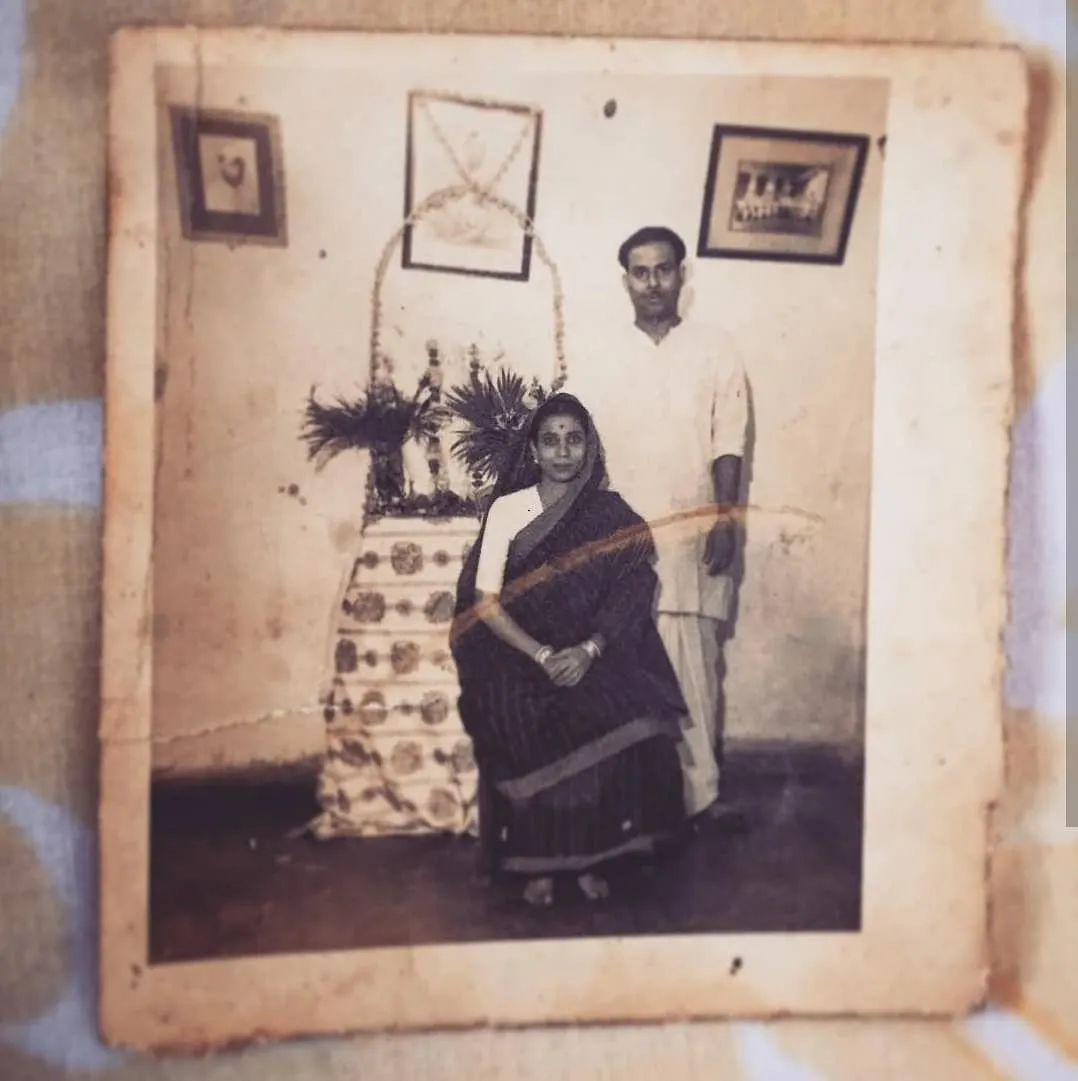
"...My grandparents were named Amiya (pronounced as omiya) and Amiya (in Bengali this is pronounced as omio) Sengupta. They were neighbours in Bangladesh. They lived across a pond from each other. Their love story began in childhood when they used to go swimming together. I have heard stories about how they sent love letters to each other via their cousins (they had huge joint families). They sometimes also sent letters written in paper boats floated on giant leaves that grew in the pond. This is one of the last stories my grandmother told me before passing away. She was bed ridden for several years.
She was a zamindar’s daughter and he was a barrister’s son. They were both educated. She studied till 10th grade whereas my grandfather graduated college with distinction in history. When they got married, people from far away villages came to see the pair since they were called ‘Shib Parboti’- a couple as perfect as Lord Shiva and Devi Parvati.
Their lives changed when they had to move to Calcutta during partition. After seeing their family members murdered and an ungodly amount of cruelty, they started on this new journey in India. My grandfather started working for India Foils. He was a factory supervisor and everyone loved him, they called him ‘kaka saheb’. He refused to wear any protective gear (because of bravado) while working in the factory which eventually led to his death as the fumes were dangerous. He passed away when my mother was 10 years old. With three children and no support, my grandmother raised them singlehandedly.
She never forgot about my grandfather and was always full of stories about him. Even though he had passed away, along with sadness was this peace that she had at least some time with the love of her life." - submitted by @textpectation_
#BrownHistoryPhotoAlbum
DM me your stories (even if you don't have photos)!
RESOURCES
Erika Thorkelson, ‘" Archives Are Adapting to An Era of Digitization and Decolonization ’" in University Affairs.
Ala Roopika Risam, " Decolonizing The Digital Humanities In Theory And Practice ." in Digital Commons (2018) [pp.78-79].
J. J. Ghaddar and Michelle Caswell, ‘"' To go beyond': towards a decolonial archival praxis ’" in Archival Science [pp.271-279].
Ibid.
Ariella Azoulay, " Archive " in Political Concepts.
Ghaddar and Caswell, haddar and Michelle Caswell, ‘"'To go beyond': towards a decolonial archival praxis’" (p.73).
Wolfgang Ernst, "Discontinuities: Does the Archive Become Metaphorical in Multimedia Space?" in Digital Memory and the Archive , ed. Jussi Parikka, (Minneapolis: University of Minnesota Press, 2012) (p.121).
Arab Image Foundation, " What’s New ."
Taylor de Klerk, "Ethics in Archives: Decisions in Digital Archiving" in Special Collections: NC State University Libraries (2018).
Kritika Agarwal, "Doing Right Online: Archivists Shape an Ethics for the Digital Age," in Perspectives on History (2016)
Jane Zhang, (2012) " Archival Context, Digital Content, and the Ethics of Digital Archival Representation ," Knowledge Organization , Vol.39, No.5 (2012) (p. 332).
Holly L. Crossen-White, "Using digital archives in historical research: What are the ethical concerns for a ‘forgotten’ individual?" in Research Ethics , Vol. 11, No. 2 (2015)(p. 109).
Ibid.
Azoulay, "Archive," in Downey’s Dissonant Archives Contemporary Visual Culture and Contested Narratives in the Middle East . translated by Tal Haran (London: I.B. Tauris, 2015) (p. 203).
Salman Aslam, ‘"Instagram by the Numbers: Stats, Demographics & Fun Facts," Omnicore Agency , (February 2020).
"YouTube by the Numbers," YouTube Press .
J. Clement, "Number of sent and received emails per day worldwide from 2017 to 2024," Statista , (March 2020).
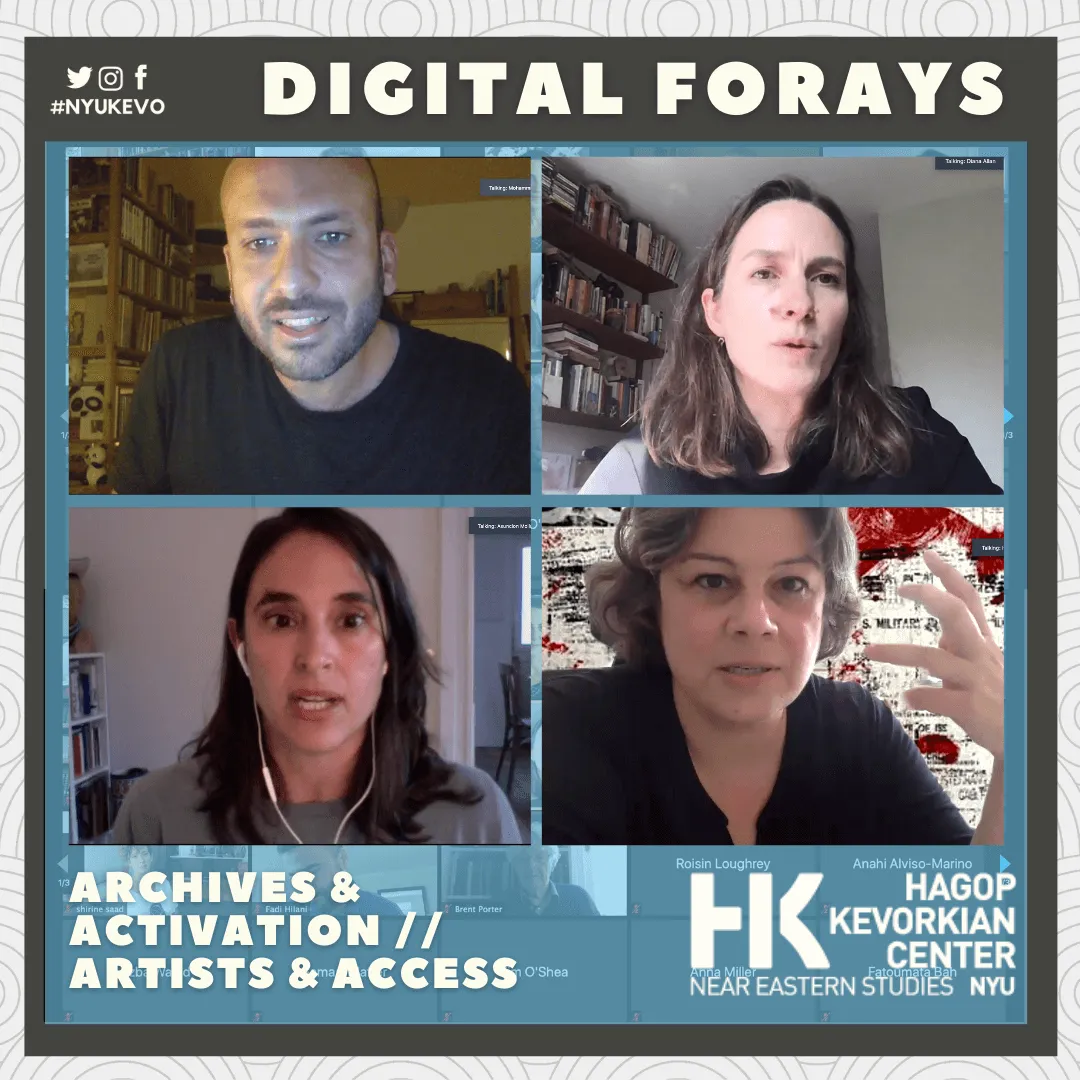
The last 20 years have been marked by the expansion and creation of many archival projects across the Middle East. What is saved? Who decides what is of worth? How accessible does it become? How are artists and cultural works accessing, making, and moving beyond archives? When speaking of Archives & Activation // Artists & Access, what are the absences, gaps, cracks…? How is digitality, in a broader sense, bridging, morphing, and exploiting the gaps of knowledge and access?
Asunción Molinos Gordo is a research-based artist strongly influenced by disciplines such as anthropology, sociology and cultural studies. In her practice she questions the categories that define “innovation” in mainstream discourses today, working to generate a less urban-centric way of understanding progress. She won the Sharjah Biennale Award in 2015 with her project WAM (World Agriculture Museum) . Her work has been exhibited at museums and institutions around the world. In 2014 Molinos was a resident at Delfina Foundation, during the first iteration of The Politics of Food thematic programme and in 2019 she was a resident at CCA Glasgow with Verbatim Theatre mentor Mark Jeary. Molinos has been commissioned to create Art Jameel’s 2020 Artist’s Garden Project in Dubai.
Mohammad Shawky Hassan is a filmmaker and video artist living and working between Cairo and Berlin. He studied philosophy, film directing and cinema studies at the American University in Cairo, The Academy of Cinematic Arts & Sciences and Columbia University. His films include It Was Related to Me (2011), On a Day like Today (2012), Compos Mentis (2016) and And on a Different Note (2015), which was acquired by the Museum of Modern Art (MoMA) in New York as part of its permanent collection. A recipient of the Fulbright Fine & Applied Arts Grant, his work has been shown at the Berlinale, Haus der Kulturen der Welt (HKW), MUCEM, Sursock Museum and Contemporary Image Collective (CIC) among other festivals and museums. In addition to his film and video work, he was the film programs director at ArteEast, the director of the Network of Arab Alternative Screens (NAAS), the Residential Fellow for Art & Philosophy at the Cairo Institute of Liberal Arts & Sciences (CILAS) and a Lecturer at the German University in Cairo.
Diana Allan is an Assistant Professor at McGill University in the Department of Anthropology and the Institute for the Study of International Development . She is a filmmaker and anthropologist, and the founder of two grassroots media collectives in Lebanon, the Nakba Archive and Lens on Lebanon. Her ethnography, Refugees of the Revolution: Experiences of Palestinian Exile (2014) won the 2014 MEMO Palestine academic book award and the 2015 Middle East Section Award (AAA). She is currently working on a historical ethnography of the sea in Palestine.
Helga Tawil-Souri is a media scholar who focuses on spatiality, technology, and politics in the Middle East and especially Israel/Palestine, and methodologically incorporates political economy, visual and cultural studies, and cultural geography. Broadly, my work critiques the notion that we live in an increasingly open and borderless world, by analyzing how technologies and their infrastructures - such as cell phones and the internet - are explicitly territorial and political and often impose new forms of borders and controls. On the flip side of that, she is equally fascinated by how spaces and 'things' that are overtly territorial and political - borders, checkpoints, and identification cards, for example - themselves function in cultural ways. Most of her teaching is through the Department of Media, Culture, and Communication . Helga teaches undergraduate and graduate courses on topics including borders and spatiality; Arab media; critical theory and media studies; Israel/Palestine; war and media; globalization, international development, and commodities. Laila Shereen Sakr is known for creating R-Shief software and performing as VJ Um Amel. She is an Assistant Professor of Media Theory & Practice at University of California, Santa Barbara. At UCSB, she co-founded Wireframe, a new digital media studio that supports critical game design and digital arts practice.
This event was part of the Fall 2020 course: Problems and Methods in Middle Eastern Studies

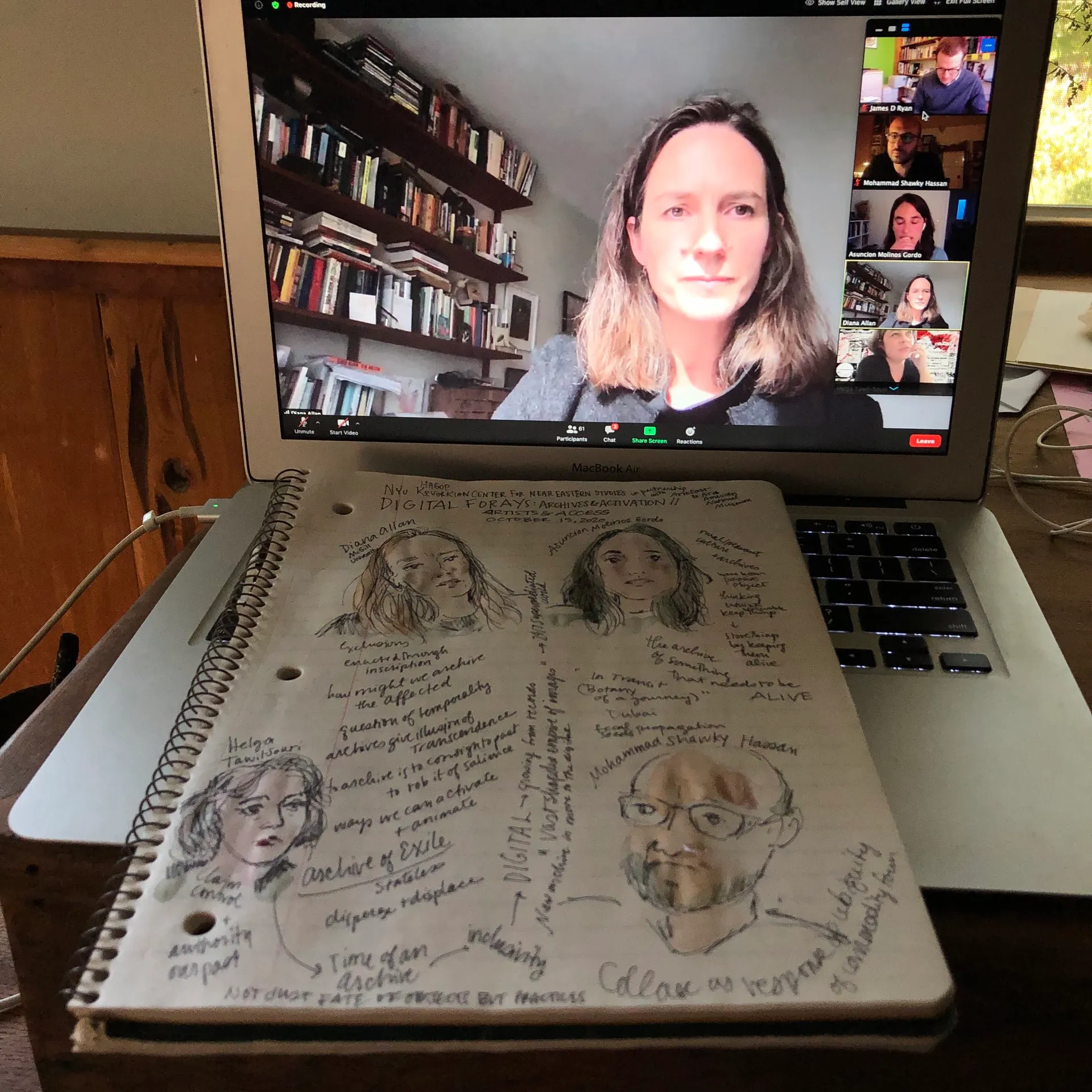
Creating meaning from fragments. Another fascinating panel @nyukevo #DigitalForays Archives & Activation // Artists & Access with Mohammad Shawky Hassan, Diana Allan, Asunción Molinos Gordo, and discussant Helga Tawil-Souri. #jojodoodles #visualnotetaking #nyudh
Group Saffron Vesper
EVENT EXTENSION
The archive is one of the most seductive objects within our modern world. Originally referring to a location where government records are stored, the emergence of the digital archive, as well as access to archives within the digital space, has pushed the boundaries on what an archive is. The allure of the archive has given birth to what Derrida calls “Archive Fever” – a mad rush by academics to read both with and against the grain of archives. In the shadow of academic archive fever, the digital space has produced an analogue: rather than reconstructing the logic for government archives, every person is constructing their own archive. Whether through photos or messages, we have become sentries of our own knowledge and experiences, and in sharing portions of our own archives with one another, we allow each other to engage in archive fever.
With this lens, we analyzed the Digital Forays event held on October 15th with Asunción Molinos Gordo, Mohammad Shawky Hassan, and Diana Allan, moderated by Helga Tawil-Souri. The panel touched on a variety of topics throughout their three projects: the living archive with Asuncion, reenactment of the past to incorporate lost narratives with Shawky, and the transformation of a classical archive into a digital one via video with Allan. The panel ultimately focuses around a renewed understanding of what the archive is, and the ways in which an archive is problematic. We understood this to be three main topics: the accessibility of an archive, the scope of an archive, and the temporality of an archive.
The accessibility of an archive is one of the more classical archive questions. In answering the questions: who is allowed to see an archive, and what the archive is meant for, we can begin to see the contours of how an archive breaks down. Archives meant for a specific purpose can be challenged and be read in a very different way, and by understanding the logic of how the archive was constructed in the first place, we can begin to break down the archive into its constituent parts. Diana recreated an archive of refugee experiences, and in so doing, very specifically chose to speak against British propaganda. Although her source material was pulled from a state archive that was geared towards a specific purpose, alteration to the films allows us to view these experiences in a new light.
The scope of an archive, like the accessibility of an archive, is another classical archive question. The questions of “what is worthy of storing in an archive” has plagued scholars for centuries. Not only does this question affect the items that go into an archive, it affects which items may be stored alongside the items, and how items are arranged within an archive. In the wake of the French Revolution, which spearheaded the development of the archival science and “included the conceptualization of the public status of and the state’s responsibilities to guard both the nation’s heritage” ( DiCapua, 100 ), two principles were established: the reliance on provenance and the respect for the primitive order.
The reliance on provenance assumes that records have originated from purposeful organized activity, and that records should be kept within the same order they arrived, allowing them to be reviewed in their totality (this point was replicated by Zaatari). Respect for the primitive order states that documents should not be reordered, understanding that each series was constructed with reason, and the series order itself is a document. These two principles, in conjunction with the pure decision on what kinds of items go into an archive, means that many voices are left out of archives completely, either based on pure chance or deliberate elision. Shawky’s work addressed these points: by recreating classical works and music through queer narratives, he has preserved the series of classical records, in line with archival principals, but also deliberately added the narratives that had been elided out.
The temporality of an archive, or “when does something become history”, is the last portion. Classical, state run archives tend to have long durations of inaccessibility, such as the Ottoman archives in Turkey. However, Asuncion’s project challenges us to rethink the temporal facet, not only can documents require gestation before becoming unsealed, many living archives around us require the same.
As a group, we decided to identify an existing archive to interact with and access. This led to the lengthy process of selecting an archive to work with. In following with the event speakers, who each challenged and expanded the definition of what an archive can be, we wanted to choose something that falls outside the traditional confines of what an archive is assumed to look like. We considered broadly: what is an archive? How do we limit ourselves when we only consider traditional forms of archive? Michael Foucault, in The Archeology of Knowledge and the Discourse on Language , defines the archive as follows:
The archive is not that which, despite its immediate escape, safeguards the events of the statements, and preserves, for future memories, its status as an escape; it is that which, at the very root of the statement-event, and in that which embodies it, defines at the outset the system of its enunciability. Nor is the archive that which collects the dust of statements that have become inert once more, and which may make possible the miracle of their resurrection; it is that which defines the mode of occurrence of the statement-thing; it is the system of its functioning . Far from being that which unifies everything that has been said in the great confused murmur of a discourse, far from being only that which ensures we exist in the midst of a preserved discourse, it is that which differentiates discourses in their multiple existence and specifies them in their own duration (129).
In this way, Foucault characterizes the archive as not as a set of texts or statements but as a series of relations and spaces that allow statements to be formed. Is, then, a restaurant an archive? A restaurant is a space for text, knowledge, statement, experience to be created, shared and disseminated. A restaurant produces food, provides experience, houses bodies, and allows for an endless production of material: reviews, photographs, stories (and as Asunción would point out, even human feces). We would argue that a restaurant engages with and produces archives while simultaneously being an archive in itself. It was this discussion that led us to the idea of visiting a restaurant and engaging with it as an archival space.
We chose Sofreh , a Persian restaurant in Brooklyn, as our archive site. We picked a place that none of us had been to before, though we brought varying levels of existing knowledge: some of us had heard about Sofreh from friends and family who had eaten there, others had read reviews from the New York Times, Eater and New York Magazine, and several of us had never heard of the restaurant. We also thought it would be interesting to go to an Iranian restaurant, because half of our group members are Persian, and half are not. So-called “ethnic” restaurants in the US that produce food from other countries are creating a source of knowledge, food and culture. As a restaurant that serves Iranian food, Sofreh might, in some ways, be attempting to capture and recreate an Iranian experience. In this way, Sofreh can be thought of as an archive of Iranian food, and perhaps, even culture.
 Why did Nasim Alikhani, the owner of Sofreh, open this restaurant? What is she hoping to do by serving Iranian food in Brooklyn?Who eats at Sofreh?Does the restaurant employ Iranians?How might Sofreh contribute to gentrification in the neighborhood?How is the menu presented? What language is it written in? Who was it made for?How is Sofreh received by the general public? By food critics? By Iranians?
In considering Sofreh as an archive, we could identify connections with all three of the event participants’ statements and projects. Our conversation about ethnic restaurants as sites of cultural archival reproduction alludes to Shawky’s discussion of cultural reproduction, and his framing question: How can you acknowledge the effect of cultural production on a work without reproducing it? Diana and Asunción called for us to trouble the temporality of archives by thinking of them as live spaces and bringing the archives “into life.” By visiting Sofreh as a group, eating there, observing the space and the people, and then reflecting on our experiences afterwards, we set out to do the following: incorporate ourselves into Sofreh’s existing archive, by physically going to the restaurant and engaging with the archival site; construct a new archive from our experiences at the restaurant, by taking photos and creating and sharing our own experiences and reviews; and reinterpret and recreate aspects of the archive, perhaps by rewriting the menu or creating an alternative Spotify playlist. We made reservations to dine at Sofreh on Sunday, November 1st.
Although fairly new to the restaurant scene, Sofreh is a high end establishment in Brooklyn’s Park Slope area and a very well-known restaurant that has made it on Tripadvisor’s 2020 Traveler’s Choice. Online, Sofreh has overwhelmingly good and positive reviews, ranging from various platforms such as yelp , google , tripadvisor , and opentable . Reliable or not, online reviews do have the power to negatively impact and ruin the online reputation of any business or company or accomplish the opposite; thus for any business, maintaining a positive online presence is very important. Online reviews also give us an idea of a business’ clientele and most of all a look into its digital portfolio. A look at which leads us to wonder about who is contributing to this digital portfolio? What is the reviewers’ background and what tone are they using in their reviews? For Sofreh, we found that most online reviews were written by self-identified Non-Iranians; a few of whom were trying Iranian cuisine for the first time. The lack of Iranian voices in comparison to the many non-Iranian voices in the online reviews is particularly interesting to explore.
Of the few critical reviews left online, most expressed customer dissatisfaction on the restaurant service and management. However, when it came to the food itself and the menu, there was surprisingly little to no complaints – a positive for any restaurant or business in general as these kinds of reviews contribute positively to their digital portfolio. Every review after the other about Sofreh across the four platforms mentioned above was singing praise to the array of food choices and most importantly to the savoriness and flavor of the delicious meals and dishes being served at Sofreh. A number of reviews used phrases such as, “an explosion of flavor,” food that is “well flavored, with great sauces and spices,” to describe the heavy, rich, and complex flavors and textures served in Sofreh’s courses. This awe and lack of familiarity with the dishes and flavors of the menu at Sofreh are clear indicators to the non-Iranian background and identity of Sofreh’s online reviewers and customers.
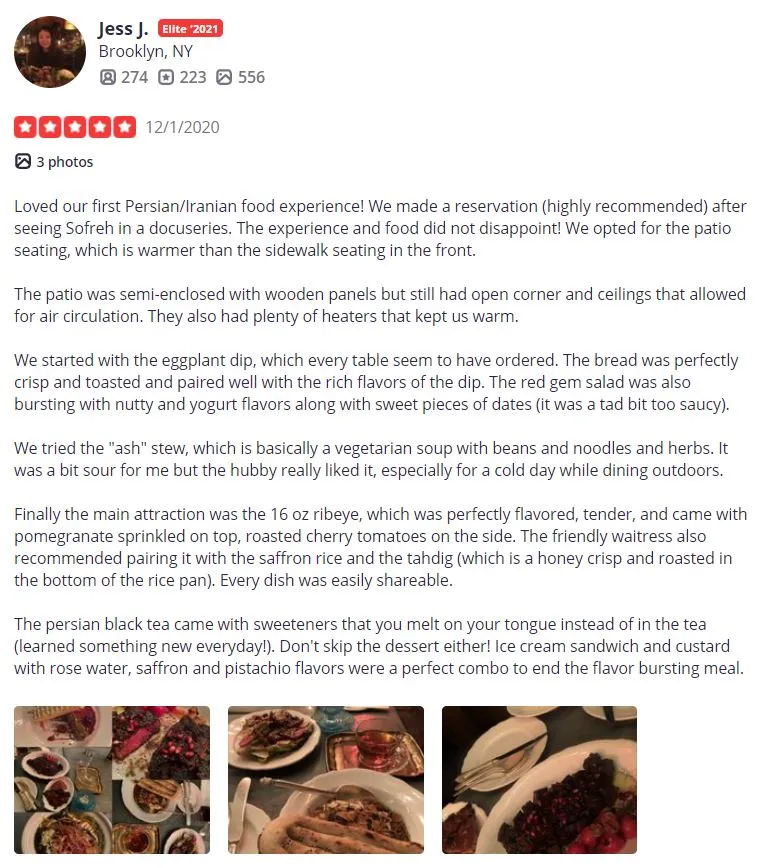
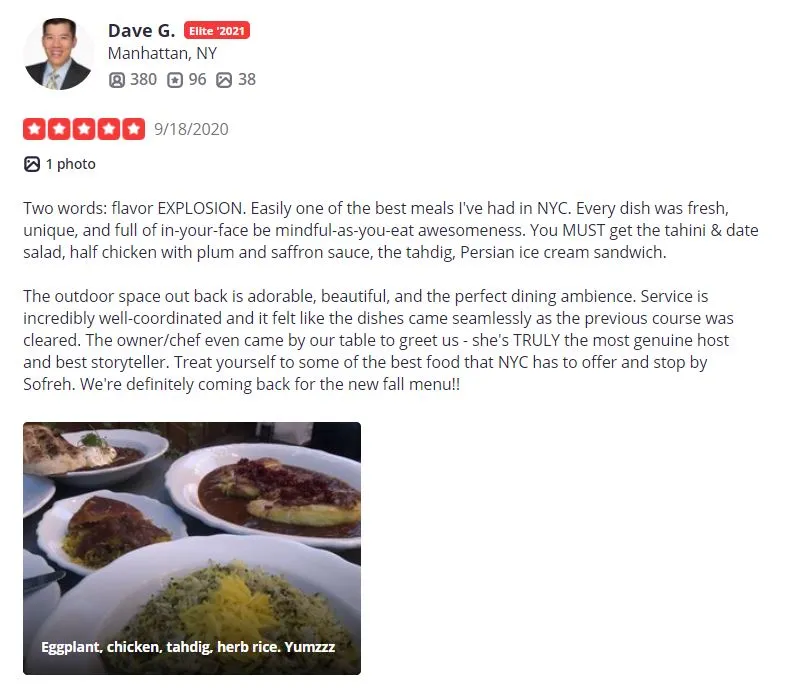
Interestingly, very few reviewers identified themselves as Iranian and of those who did, they were entirely positive. Besides mentioning that the reviewers were Iranian, there was nothing distinct between these reviews and those from non-Iranian customers. Something we found very surprising since we were expecting a range of voices from Iranian customers with mixed reviews about their experience in part because Sofreh’s image in decor and cuisine as stated on its website seeks “to interpret the welcoming, cozy atmosphere of traditional Persian homes in a bright and minimalist setting”. We saw this effort to distinguish Sofreh’s image through contemporary and modern design compared to let’s say “more traditional” Iranian restaurants as an experience that would generate diverse responses from the Iranian community.
The lack of diversity in the reviews and the fact that only a few Iranians left online reviews of Sofreh might actually be indicating that not a lot of Iranians frequent this establishment, leading us to wonder: why? Why are there only a few Iranian-self identified reviewers online? The online reviews clearly indicate that Sofreh receives a non-Persian audience majority. Does this reflect Sofreh’s intended audience or is Sofreh just succeeding at pleasing this category of customers the most with their offerings? If the latter, then Sofreh becomes this archival entry point for non-Iranians to sample and access Iranian cuisine and culture. Therefore, what does this say about the authenticity of the restaurant? Of the archive?
It’s hard to know for sure who this archive is for precisely; however looking at Sofreh’s digital presence and in particular to its online reviews, we can safely conclude that first non-Iranians frequent this archive the most and second, that Sofreh in part because it doesn’t advertise itself as a “traditional” Iranian restaurant – whether because of the overwhelming non-Iranian voices from online reviews, the minimalist and modern decor, the menu, or the small portions as remarked by the waitress at our table – acts as an access point for new-comers to Iranian cuisine and for lovers of persian cuisine of non-Iranian descent; therefore catering to a non-Iranian audience.
In the prominent New York newspapers’ reviews of Sofreh we can begin to see the “ethnic” restaurant not only as an archive in and of itself, but as a repository of knowledge concerning an object (here, Iranian cuisine and culture) interpreted, represented, and conveyed to a certain audience. The target audience is, presumably, the metropolitan reader—the “foodie” with the job affording her the nights off and disposable income to pay prices such as those of Sofreh, and the higher education and liberal cultivation to seek out “ethnic” dining experiences as access points to cultures other than her own. To understand the newspapers’ stake in the ethnic restaurant-as-archive, it is to their vision of Sofreh as a subject navigating the supposed divide between Iran’s “tradition” and New York’s “modernity” that we now can turn.
Take for instance the New York Times critic’s September 11, 2018, review of Sofreh, titled: “ For Fans of Iran’s Sophisticated Cuisine, a Reason to Cheer .” Immediately we see the critic define Iranian food by its “sophistication,” shaped by “the history, the influence,” and “the depth” of the nation’s cuisine. The meal before him is food for both his body and mind; it is a lesson in history and an access point to a culture worthy of study for its sophistication.
Sofreh offers information about a foreign place of interest to the Times critic, and he interprets this corpus of knowledge through the lens most persuasive to him: Iran(ian cuisine)’s negotiation between tradition and modernity. “The dining room is spare and modern,” he observes, “with exposed rafters, molded plywood chairs and shades of soft white.” Yet he seems to suggest that this modern décor is, in some way, a façade hiding something more interesting: “You have to look carefully to see the breaks with garden-variety minimalism, like the echoes of medieval arches behind the bar and the Persian calligraphy carved into the plaster in the back.”
The critic appreciates the effort to modernize the dining experience, but is unsatisfied to find the elements of tradition, or of cultural authenticity, to be hidden, or at least expressed subtly. His comment about the ash, a popular greens, bean, and noodle soup, standing out on the menu “because it stays so close to tradition” suggests as much. His wish that the menu “plunged into tradition with less restraint” makes his disappointment clear. It also presupposes that the unique menu choices are indicators of modernization, which for him perhaps disqualifies Sofreh from being a wholly reliable access point to Iranian culinary knowledge. Hence, he explains with some regret that, besides the ash, the restaurant’s “other dishes show the acclimatizing effect of New York,” to which Iranian tradition is an Other.
Other reviews, however, celebrate Sofreh’s unique approach, but they do so through the same lens of “tradition” and “modernity” seen above. The Times’ August 20, 2018, review profiles the head chef and owner, Nasim Alikhani, deeming her “gutsy” for her “bold, modern take on Persian cuisine.” The review tells us of Alikhani’s past in Iran—how at 23 she, a law student, left the country in the aftermath of the Revolution. To make ends meet in the United States, she nannied for an Iranian family, gradually finding her passion for cooking from humble beginnings preparing simple dishes for her employer’s children. How fitting it is that it was here in the United States, the critic suggests admiringly, that Alikhani’s passion for her Iranian culinary roots took off. For the Times, Alikhani’s success with Sofreh is the fulfillment of her “American Dream”—a successful melding of nostalgia for the distant place from which she hails and the contemporary place within which she can bring her memory of home to fruition, to new expressions.
The critic portrays Alikhani as a trailblazer for her cuisine: she explains that she caramelizes her onions instead of lightly sautéing them as one would do in Iran. “This kind of updated, gutsy touch,” the critic writes, “is evident across her menu, where she’s not afraid to rebel against tradition.”
If “traditional” Iranian cuisine is a corpus of knowledge, then Alikhani is depicted as breaking free from its onerous limitations. That she has been given that freedom in the American cosmopolis of New York, and not Iran, is implied. Alikhani herself perhaps contributes to this narrativization of her experience as one of transcending tradition to embrace cosmopolitan modernity. “I’m going to upset some people because I’m going to do pork and I’m going to do scallops, which you can’t get in Iran,” she says. The “some people” that she may be willing to upset are Iranians observant of their Shi‘i Islamic dietary guidelines, which prohibit the consumption of pork and certain seafoods, including clams and mollusks. It also warrants mentioning that Alikhani does not use halal meat in any of her dishes, another obstacle to the Iranian Muslim’s (or Muslim of any origin) enjoyment of her menu. This critic embraces Alikhani’s “rebellion against tradition,” viewing it (unlike her aforementioned Times colleague) as a legitimate expression of Iranian cuisine, despite its clear catering to the tastes of a new, non-Iranian clientele.
Eater New York ’s August 21, 2018, review carries forward this celebration of “rebellion,” commending Sofreh for distinguishing itself from the “older class” of “reasonably uniform, kebab-laden menus” of “stodgy, white-tablecloth” Iranian restaurants in the city. Eater pushes the contrast of tradition and modernity into the broader category of the “Middle Eastern cuisine” that it creates, comparing Sofreh to the compelling “change of pace” apparent in the innovative Los Angeles Iranian spots. The critic does not stop there, however. “Alikhani’s cooking also serves as a vital counterpoint to the city’s larger Middle Eastern culinary scene,” he writes, “where the diverse foodways of the Muslim majority region are often filtered through the lenses of Israeli-born chefs.” What does this mean? How does it follow from his broader point about Sofreh cutting against tradition? Are the other “Middle Eastern” restaurants of New York lacking because of their outdated presentations, or because their employment of Israeli-born chefs somehow makes their food less Muslim, less authentic, less traditional? Can Middle Eastern culinary modernity only be expressed by “native” chefs?
Perhaps Eater believes this to be so, as they commend Alikhani for standing “poised to help local Iranian food evolve.” In the eyes of Eater and the Times , Alikhani does her culture a service by departing from its traditionalism and embracing the modernity afforded her by New York. Whether she aims to or not, Alikhani’s person and expertise are implicated into these narratives of tradition and modernity, authenticity and innovation. Within these narratives, she is judged by the standards of an elite, liberal readership and clientele, who seek out Sofreh not just as a good meal, but an access point to an alien culture—a deeply politicized, antagonized place—that they seek to understand and critique, even if just for one night, once a year.
The archive is constantly being unmade and remade; it is not a static thing but rather mobile, amorphous, constituted by and constitutive of the myriad objects and subjects it comes into contact with. A restaurant is an archive in that it is routinely taking in and releasing subjects and objects, producing particular narratives about the food, physical place, and people. If we take what Mohammad Shawky Hassan did with his project—a process of undoing narratives and remaking new ones by imbuing his personal subjective desires and views onto popular Arab cultural pieces—the restaurant is one such space where dominant narratives are reified and simultaneously altered little by little by the very virtue of the ephemera it cycles through. There is a certain gatekeeping structure that forms the bounds of the archive, a sort of skeleton, with the intention of relaying some message as determined by the keeper of the archive. Physical (often permanent?) items like photos, familial tokens, or identifying clothing contribute to a specific narrative, partly informing the interlocutor on what they should be receiving from the archive.
Sofreh, as a physical location with particular physical objects and attributes placed there by the keeper, creates the skeleton for a certain narrative to erupt. To take these qualities at face value, you see a rather simplistic, minimalist setting. The lighting and decoration is forgettable, dark tables sans tablecloths and a generic “Oriental” inspired fabric design on the booths. There is a large piece of calligraphy hanging on the left when you walk in, facing an arched opening to the kitchen that you can look into. Overall a simple, sleek look, a look that can largely be molded to what the viewer chooses to bring with them into the space. The more subtle attributes that identify Sofreh as a Persian restaurant come from the music playing, a playlist of primarily classic, recognizable Persian songs (to someone who identifies as such), the bathroom plastered with pulpy Iranian movie posters from the 60s and of course the name and food being served. By the very nature of these identifying markers, the restaurant is implicated in inescapable hegemonic narratives about Iran, Iranians, New York City, the post-9/11 War on Terror, a whole host of subjects that circulate within this archive and others.
Sofreh’s penchant for straying from traditionalism is no more evident than within its bathroom, where every inch of its four walls have been plastered in vintage Iranian movie posters dating back to the 1970s. The bathroom puts into question the temporality of the archive by simultaneously positioning its guests within the past, present, and future. As an archive in and of itself, the movie posters most evidently bring forth nostalgic sentiments of a pre-revolutionary era; Iran is no longer a region plagued by the heavy dust of contemporary politics inclined to delineate it through dominant “War on Terror” rhetoric or Orientalist-esque imagery of veils and chadors, but rather reclaims its position as a standard-bearer of culture. The retro, pulp fiction aura of the posters—with charismatic men and women dabbed in modern-day dress (or close to nothing at all)—suggests to Sofreh’s guests that Iranians are as nuanced and animated as the characters within these films, and that the grand narrative of their nation has been appropriated by those in positions of power both within their own borders and across the West.
As much as Sofreh interrogates the inflexibility of Iran’s national image through its preoccupation with the past, the mischievous design is also a strategy that speaks directly to the social media age. A quick hashtag search of Sofreh on Instagram will show images of barbari and polo sabzi competing for screen space with bathroom selfies; thus, more than just a marketing tool for garnering new customers, Alikhani has cleverly ensured that the image she has put forth of Iran is what gets proliferated across digital platforms that transcend time and space. In this way, the archive of Sofreh, as a beacon of Iranian cuisine—and thus, really, its ethos—has become immortalized.
To this point, what Sofreh is doing as a type of alternative production is slowly, subtly decentering dominant Iranian narratives by virtue of the fickle subjects who engage with it. Each individual who hears about Sofreh, eats their food, posts pictures and relays their experience is part of Sofreh’s archive, unmaking it and making it differently based on their specific background and subjectivity. What happens when the menu presents each dish merely by descriptors, not their Persian names? Does the archive become more accessible? For who? Are the subjects more willing to engage or less? What reactions erupt, what memories and attachments are evoked in each subject when they hear music they recognize or don’t recognize? What happens to Sofreh as an archive once subjects and objects leave the physical location? In this way, Sofreh pulls at the construction of the archive as a fixed entity, making it mobile via the food that is ingested by people, the pictures and commentaries that manifest by word of mouth and occupy transnational spaces. New narratives swirl into this fluid repository, changing the archive so that our bodies and our stories negotiate with particular histories encased there, finding potential for new temporalities, new forms of power and perhaps even liberation.
The archive is not only constructed by those who create it, but - as evidenced by the customer and journalistic reviews - by those who engage with it. As such, here, we contribute to the every-growing archive around Sofreh by offering our personal reflections. We wrote these reflections with no knowledge of what others would be discussing; it is interesting to see how much our takeaways converge despite the diverse positionalities we bore to the experience.

As the cultural hallmark of community and camaraderie, my Iranian identity is, in large part, defined by the preparing, cooking, and eating of food . Indeed, one of my distinct memories growing up is the women in my family gathering around the kitchen to stem herbs for ashreshteh during our Nowruz celebration; as they filled the large metal pot with brown lentils and chickpeas, my cousins and I would take turns adding in the reshteh noodles (it was our tradition to make a wish for the new year as we split the noodles in two and threw them in the pot alongside the ingredients). Persian meals weren’t just reserved for the holidays, however, and neither are they a thing of the past; I look forward to Friday night Shabbat dinners as my weekly return home—to the physical space of home, yes, but also to the figurative connotations of home that these dinners evoke; ghormeh sabzi and kabob koobideh are served next to plates of baghali polo and steamed white rice, the latter of which is always followed by tahdig (“ people must find it so strange that we willingly choose to eat the burnt parts of the rice pot ,” my brother notes on occasion). With my father’s favorite Persian songs chiming in the background, we end our meal with cups of sadaf tea (black, which we slowly slurp while sugar cubes melt on our tongues) mediated by cool bowls of faloodeh. And because Persian food never abides by standard serving sizes, my mother usually brings out the tupperware and taarofs with my aunts until they begrudgingly agree to take home leftovers. In this way, my engagement with the archive of Sofreh was in direct conversation with the archive of my body—the collection of traditions, pastimes, and experiences connected to Persian food that represent what it means to be Iranian .
I admittedly approached Sofreh expecting to be underwhelmed by the experience. When it had first opened two years ago, it received raving reviews by reputable magazines and newspapers, and was consistently listed among the top ten NYC-based restaurants on food blogs. And yet, amongst my home-base Iranian community, it was touted as an inauthentic and overpriced tourist cash-grab. Indeed, I did find some personal grievance with the restaurant after I had taken a look at their menu online; many of the dishes that were staples in my household were given watered down, Westernized titles—“kabob” was written in air quotes (could kabob be anything else but a kabob?) and “ghormeh sabzi,” a staple in Persian culture, was generically labeled “dried lime and herb beef stew.” I was under the impression that Alikhani was trying to create a degree of separation from her food’s ethnic origins; it not only made me skeptical about the legitimacy behind the tributes she had been given by the likes of the New York Times and the New Yorker (really, what would they know about Persian food?), but also about the clientele she was trying to attend to.
Alas, in some ways, Sofreh did prove to be the antithesis of what my experience with Persian food at home is like . It was strange to have the waiter ask if I wanted to start with a drink (Iranians don’t eat their meals alongside alcoholic beverages, let alone have their own cocktails) and I was surprised to learn that stews weren’t automatically served with a plate of rice (how were non-Iranian customers supposed to know the proper way to eat ghormeh sabzi?). The portions, too, seemed to defeat what makes these dishes quintessentially Persian; whereas I was used to long trays of assorted rice and deep pots of ashreshteh, every item arrived in small round plates that seemed more like personal portions than meals to be shared. In fact, the waitress, who sensed that some of us were Iranian, was seemingly uncomfortable by our critical scrutiny of the menu and suggested we ease our expectations. Like so much of Persian culture, the act of preparing food is performative—in the communal nature of cooking, but especially in its elaborate presentation—and because Sofreh was proving (perhaps even admitting) to fall short in this regard, I was already convinced of its insincerity and discouraged by what appeared to be an Orientalist exploitation of culture in service of a curious American audience that likely wouldn’t know better.
In true Iranian fashion, I was quick to judge; everything served—from the sweet and sour eggplant puree to the crispy tahdig—were visceral reminders of the dishes I had grown up eating in my own household. More striking than the taste of the food itself, however, was what the experience of being at a Persian restaurant with other Iranians revealed about the concurrent collectivity and singularity of my Iranian identity. In one particularly touching moment, Mehrdad, Dorsa, and I huddled around the menu as Mehrdad read the Farsi translations placed next to each dish, trying to see whether they matched their English complements. Mehrdad’s fluency led way to a discussion of our respective backgrounds and it was evident that, despite our shared heritage, the ways in which we situated ourselves as Iranians were completely different ; Mehrdad and Dorsa had grown up as one of the only Iranians in their hometowns, but were connected through the mutual experience of regularly visiting the homeland (“ I was actually in Iran during the Green Revolution and remember witnessing the protests ,” Dorsa had recalled). The closest I had ever been to Iran was the diasporic Iranian community among whom I had spent all of my formative years, yet the very notion of growing up with other Iranians in America was as extraordinary to them as spending the summer months traveling the cities of Iran was for me.
Despite the different ways of “being” Iranian that we (literally) brought to the table, we were nevertheless connected by the shared experience of eating—and even critiquing—Persian cuisines that were central to each of our upbringings. We joked about how the platters of rice were coated in just as much butter as we’d expect them to be, and instinctually swirled pieces of barbari into our eggplant puree and yoghurt dip, staples at our home breakfast tables. When the tea arrived, we each compared the opaqueness of our cups (“ Mehrdad got the darkest one ,” we teased), and as we placed noghl sugar clusters between our teeth, Dorsa and I joked about the seeming novelty of adding sugar to tea (“ My American roommate in college would criticize me for drinking sugar with tea while she ate Nutella directly from the jar ,” she rebuked). This process—of sharing memories and discovering connections—persisted throughout the night, and there was something cathartic, but also quite fitting, about being able to consolidate both the differences and gaps in our respective identities as Iranians through the experience of passing stories over a Persian meal , a centuries-old tradition that was common to us all. Whatever the idiosyncrasies in our experiences as Iranians might be, we’re inevitably connected by the golden crust of tahdig and the sprinkle of saffron—and I take comfort in that constant.

Sofreh was one of the places I heard about when I first arrived in New York, along with Ravagh and Persepolis. Both these restaurants are familiar, you could drop them virtually anywhere in the U.S. and there wouldn’t be any particularly distinctive quality that would put them out of place. There’s a Persian restaurant in Denver that reminds me of both these restaurants, opulent, traditional, with a menu that you could virtually trade out among them.
When we decided on Sofreh as a group, I was immediately skeptical . I had looked into Sofreh before when my family was visiting me for the first time in New York and dismissed it because of a quality I could only describe as “assimilationist.” I vaguely remember reading about a “modern take on Persian food,” which was not a positive attribute to me. Persian food is the most traditional, classic food I can think of. You don’t mess with the classics.
It seemed to me that Sofreh was trying too hard to reinvent Persian food, to make itself palatable to a trendy, and what I inevitably saw as a “white vibe” fostered in New York. We spent some time reading the big reviews, which prompted some immediate reactions. The New York Times referred to Sofreh as “sophisticated” Persian cuisine, implying that Persian cuisine typically is not sophisticated. New York Magazine refers to Sofreh as contemporary, a break from more typically “stodgy” Persian restaurants helping the look and taste of Persian food in the city “evolve.” What was this obsession with changing Persian food? Was the actual food at fault? Not evidently, it rather seemed Orientalist discourses were creeping in through these critiques and Sofreh was enabling them.
It’s important to note however my particular subjectivity, and the attachments I brought into the experience of Sofreh as an archival location . I’m originally from Colorado with very little exposure to other Iranians or other Persian cuisine outside of my mother’s. When I do get the chance to eat Persian food elsewhere, I’m ecstatic, and I relish in the “traditional” and familiar atmosphere and menus that remind me of authentic food from Iran. Going to Ravagh and Persepolis with my family were sweet moments filled with nostalgia and unbridled joy that they were just like other Persian restaurants we had encountered in the U.S. The fact that New York City, this bright, foreign unknown place could have something comforting in its familiarity was reassuring; perhaps I wasn’t straying that far from home after all.
Ultimately, while the nuanced pieces that made up Sofreh made me pause, the overall environment that Sofreh created for me and my group members was every bit as “Persian” as I would hope. The setting was stark, which I noticed immediately. No glittering chandeliers or luxurious tablecloths. There was however a playlist of classic Persian songs that I could hum along to and a drinks menu that I enjoyed despite knowing that Persian restaurants typically don’t serve alcohol. I noticed a couple our age sitting next to us who I was sure were Iranian; in general it seemed there was a fair amount of non-white people in the restaurant, which I took as promising. I felt that if the place was packed with white people it would confirm my suspicions that Sofreh was catering to a particular audience, trying to make Persian food palatable for white people and thus sacrificing the integrity of our cuisine. I spent so many years growing up being ashamed of my food, trying to hide my pungent, strange looking dishes in the cafeteria next to the neat little sandwiches of my classmates, not appreciating that our food is some of the most delicious in the world. I ’m finally done trying to explain away Persian food and I’d like for others to do the same . My sentiments are different from my mothers, and I imagine the founder of Sofreh would agree with her: she wants desperately for non-Persians and especially white people to be curious about and eat our food, even if it means altering it for their tastebuds.
I suppose I don’t want us to diminish any aspect of our very rich culture for the sake of making it easier for outsiders to understand or accept us. Sofreh’s menu felt like an exercise in that very phenomenon by Anglicizing all the names of the dishes to where half of them I didn’t recognize at all. At the Persian restaurants I’m familiar with, the menu will spell out the Farsi name in English, “joojeh kabob” for example. At Sofreh, the Farsi was written out in tiny, almost illegible script next to each English description of the dish that Mehrdad had to read for us to recognize what they were. Classic dishes like ghormeh sabzi were not written as such, which feels to me like a huge disservice if in fact your goal is to introduce Persian food to people unfamiliar with it. I understand that it may be difficult to pronounce, but if you expect to know me, Dorsa Djalilzadeh, I expect you to call me by my name, and pronounce it correctly, and I expect you to do the same regarding our food.
The bonding experience overall, as Mehrdad, Sahar and I tried to understand the menu, as we explained things to Anna, Peixian and Fatouma, was most reminiscent of what I consider to be a true Persian meal, and it’s what I leave this experience fondly with. The food was good and tasted like home with few variations (that you had to order the rice separately was the biggest travesty). We spent a long time at Sofreh, finishing with dessert and tea, as is customary. I was stuck looking for reasons to not like Sofreh but left feeling that perhaps it was fostering a space that had existed for some time, and that I had actually been searching for, but had merely been inaccessible to me. I originally equated Sofreh with a kind of inauthentic break from traditional Persian spaces without acknowledging that more than just a restaurant, it acted as an expansion of Persian spaces of companionship, connection and care. The food and ambiance is an important aspect to Sofreh as an archive but what has struck me is Sofreh’s ability merely to incite a discourse about what it means it means to be Iranian. It’s a cross-section of the diaspora, inviting us to share our individual experiences and form new ones. I don’t know yet if I would go back to Sofreh but it’s ingrained in my memory now as a place where I learned more about Persian cuisine, my friends and the varying ways I can negotiate with my Iranianian-ness.

Growing up, my family didn’t have a strong habit of eating at restaurants. As Muslims living in Phoenix, Arizona, our options were limited to vegetarian places or, more likely, Middle Eastern ones that would serve halal meat. As Iranians, my family liked the familiar taste of “our own” cooking, which was passed down to my mother by her mother, up the generational chain. (This would constitute its own living archive) . My sister and I would joke: Why would we eat at an Iranian restaurant when our mother could regularly outdo the chefs at most places? Each night at home our Iranian dinner was not Iranian dinner; it was just dinner.
It was only when setting foot in restaurants such as Persian Room in north Phoenix, Caspian in Orange County, California, or Pars Grill House in New York City, that you get the sense that you’re supposed to be having an Iranian dinner. In other words, the restaurant delivers to its patrons not just a meal, but a representation, an expertise . The Iranian restaurant represents “Iranian culture” to its customers, with cuisine as the access point . For the Iranian customer, being seated in this hall of representation may be a bit awkward—awkward in its commodified familiarity, perhaps.
And across these Iranian restaurants in the United States, the menu itself was so similar: skewers of fatty kebab and heaps of over-buttered rice, alongside far too often far too watery stews. What also was similar was the oversaturated “aesthetic” of these restaurants—the cultural memory that they tried to evoke as “authentic Iran” to their patrons. Oversized portraits and busts of Darius I and Cyrus the Great. Gold accents, on everything. Too many rugs. Besides the overabundance of rugs, I, an Iranian, did not recognize any of these ostentatious displays of “Iran.” Who was this all for?
Our readings of the New York newspapers’ reviews of Sofreh try to show how elite food critics situate themselves as interpreters of foreign places through their cuisine. The critic functions as a gatekeeper to the culinary archives publicized in the “ethnic restaurant,” manipulating the corpus of knowledge contained therein to articulate narratives of that foreign place. In the case of Iranian cuisine, the dominant narrative across the reviews was that of the tense negotiation between tradition and modernity, authenticity and innovation. Hence, I came to Sofreh with some preconceived disappointment, skeptical to see the ways in which the restaurant and its owner had been implicated in these clichéd, politicized narratives about the Middle East we all now know to critique.
Nevertheless, as a student investigating the restaurant-as-archive, I had to try to come in with an open mind, and more importantly, an awareness of the stakes of my own positionality. I had to be cautious not to judge Alikhani’s self-expression and culinary presentation by some self-constructed benchmark of what it is acceptable for restaurant-Iranian cuisine to be. We were there to experience her artistic expression.
So, we did. And we had a great time doing so. There were many moments, of course, in which we ran into confusion with what Sofreh was trying to offer us. Fatouma, a Muslim, learned from the waitress that their meat was not halal, so she was limited to the vegetarian options. I also ran into this problem, wondering how many Iranians and Muslims had come to Sofreh surprised to hear about this. Like us all, Peixian was curious about the naming of certain items on the menu, specifically the seemingly tokenized cocktail titles such as the “Bahar Bitter,” “Tehran Dirty,” and “Isfahan Smash.” And though excited to try something new, Anna noted her unfamiliarity with the menu, different from the Middle Eastern dishes that she was used to from her time in Turkey.
Fitting with the rest of Sofreh’s dining room aesthetic, the menu bore a minimalist presentation, with sparse descriptions in black ink on a large white broadsheet. The titles of the dishes were not Anglicized versions of the Iranian names, but rather English explanations. Thus Sahar, Dorsa, and I had to do a close reading of the menu’s text to recognize what the dishes were. The ingredient listings did not help. I mainly know the Persian names of ingredients used in Iranian dishes. What is fenugreek stew? At home, my mother taught us how to use shanbilileh in our ghormeh sabzi .
Each English explanation of a dish, nevertheless, was accompanied by the Persian name written in calligraphic script. But the small font suggested that those Persian titles were there for aesthetic reasons . Otherwise, many would need reading glasses to follow along.
The three Iranians among us, Sahar, Dorsa, and I, surely gave the white American waitress quite the headache with our probing of the menu. We were gently disturbed to not find complimentary bread offered. We were perplexed as to why the beef ribeye steak had “kebab” written after it in quotes. How many Iranians like us had come in, expecting kebab barg , surprised to be served the rarest cut of meat they’d ever seen? What is more, we were genuinely concerned to find that rice was sold separately, and for $6 to $8 a plate, at that. When we raised our questions with the waitress, she paused, as if she’d given this spiel to dozens of confused Iranian customers before us. “This isn’t like the Iranian restaurants you’re used to. Portions will be way smaller.”
There is a common understanding among Iranians—and certainly among Sahar, Dorsa, and I—that food has certain conventions to be upheld. For example, a few years ago, my uncle and I visited one of the few Iranian restaurants in Paris, hungry for some familiarity after a day of sightseeing. Watching his carbs at the time, my uncle requested his ghormeh sabzi stew be served with Shirazi salad instead of basmati rice. The French waiter took his order without question. But the Iranian chef was floored. He left the kitchen to come take a look at—to try to figure out—my uncle, the Iranian man who didn’t want rice with his stew.
Sofreh didn’t even want to serve rice with their stews. They know they’re going to perplex their Iranian guests. S ofreh is not interested in upholding the old conventions, and I admire the restaurant for it. Sofreh was interested in being a site of self-expression for its chef , sharing her personal articulations of that corpus of culinary knowledge from Iran with her clientele. Examples of Alikhani’s synthesis of Iranian culinary methods with non-Iranian ones, moreover, are legion across the menu. It is understandable that many Iranians may find the experience grating at first, uncomfortable to feel like a stranger in a setting they expect to understand.
The eggplant and ash dishes that I tasted were delicious, cooked with an attention to detail characteristic of a kitchen prideful in its craft. The dessert items were impeccable. The faloodeh and saffron ice cream were as good as that served to us in the summer in the old quarter of Isfahan, my family’s home city. It was delightful to share those memories of my childhood with my friends, to circulate our knowledge of the foods that raised us to each other.
I’m still left to make sense of the narratives into which Sofreh is, perhaps inescapably, implicated by its departure from old conventions, by its abstraction of its “Iranian-ness.” The newspaper reviewers interpret Alikhani’s self-expression only as a “sophisticated” or “modern” take on a traditional cuisine. And Alikhani surely helps establish this perception. Her quote about upsetting “some people” by serving pork, or her pro-1970s-Iran-themed bathroom, and her cocktail menu, make this clear. I am left to think, nevertheless, about whether the “ethnic” restaurant can find self-expression without being implicated into narratives of tradition and modernity, and of the greater stakes of “ethnic” restauranting as knowledge reproduction and communication about an Other.

As someone who admittedly knows little to nothing about Iranian cuisine and culture, I had few preconceptions about what this experience would bring. I didn’t know what authentic Iranian food tasted like, and would have nothing to compare this to . In the group conversation that led us to choose Sofreh as our archival site, I listened as Mehrdad, Dorsa and Sahar discussed what they’d heard from other Iranians about the restaurant, and how these word-of-mouth reviews compared to those from NYT , Eater , etc. I knew that there was contention about whether or not the restaurant was authentic, and who it sought to serve. The owner was Persian, but what about the employees who worked there? We also noted the restaurant’s location in Prospect Heights and its high prices. Who came to eat at Sofreh? Who is this restaurant for? These were questions that framed my expectations. I figured that Sofreh would be an overpriced, trendy restaurant with good, though probably inauthentic food. I also figured that I wouldn’t know the difference enough to be disappointed. But mostly, I was just curious and excited to see the reactions and thoughts of the Iranians in our group.
The first thing I noticed upon entering the restaurant was, of course, the space: clean, white, modern, and sparse. There was almost nothing about the decor that suggested you were in anything other than a trendy upscale restaurant in Brooklyn. The only elements that stuck out to me and hinted at any kind of Persian identity were a framed piece of Persian calligraphy art hanging on the wall, and the music, which was, according to Dorsa, more traditional Iranian music. The menu did feel like it was created for someone like me: everything was described in English and simplified to the point that it sometimes bordered on absurdity. The word kebab was actually put in quotation marks, as though to suggest this was a rather exotic term that might not even exist. One of the section headers read “Greens & Grains,” which sounds like something you would see on the menu at sweetgreen. And the only times actual Persian words were used were to make something appear more unique or exotic: the Shiraz-style salad (we had to ask what this was), or the Golab gimlet. The fact that they served alcoholic drinks at all prompts a question of authenticity (though I didn’t let this deter me from ordering one). The Persian script that was on the menu was too small to be read and therefore purely decorative. In some ways this felt orientalizing: if it wasn’t put there to be read and understood by Iranians, who is it there for? Again, this reinforced initial feelings that the menu was made for someone like me. After deducing that some members of our group were Iranian, our non-Persian waiter informed us that rice was not included with the food, and that “portion sizes are much smaller than those at traditional Iranian restaurants.” When asked, we were told the meat was not halal. These moments made us laugh, as it felt like the restaurant was directly pointing out ways in which it was not authentically Persian.
We all agreed the food was delicious, if not stretching the limits of what is considered authentic Persian fare (even with my limited knowledge, I could guess that a poached egg on the eggplant stew was probably not standard practice). It was fun to hear everyone’s opinions on the food, and it was especially interesting to listen to Mehrdad, Dorsa and Sahar share their own stories about the dishes and what they meant to them. We also engaged in debates about the correct way to cook rice - Dorsa and Mehrdad were mildly horrified when Peixian explained that you never add butter or salt to Asian rice - or the proper way to drink tea - Sahar insists that sugar must be added, while I remarked that in Turkey, sugar-adders are regularly mocked. And throughout the evening, someone would often jokingly proclaim, “it’s all for the archive!”
Visiting an Persian restaurant in Brooklyn with a mixed group of Iranians and non-Iranians turned out to be an enlightening and genuinely enjoyable experience. In revisiting my initial framing questions, the one that came to mind after the evening had ended was: who is this restaurant for? Is this a restaurant by an Iranian for an Iranian? It’s hard to say, and also doesn’t seem like my place to decide. From my own observations of the location, the decor, and especially the menu, it did feel like Sofreh was attempting to appeal to a wealthier, white demographic. In some cases, like with the decorative Persian script on the menu, it seemed like the restaurant was marketing Iranian-ness as trendy, in order to attract hip clientele in Prospect Heights. But when the food came, aside from slight variations, the Iranians in our group seemed to approve. I also tried to consider what my experience would have been had I visited Sofreh under different circumstances and with a different group of people. If I had been among people who have as little knowledge of Iranian cuisine as I did, and who do not know what a true or authentic Persian restaurant experience looks like, would all these potentially orientalizing elements have drawn my attention? In all honesty, probably not. Also, how might my role as a white person visiting an upscale Persian restaurant alter, or play into, narratives of who this restaurant serves? Aside from being a really fun evening, this experience reminded me to be aware of the ways in which I, as a white American, move through certain spaces without always reflecting on how they might be deliberately constructed for me. And as someone who studies and has lived in the ‘Middle East,’ I can still sometimes overlook - or even fall for - orientalizing narratives.

Walking into Sofreh, I had been primed for the experience. Various Iranian friends had already told me a series of reviews, each of them glowing but with certain reservations. The neighborhood and the menu of Sofreh belayed a specific archetype of restaurant, but I was excited to see what it was in person.
Walking in, the first thing that struck me was the music. Viguen, the “Sultan of Jazz”, was playing through the speakers, accompanying an almost gallery-like austerity. The menu was a battleground , caught between the authenticity of the Iranian owner’s background and the need to appeal to the urban Brooklynite. Persian was on the menu, although watching my three Iranian cohorts decipher the Persian showed that it was not designed with readability in mind. Asking the waiter revealed that the food was not halal and came in small portions, two transgressions for Iranian restaurants in the city. Although the food was undeniably delicious, it was hard to shake the shadow of commodification that accompanied the restaurant.
I often joke that the best part of being a Chinese immigrant in the United States is relearning what Chinese food is. Chinese food in New York, whether from the humble Chinese take out spot–where food is prepared behind a plexiglass barrier and handed to you through a hole–to the exclusive restaurants nested below skyscrapers in Midtown, each provides you a unique interpretation of the Chinese cuisine. Yet each of these are rarely “authentic” Chinese cuisine, it is as if Chinese food in the United States followed a parallel evolutionary path to cuisine in East Asia. Chinese take out spots package food in such a way to never arouse questions, the food typically evokes a stereotype: greasy and large portions. Exclusive Chinese restaurants make their gold by going against the stereotype, promoting healthy and “clean” food, typically with smaller portions.
Sofreh’s migration from Iran felt much of the same way . In its rejection of classical tenants of Iranian restaurants in New York: bread and rice do not accompany any of the entrees, tea is not refilled at disturbingly short intervals, the food is not halal, etc, Sofreh acts as a foil to the other Iranian restaurants in New York. In keeping the authenticity of the food while distinguishing itself from the rest of the pack, Sofreh has commodified and turned a specific portion of Iranian culture into a marketing tool.

From the online reviews to my Iranian friends’ comments, I walked into Sofreh expecting a very high-end Iranian restaurant, and establishment serving “ethnic” dishes but at the same time seeking to branch out of the “traditional” label of an Iranian restaurant, and to that it didn’t disappoint. Despite being a fancy establishment, the restaurant had a very minimalistic look to it which I really liked. I loved the simplicity of the decor, the light colors, and the wooden furniture and decor. The restroom on the other hand, was completely the opposite; it was very vibrant, with strong and bold colors of old movie posters covering the entire walls. A very loud and expressive statement compared to the dining area.
It was my first time at an Iranian restaurant and the food at Sofreh was delicious, from the appetizers, to the entrees, and the dessert; however, I found the portions to be smaller than what I assumed was served at “traditional” Iranian restaurants. Although, for this high end Iranian restaurant, that was to be expected. To my huge surprise, I learned at the restaurant that Sofreh is not a halal serving establishment . I remember on my train ride to the restaurant, at every train stop underground, trying to quickly connect to the wifi and look up whether Sofreh was certified halal , but to no avail. I assumed being an Iranian restaurant in New York City, that that was a given.
I had just arrived a few minutes prior and we were taking a look at the menu. Feeling embarrassed but needing an answer before deciding on what to dine from the menu, I asked Mehrdad, seating on my left at the table saying, “this is a silly question, but is the meat here halal?” to which he answered no, it most likely isn’t. To make sure, I asked the waitress, again shy and embarrassed because I thought it obviously was halal , and again to my surprise she replied that it wasn’t.
I was honestly shocked, not only because we were at an Iranian restaurant, but mainly because we were in New York City and first off, I assume that it is not that difficult to obtain halal meat considering the sheer number of Muslim New Yorkers, about 9 percent of the city’s population , and the vast presence of halal certified restaurants meant that halal meat was something accessible in NYC. Secondly, by not offering a halal menu or halal options, Sofreh is not only losing potential customers to its competitors – halal serving Iranian restaurants – but also intentionally alienating a massive clientele of Muslims who prescribe to a halal diet, and that on the money side, it just plainly makes no sense to me, and as an archive, becomes one of limited access.
So, it goes without saying that I ordered the vegetarian dishes and yes, the food was amazing and delicious. But, being a non-vegetarian Muslim who subscribe to a halal diet, Sofreh wouldn’t be my choice of dining establishment for mostly that reason, and secondly for being a high-priced establishment.
RESOURCES
Since the Arab Spring, protests and dissent have only become more audio-visually mediated with an instantaneity and ubiquity that is never merely ‘formal.’ The mediation and the aesthetics are in many ways also the uprisings themselves.
What types of imagery are being captured, circulated, and remade in these moments of conflict—and how do they travel from one site of conflict into others around the globe? What devices, channels of communication, and infrastructures allow and/or impede such exchanges? What sort of visual logics of dissent are emerging across the world through digital practices? How is it changing form—lending itself as material for memes, slogans, and graffiti—but all the while changing one’s view of participation, agency, and belonging?
This session, we consider the digital junctions of aesthetics and protest—mediated by a capture, circulation, and reconfiguration that spans the globe.
.
Amal Khalaf is a curator and artist and currently Director of Programmes at Cubitt, London and Projects Curator at the Serpentine Galleries , London where she has worked on the Edgware Road Project since its inception in 2009.
An Xiao Mina was an affiliate researcher at the Berkman Klein Center for Internet and Society and a 2016 Knight Visiting Fellow at the Nieman Foundation for Journalism, where she studied online language barriers and their impact on journalism.
Rebecca Stein is an Associate Professor of Cultural Anthropology at Duke University researching linkages between culture and politics in Israel in the context of the Israeli military occupation and legacy of the Palestinian dispossession. She is the author of Digital Militarism: Israel's Occupation in the Social Media Age (co-authored with Adi Kuntsman; Stanford University Press, 2015), which studies the ways that social media has altered the Israeli relationship to its military occupation, in both state and civilian contexts; Itineraries in Conflict: Israelis, Palestinians, and the Political Lives of Tourism (Duke University Press, 2008) which considers the relationship between tourism, mobility politics, and the Israeli-Palestinian conflict (to name a few)
Nicholas Mirzoeff is a visual activist, working at the intersection of politics and global/digital visual culture.
This event was part of the Fall 2020 course: Problems and Methods in Middle Eastern StudiesA joint Digital Forays and Global Uprising event
Thanks @nyukevo for a stirring investigation of digital dissent. @GloJo_NYU @CMCHnyu @nyugrey & @DukeMideast "AESTHETICS OF DIGITAL DISSENT" Amal Khalaf (@amalandaplan), An Xiao Mina (@BKCHarvard), Rebecca Stein (@DukeU) & Nicholas Mirzoeff (@nickmirzoeff)#jojodoodles #nyudh
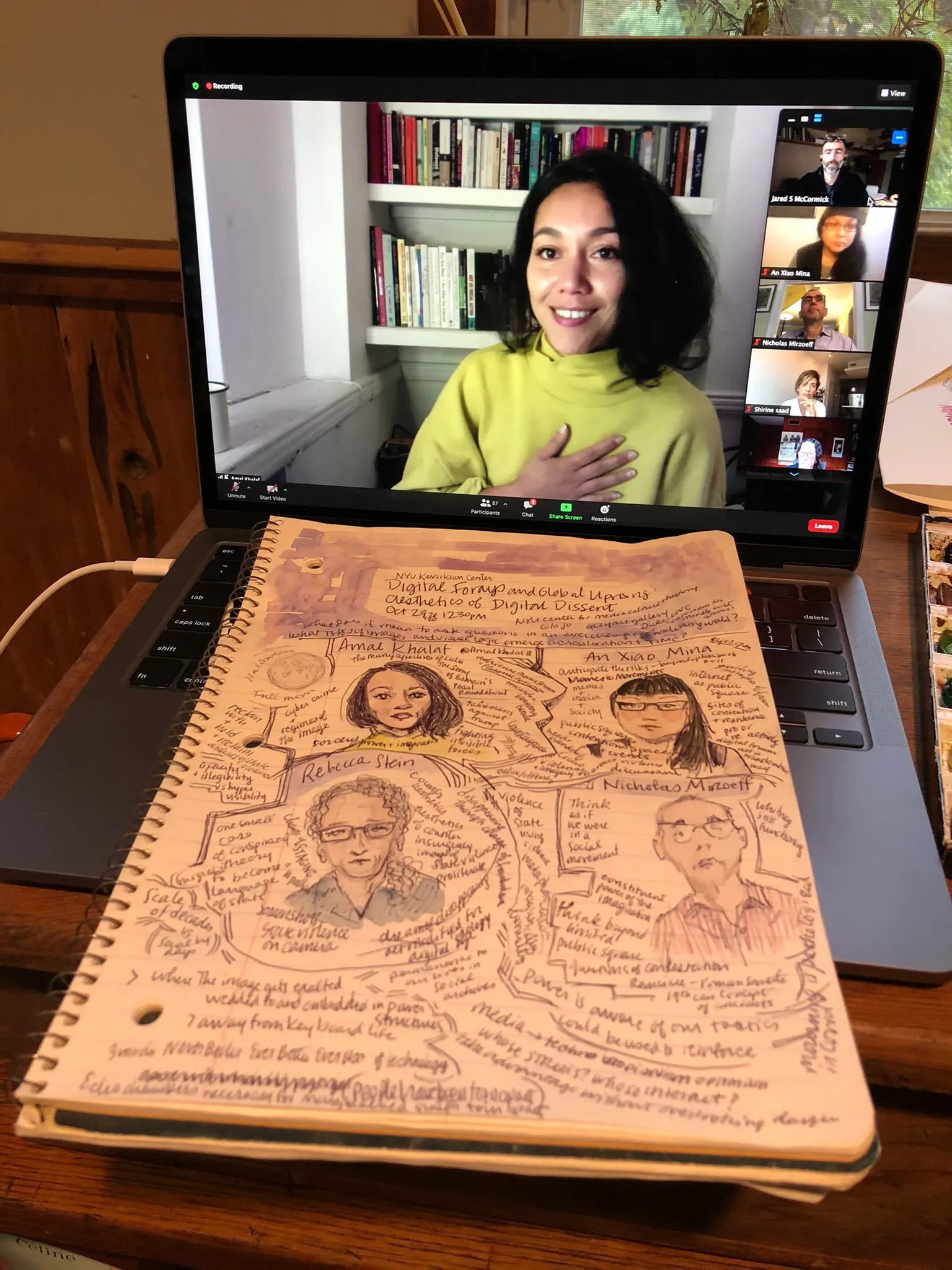
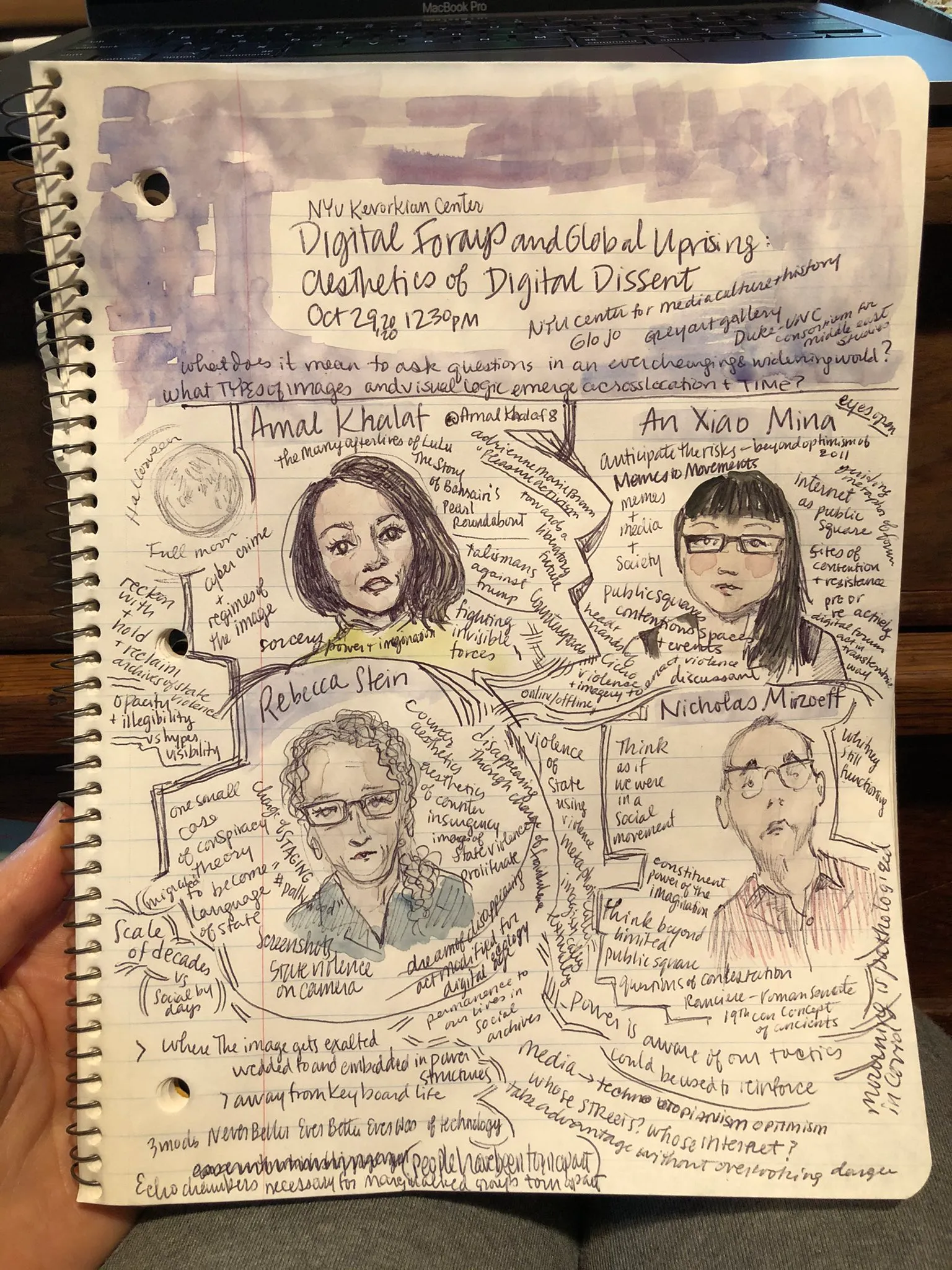
Group PAH
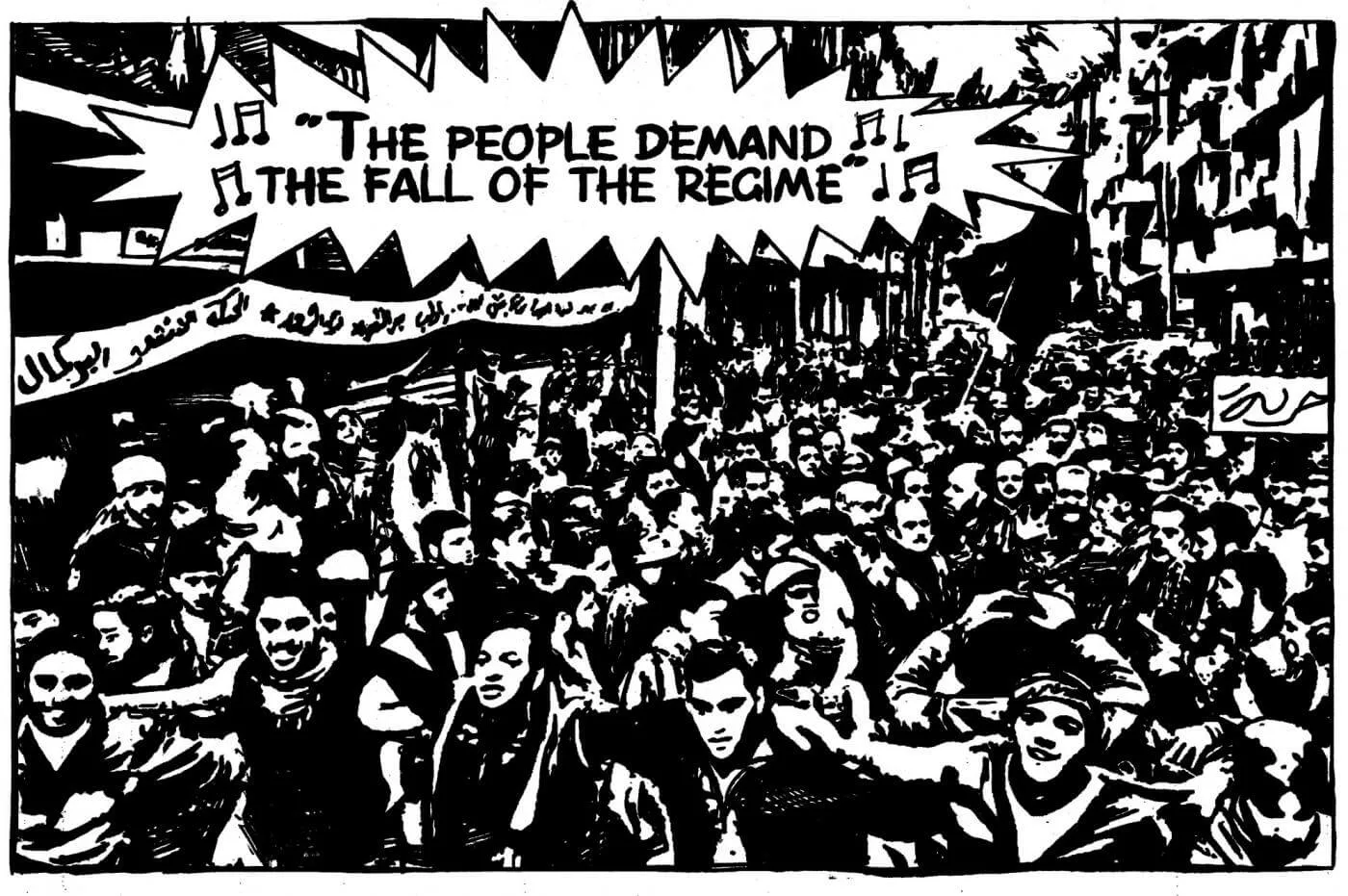
Inspired by the Kevorkian Center’s Aesthetics of Digital Dissent , this extension uses a selection of images to explore the way that protests have been visually documented, as well as the way protest aesthetics have been replicated and co-opted by various actors. Like public space, digital space is not really public, nor is it “neutral,” and the overlapping modes of power that precede the creation and circulation of an image, and that shape the iterations that an image takes on upon its virality, often represent privatized or localized interests.
Nicholas Mirzoeff drew our attention to the state’s ability to reinforce its violence through the appropriation of the very tactics created and implemented by radical social movements. This appropriation is persistent in the realm of visual culture: from protest signs, memes, and Twitter graphics to corporate advertisements. If visual culture is not outside the operations of state violence, it should then be placed within a theoretical framework that interrogates it. While techno-optimism—in its inability to see state violence and the workings of capitalist accumulation—does not offer the necessary framework for understanding visual culture, neither does a model of techno-pessimism that maintains its own short-sightedness; namely an inability to wield visual culture in a way that furthers a radical agenda against the ongoing enclosure of public space, whether those spaces be material or digital. With this in mind, this extension aims to move beyond the binaristic model of techno-optimism and techno-pessimism by drawing inspiration from Amal Khalaf’s discussion of magic, sorcery and spells.
In expanding Marx’s theory of primitive accumulation, Sylvia Federici writes about the systematic violence against women that accompanied capitalism’s development . Social relations were not merely re-arranged and the commons were not merely enclosed; torture, witch hunts, colonization, witch trials, and sexual violence were all foundational to the process of producing subjects “in the image of capital.” The world is continuously being re-made and re-formed in this image. While female sexuality was “exorcised,” in that it was removed from the context of subversion and re-shaped to work in the interests of capital, the imperial state and other repressive formations approach contemporary radical efforts against enclosure by exorcising and appropriating them, or outright suppressing and eliminating them. In this extension we take up “exorcism,” not as an accompaniment to enclosure and appropriation, but as a strategy of exorcising the motives and meanings embedded in images. By displacing images from interpretations that enact violence and co-option we reconsolidate them within their larger histories, with an eye towards what may be made in common.
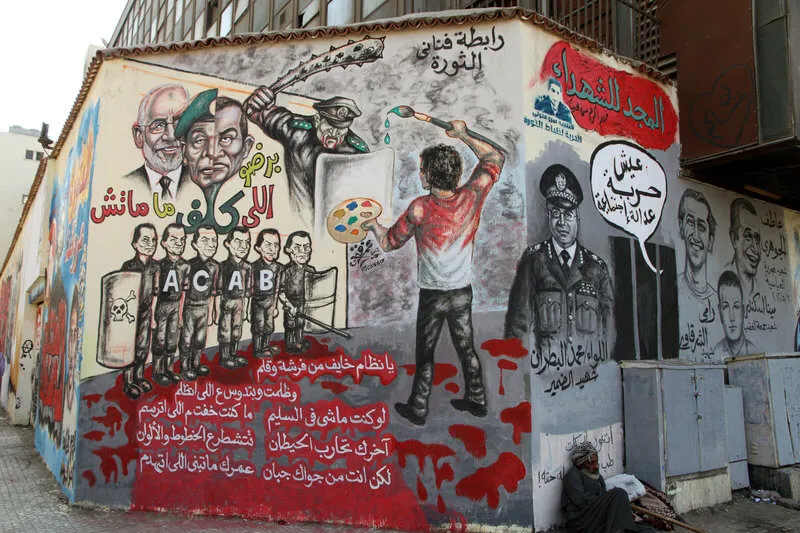
The images we exorcise stem from the United States, Southwest Asia, and North Africa. By grounding the conversations presented in various locations, we question what it means to be “polycentric,” as discussed by Ella Shohat and Robert Stam, in the contemporary moment. Without underestimating the importance of international power disparities, or attempting to divorce them from the ongoing conversation, we are interested in the implications of the digital sphere for the “center,” however it is defined. Rethinking polycenters in conversation with the rapidly developing digital present means complicating the “center” beyond geography and toward a more sociopolitical understanding of the weight of both the digitalscape and the participation of various audiences and mobilizers.
Each section in this piece was written by a different person with the exception of the introduction, which was written in collaboration. Accordingly, each section has a distinct voice. Some have more questions than answers while others found footing vice versa. We invite you to read the sections in whichever order you like as we found different sequences to not necessarily be more fluent than others but rather emphasize alternate notes of the assemblage. Ultimately, we find our harmony in carrying a conversation about the relationship between reality, memory, and digital scapes. We encourage you to read these exorcisms as preliminary considerations toward a myriad of perspectives developing and unsettling themselves with every keystroke and click.
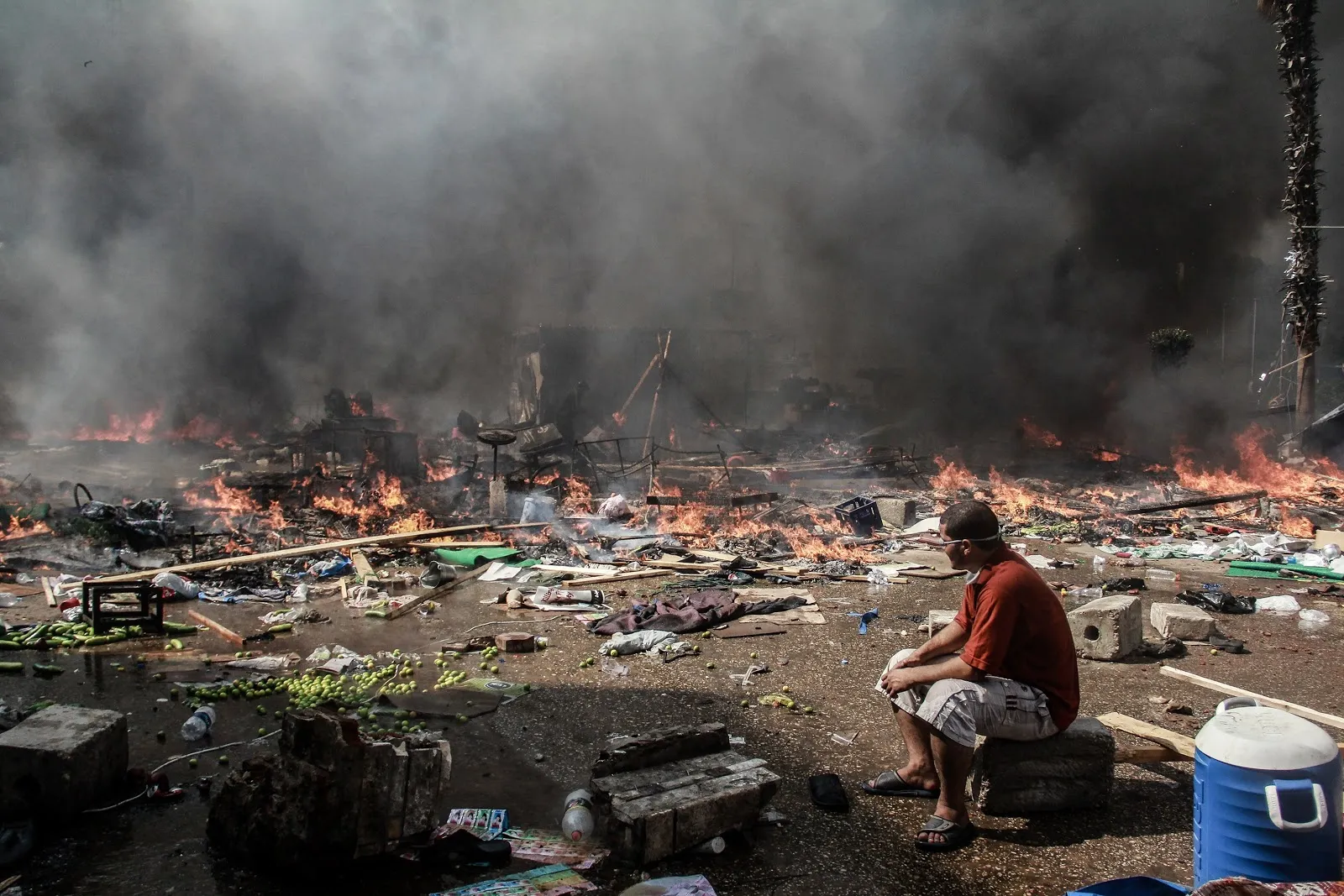
Just over two years after the Rabaa massacre, the square was renamed Midan el Shaheed Hisham Barakat. The announcement came shortly after Barakat’s assasination, on the tails of other manipulations of the square and cleansing of its history: an abstract sculpture that represented the unity of the military, the state, and the people was placed in the intersection; the burned mosque was freshly painted and gated off, indefinitely closed to the public; the roads were smoothed over. Less than a year later, the name of Rabaa al Adawiya mosque itself was also changed to El Shaheed Hisham Barakat. The new names have not stuck, but the specter of Hisham Barakat, the only presence in Rabaa allowed to be a martyr, continues to haunt Egypt.
In August of 2013, what seemed like the worst that the military regime could be capable of was brutally on display at Rabaa. This was the moment when I realized that the worst was soon to become a presence in daily life. The vestiges of the triumphant occupation of Rabaa are just decipherable in this photograph. Cucumbers and lemons that came from one of the many stalls and carts that fed the occupiers are strewn on the ground. Water bottles, clothing, plastic bags, and single use packets of shampoo trace the comings and goings of protestors and what was abandoned in the struggle. The goggles the man in the foreground wears are a reminder of the feeble attempts of protestors to prepare after hearing warnings of impending forcible removal. In truth no one could have prepared for this regime unless we took seriously the absurdity of notions of progress and revolution.
The violence of the military regime was incarnated after Rabaa in the body of Hisham Barakat. Through him, as the judiciary arm of the regime, thousands of dissidents were detained and many were put to death by the state. As I struggle to decipher something through the smoke that looms over this photograph, I imagine it taking on the shape of Hisham Barakat. I cry out to warn this man in goggles that the smoke burning his eyes will remain shrouded over Rabaa, that it had already spread across the country. Even beyond the grave, Barakat is a medium for state violence. Not content with the corporeal violence inflicted on protestors on August 14, the state carried out a cleansing and renaming of public space, followed up by a continuous threat of imprisonment, detention on any grounds, military trials, social media searches, and sudden disappearances.
But there is another spirit implicated in this story, that of Rabi’a al-Adawiyya, for whom the mosque was originally named. Rabi’a, a medieval Muslim woman from Basra, is a Sufi saint who is said to have championed devotion through pure love of God, rather than worship through fear of punishmentor reward. Her spirit was a threat to the regime and Barakat’s name was dispatched to eliminate it.
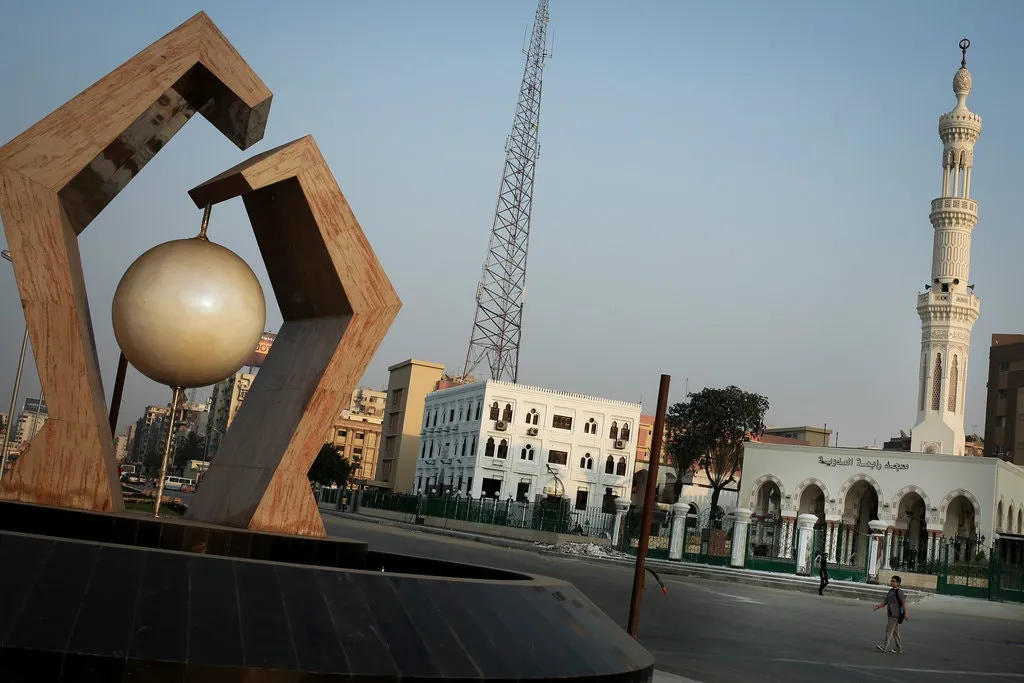
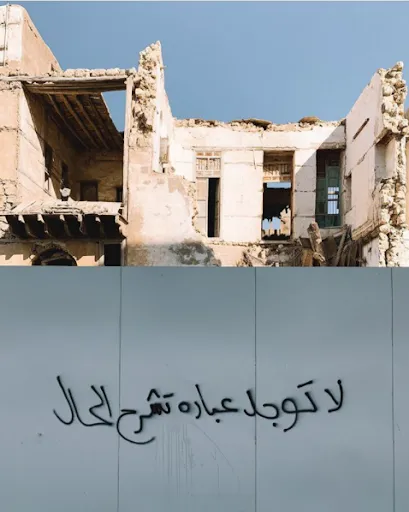
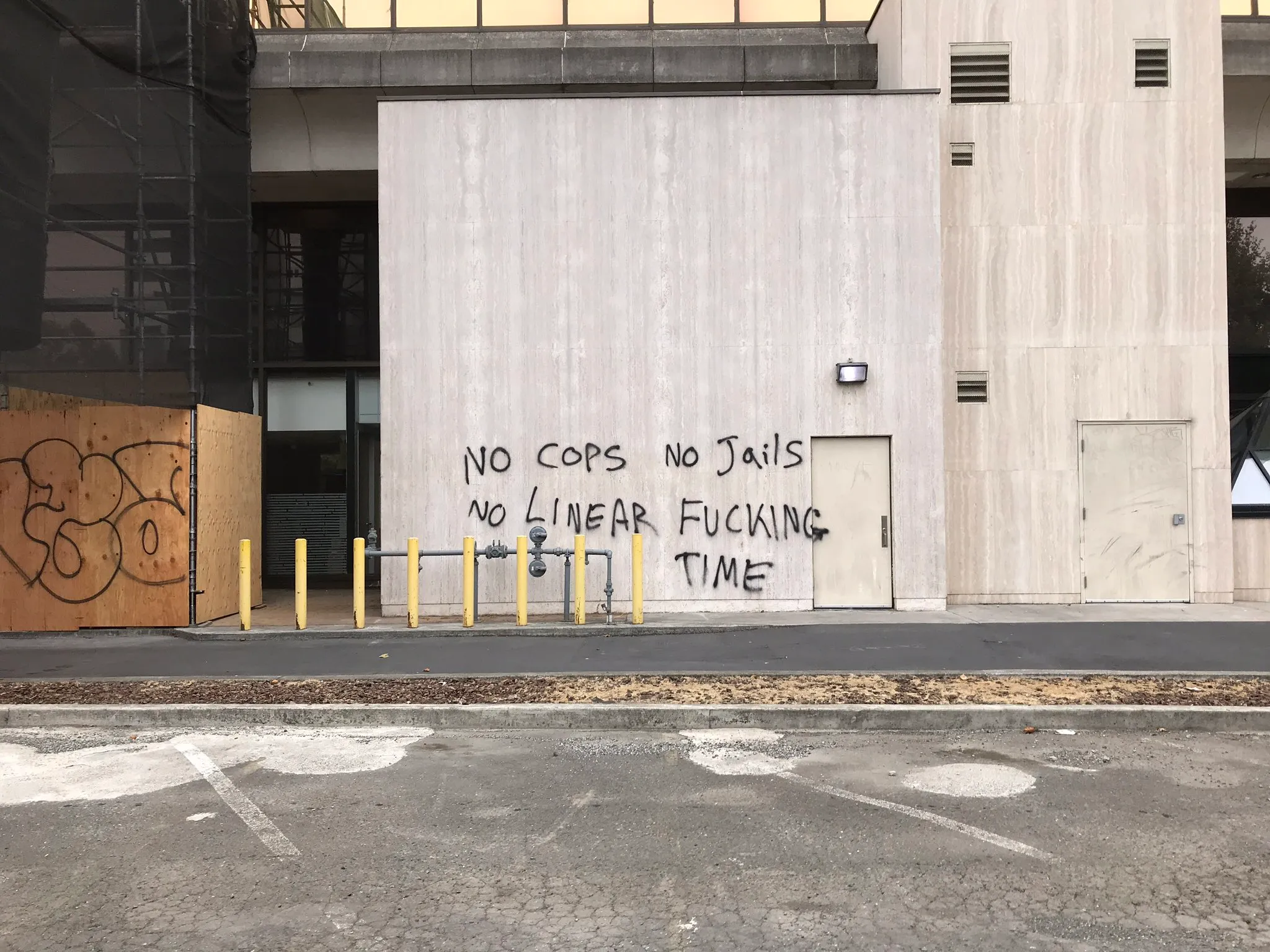
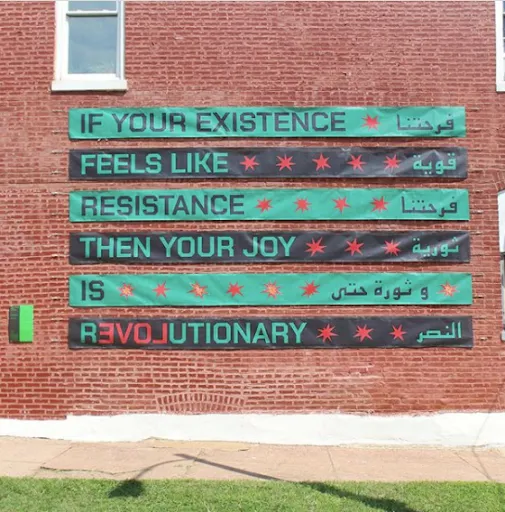
Street art and slogans are bastardized by the state to become transient missteps in a tailored reality. Walls—and public space in general—are supposed to be decorated “appropriately,” in compliance with the image the state curates for itself. Equally as significant, public space can be decorated but not claimed. Space can be pretty, but it cannot be disruptive. Even when they can be pretty, they must be a particular type of pretty that is pleasurable to the “public,” meaning the privileged. Aware of such, neoliberalism creates art that claims to be progressive, revolutionary even! Yet it still operates within the permitted realm; for instance, “girlbosses” and the politicians that embody the idea are touted as emblems of rebellion when they do not actually change anything but the face of power.
As you are reading, I hope you realize what I have realized in the process of writing: there are so many caveats to what is allowed into popular space and conception that the state and its accomplices tailor a particular reality. Living in conditions out of bounds thereby segments life in such a way that existing unashamedly constitutes a significant disruption—what many would consider everyday revolutions. Consequently, it tracks for the state and its accomplices to obscure undesirables out to be almost supernatural.
After all, how do you act when you are no longer real? What credibility does a voice that only comes through in seances under the name of diversity initiatives carry? Most of all, what blood is there to be shed if you are all just ghosts? To digitize and circulate moments of breaking through the now supernatural veil is part of a new method of mobilizing. There is very clearly not only resistance, but full and happy lives in the shadow of the state. Perhaps we do not think of joy and anything more than the bare minimum of survival as only resistance, but perhaps we recognize the disruption it causes while simultaneously understanding that joy lives a life of its own. Digitizing and circulating instances of reclaiming public space reminds us that the state’s supernatural does not only become real in hindsight; it reminds us that we are living history, we are part of an eternal present, and we are quickly becoming our own future.
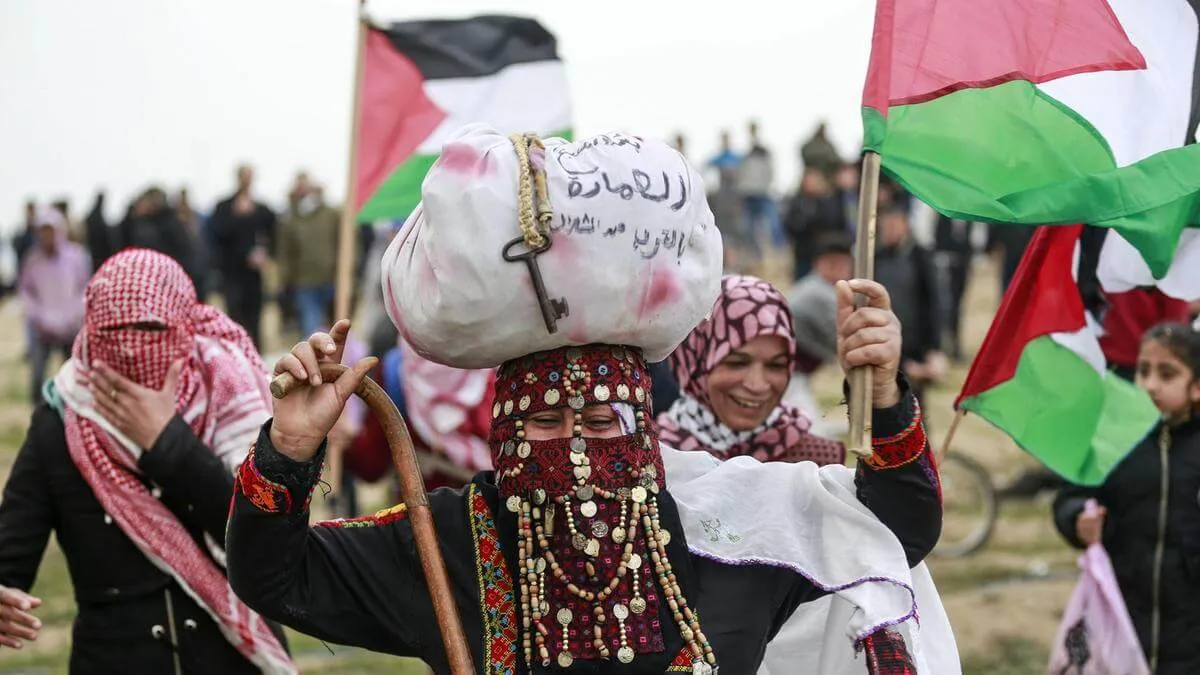
Dr. Stein described the migration of conspiracy theory from the margin (of blogsites) to the center (of Israel’s narration of images of Palestinian death). The video of Mohammed al-Durrah’s murder is a case in point: the state responds by charging Palestinians with performance. In their confrontation with the settler-imperial colony, Palestinians are accused of skillfully executing their very own production: “Pallywood.” It’s as if they have, through deceit and staging, convinced the world that Israel is the bad guy.
Of course, a significant majority of the world does not need convincing. Those not committed to American Zionist exceptionalism know very well that the state tortures, confines, exiles, kills, separates, imprisons, destroys, encloses, maims, assassinates, exploits...and as the list goes on it wages this very violence in digital space. The beautiful Razan al-Najjar was killed by Israel as she aided Palestinians marching for their return. The IDF turned to Twitter & wrote that she was “incited by Hamas to give up her life for their goals.” As Hamas is transformed into a conniving producer and Razan into a manipulated prop, the centrality of return conveniently disappears. What do we do with this colonial narrative and its digital warfare?
Some track the variations and iterations of the state’s management of digital economies. Others feel compelled to respond to the state’s claims, to counter settler aesthetics with “proof,” with more photos of Palestinian death and more statistics to qualify these photos. But what is foreclosed when well-meaning analyses take as their point of departure the terms established by the settler state? What aesthetics of resistance are skimmed over and strategically erased? What modes of knowing are dismissed as infantile rage?
If there is something we call a settler-aesthetic,
what methods of analysis and modes of creation are necessary...
to un-settle it,
to shatter its very foundations?
In A State of Siege , Mahmoud Darwish writes:
“The soldiers measure the distance between being and nonbeing
with a tank’s scope
We measure the distance between our bodies
and mortar shells ... with the sixth sense.”
There are senses imperceivable to the state—forms of knowledge produced & cherished by those struggling against enclosure and siege. The insistence on returning un-settles. It un-settles precisely because its insistence on land unravels the state’s foundational myth, its ongoing conspiracy theories, for what they most fundamentally are: abstractions derived from imperial rot.
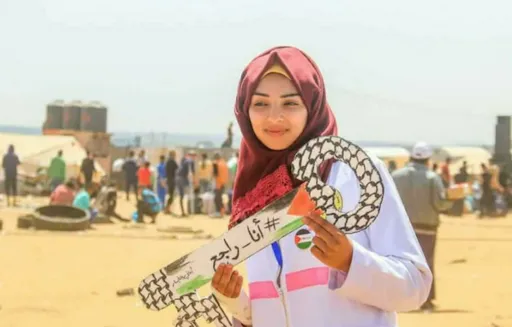
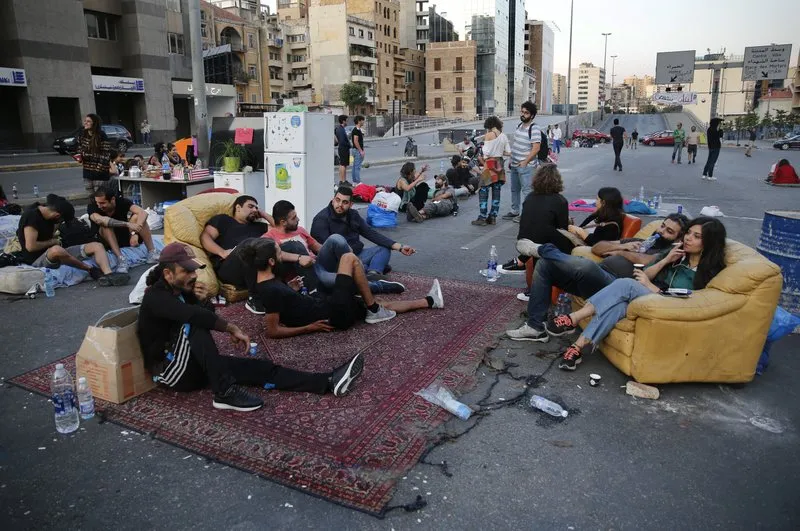
Public space in Beirut is a prime site where Lebanese people face securitization and control over violence by state officials. The environment within which people live is dominated by omnipresent levels of state violence, which interrupt the ideal function of public space. This became even more apparent during the recent 2019 Lebanese protests, when the control of public space became a key demonstration of power between protesters and the government.
However, the intrusion of the public’s conceived space through shifts in the visual order and increased representation of the government’s power on the everyday lived space has occurred throughout Lebanese history. During the Lebanese Civil War (1975-1990), snipers symbolised the state’s violent control over public space. The snipers took aim from buildings such as the Holiday Inn, looking out over areas once used by the Beirut population for leisure. So too did the strongmen wielded by the zayem and politicians perform a role of public control, curtailing freedom of movement and preventing access to public space through threats and violence. Today, the sniper and strongmen manifest in different forms, appearing as security guards, barriers, checkpoints, convoys, and the average valet parking. As well as digitally, through strongly partisan leanings in Lebanese news media, censorship, and paid social media bots and trolls. These mechanisms seek to instill a pervasive psychological fear as violence has become diffused and inherent within the spatial and social order.
One of the most notable gains made by the 2019 Lebanese demonstrations was the activation of the public space’s intended social and political role in facilitating social interaction and forming public opinions that are parallel to the political power. Protesters in Beirut reclaimed highways, squares, and abandoned space in a transgressional manner, overturning the state’s intended function for them and transforming it into another. The resurrection of abandoned and forbidden spaces, like the Grand Theatre and “The Egg”, invited a new generation to engage with the capital’s buried demons as they considered the city's uncertain future. The revitalization of the rigid commercial centers allowed for a reimagining of how space in Downtown could be differently conceived and then lived. And the performance of leisure activities on Beirut’s squares and the highway known as “The Ring”, later renamed the “House of the People”, became a symbolic spatial translation of the political role of the people as the source of decision-making and authority.
Yet, more than a year after protestors first took to the streets, Lebanese authorities continue to deny the people basic social and economic rights, civil rights, protection from non-state armed actors, and even the right to live. Despite the different apparatuses Lebanese authorities employ to curb dissent, people will not stop demanding accountability, repair, and reconciliation. And Beirut’s contested sites offer protesters room to have dynamic negotiation with space and place—conjured and lived, preserved, reconstructed, and always in flux.
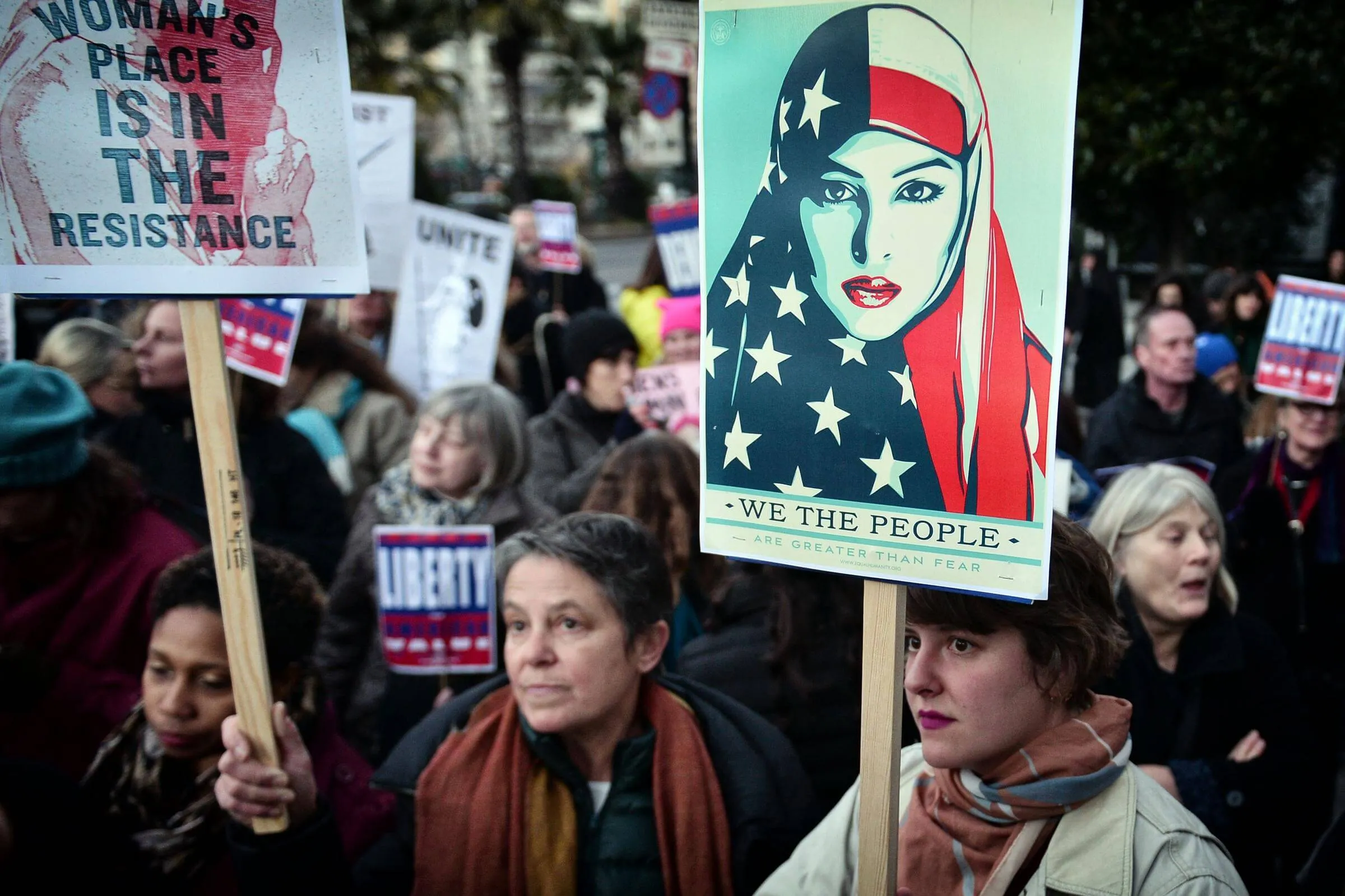
In collecting images of dissent and resistance that had gained prominence in digital spaces, we noticed a number featured flags. Physical pieces of cloth, dyed various colors, imbued with history and meaning by those who claim them and those who oppose them.
An utterly visual symbol, a flag represents an identity, a nation; it represents people. While certain flags are also tied to space, it is ultimately people, within and without, who give meaning to the symbol. In representing people, flags easily become symbols of exclusion—of defining who is in and who is out—as the identities represented are predicated on the exclusion or the definition of the self in opposition to the external other. But who they represent, and who is deemed legitimate, is not clear-cut.
Without borders, certain flags are able to represent visions of the world that are more expansive, that transgress and resist the existing international (dis)order.
Most of the flags observed do not represent states recognized within this order, yet, situated in public space none of them were far off from the pervasive reality of state violence. As An Xiao Mina put it when speaking of the internet—in which the images of these flags have been immortalized and re-mobilized—as a public space: “public squares have always been sites of contention, sites of resistance, but also sites in which power is [...] seeking to control that resistance.”
In the lead up to Canada150 in 2017, the Canadian-Muslim Vote ran a campaign to erect a Canadian flag in front of every mosque in the country. The group, which advocates for civic engagement, saw the initiative as a way for Muslims in Canada “to take strides towards [becoming] a unified and integrated community.” The flag was seen, quite genuinely, as an antidote to the hate crimes and Islamophobia that had seen a sharp increase in the wake of the American election. As if unchecked nationalism—pledging allegiance to a settler-colonial state with genocide on its hands, ongoing broken promises of upholding ideals of truth and reconciliation—was the solution to an epidemic of white supremacy and bigotry that the myth of multiculturalism had fought (not) so hard to cover up.
The 2016 election ignited a particular fear and outrage from a constituency that had not prior felt, or been bothered, by the violence of American imperialism, particularly within its own borders. This fear engendered a performance of collectivity among Americans for whom this was the defining moment of injustice, of inhumanity. The poster of a woman in an American flag hijab surfaced as a symbol of the “melting pot” (that had ostensibly boiled over) in an effort to gesture that difference should not matter. But it does matter, and it is the reason why some people are detained and deported, some people are targets of police brutality and drone strikes, and some people are embraced in patriotic propaganda but threats to national security when they exist and pray . More insidious, perhaps, is the persistence of Islamophobia veiled by this sanctimony. In the words of Iman AbdoulKarim on the tense silence that blanketed the Women’s March in Boston when greeted with as-salamu ‘alaykum wa-rahmatu-llahi wa-barakatuhu: “Why would a crowd carrying thousands of posters and fliers with an image of a Muslim woman in an American flag hijab be made to feel so uncomfortable with such a simple statement?”
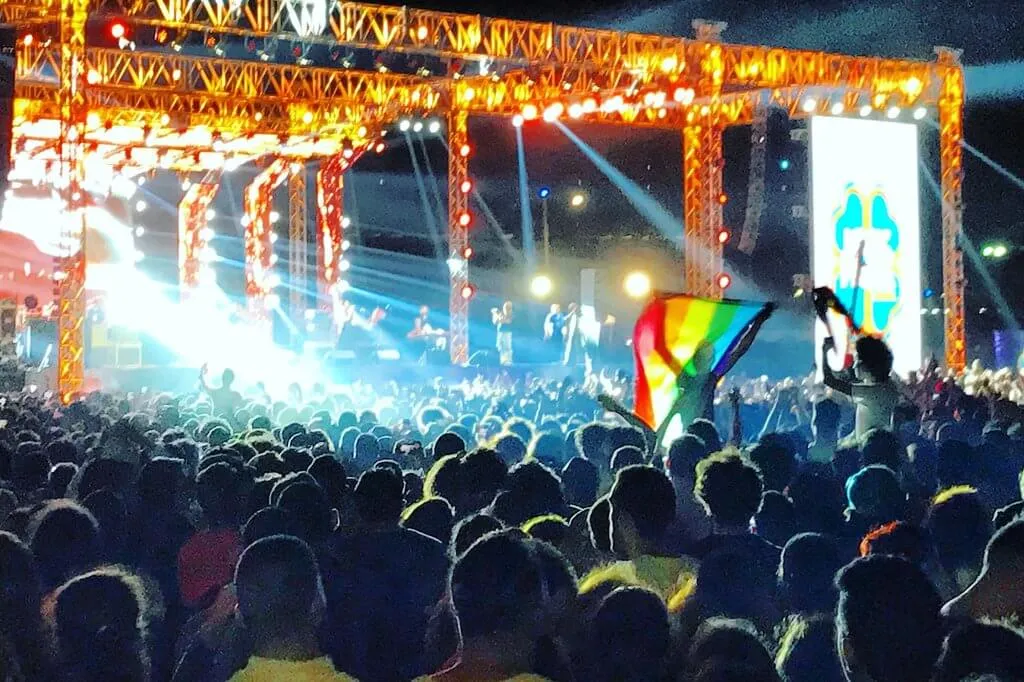
Sarah Hegazi was arrested, detained, and brutally tortured by the Egyptian state for raising a pride flag, at a Mashrou’ Leila concert in Cairo in 2017. A queer activist, a staunch communist, a revolutionary , Sarah’s public expression of joyful resistance to the heteronormative capitalist order, in wielding a rainbow-colored flag, was enough of a threat to the order necessitated by the regime. While the act was public, it was the digital inscription and dissemination of Sarah’s image that led to the violation of her dignity and life. The violence perpetrated by the ostensibly liberatory image was exponential: in her detention, torture, and exile, and the de-radicalization and appropriation of her image/memory after her death.
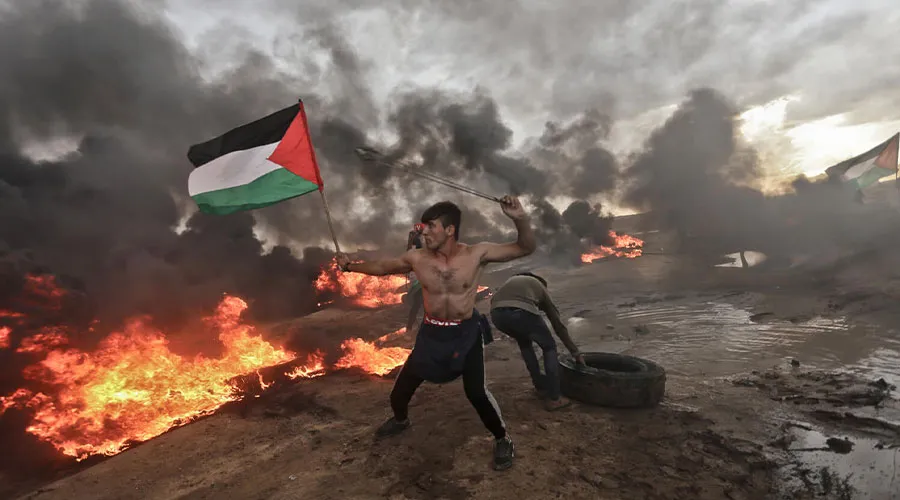
“Our graces are white,
our battles are black,
our meadows are green
and our swords are red."
-Safi al-Din al-Hilli (d. 1349)
What we recognize today as the Palestinian flag was the flag of the Arab revolt against the Ottomans in 1916, and it was one of at least three motifs proposed to represent the Palestinian identity. According to Tamir Sorek , the four-colored flag was victorious as its competitors represented the interests of a few, were disconnected from revolutionary moments, and lacked historical relevance. During the March of Return (2018-2019) and acts of resistance prior, the flag, which is far older than the occupation itself, was ubiquitous. Even though it has been symbolically recognized and permitted to fly alongside that of its occupier’s, the power of the flag lies in its incessant reminder of the resistance of those it represents, of those who claim the struggle, in the face of the ongoing violence of apartheid and dispossession.
A white supremacist state, America was built on genocide, stolen land, and the violence of enslavement. From 1861 to 1865, the Confederacy was characterized by a desire to uphold white supremacy and the institution of slavery. In 1961, the Confederate flag was raised outside the South Carolina statehouse in opposition to the civil rights movement. Reflecting on scaling the flag pole and removing the flag, artist and activist Bree Newsome stated: “When the Confederate flag came down people were like, ‘Oh, man. We won.’ It’s this victory and it feels really good in that moment. It is a victory, but we still got a lot more battles to fight. We just got to pace ourselves.”
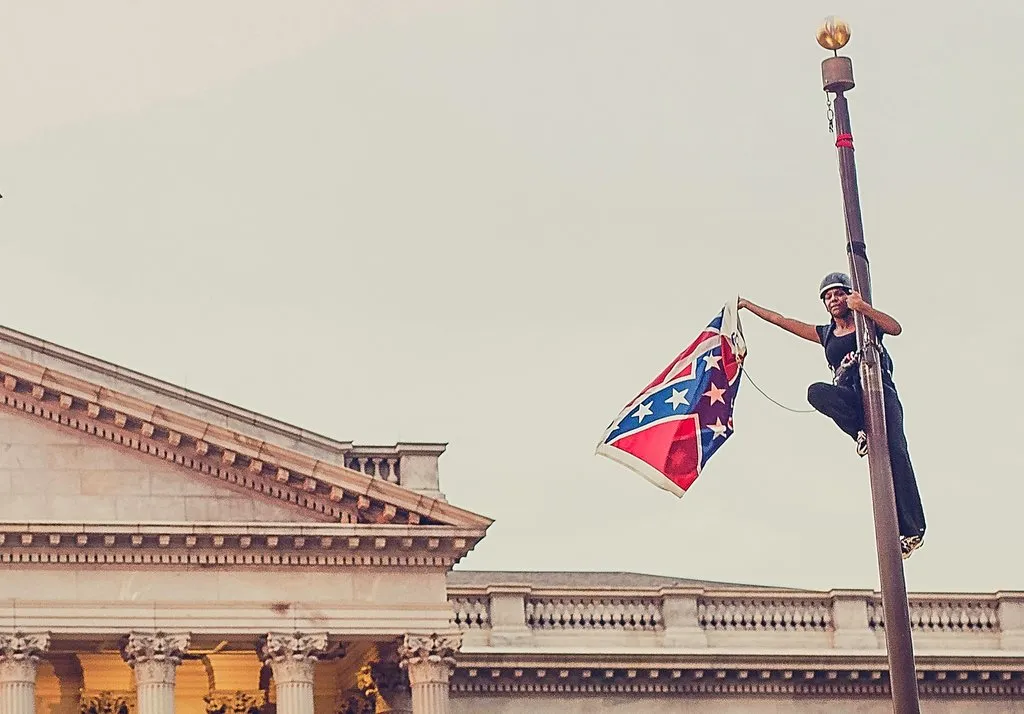
In the opening scene of Ariana Grande’s “Positions” music video , released on October 23rd of this year, we are presented with Ariana Grande’s version of the Oval Office. She sits at the head of the table, channeling the ghosts of first ladies past in white gloves and a matching pillbox hat, and surrounded by a “Cabinet” of attractive, diverse people—including a hijabi, a Black woman in braids, a queer person in a manbun, etc. Although the portrait of one of Grande’s dogs in the background underline the fact that this is a spoof, the careful liberal optics of Grande’s Oval Office, coupled with the celebrity’s well-known voting registration efforts , send a message about the limits that such a celebrity and her team (including millionaire director Dave Meyers) can offer in terms of our imagined futures. In Grande’s White House, six-inch heels are allowed on the table, and foreign wars are orchestrated by women of color and queer people.
While this pop culture example is not as immediately offensive as other, more poorly executed corporate attempts to co-opt the aesthetics of political dissent—for example, the infamous Kendall Jenner Pepsi ad of 2017, in which Jenner crosses the picket lines of a protest to offer a cop the drink in question—it is still part of a circulation of images that invoke the talk of resistance without walking the walk. Or perhaps more gravely, judging from the media pushback on the Jenner ad, and the lack of discourse around the Grande video, talking the talk wrong. If Jenner had joined the protest, in which swarms of diversity carried hilariously vague signage (prominent signs read “Peace,” “Love,” and “Join the Conversation” written in multiple languages), the ad would not have made a mark on the media landscape. Perhaps the inclusion of the obligatory hijabi—in the case of the Pepsi ad, the diversity-signifier is a photographer and not a politician—would have instead inspired some tweets of admiration about the power of representation.
Foucault warns us of the ability of language to obscure, and it has since become clear that digital images have the power to do the same, if not with more detrimental effects due to their ability to circulate instantly. When capitalism invokes the language and imagery of resistance to perpetuate itself, it strengthens its own project while making resistance weaker (compromising the signifiers attached to it, like protests). Another theoretical parallel here can be made in the world of prison abolition. Ruth Wilson Gilmore draws a distinction between the prison reforms she seeks to problematize (reforms that seem meaningful but actually help perpetuate the carceral system) and “non-reformist reforms” (reforms that materially help achieve a prison-free future). In a similar vein, we should perhaps draw a distinction between resistance as optics, and resistance as material (i.e. resistance that necessarily threatens the capitalist system.)
RESOURCES
Audio
Social Media
If social media was hailed as crucial to the start of the Arab Spring, what has the last 10 years brought in terms of increasing cellphone connectivity, usage, and entwinement in our lives?
A flood of research pinpointed changing digital access/practices as linchpins of the Arab Spring (perhaps overly simplistically, or correct) - but what is our perspective looking back over the last 10 years?
How do/did we archive the “Arab Spring” and the other swells of protest and dissent across the region? Looking back on what/how we “save,”what do we learn about documentation, memory and access? The speed, scope, and prevalence of various technologies has expanded exponentially, yet how are we activating/archiving current protests as they now occur?
This panel looks back on many connected waves of protest, but also zooms out to our global present to explore dissent, smartphones, and the digital ephemera that overflow from an ongoing Global Uprising. What does this tell us about the current moment - but some future direction of digital visuality and digital dissent.
.
Omar Al-Ghazzi is Assistant Professor in the Department of Media and Communications at LSE.
Jasmina Metwaly is an artist and filmmaker based in Cairo and Berlin, and a member of the Mosireen video collective.
Isra Ali is a Clinical Assistant Professor in Media, Culture, and Communication at NYU Steinhardt and a feminist scholar who writes about militarism, citizenship, Islam, and culture. Her current project looks at how Muslims engage the question of citizenship online, in the era of War on Terror militarism.
Marie Grace Brown (PhD, University of Pennsylvania) is a cultural historian of the modern Middle East, who specializes in questions of gender and alternative historical texts. Her award-winning first book, Khartoum at Night: Fashion and Body Politics in Imperial Sudan (Stanford University Press, 2017), argues that Sudanese women used fashion and their bodies to mark and make meaning of the shifting sociopolitical systems of imperial rule. Continuing her interest in sensory experience, Brown’s current project, Sex on the Edge: Adventures in Romance in Imperial Sudan , claims that romance and play were dynamic means through which individuals understood and moved across the British Empire. Her research has been supported by the American Association of University Women, the Social Science Research Council, and the Woodrow Wilson National Fellowship Foundation. Brown is an Associate Professor in the Department of History at the University of Kansas.
This event was part of the Fall 2020 course: Problems and Methods in Middle Eastern StudiesA joint Digital Forays and Global Uprising event
Caught the top of @GloJo_NYU, @nyugrey & @DukeMideast for, "ARCHIVING A REVOLUTION: SMARTPHONES, SOCIAL MEDIA, & PROTEST w/ @omar_alghazzi (@MediaLSE), @benthanaa (@mosireen), @IYAli (@nyu) & discussant Marie Grace Brown (@Penn). Thanks, @nyukevo! #jojodoodles
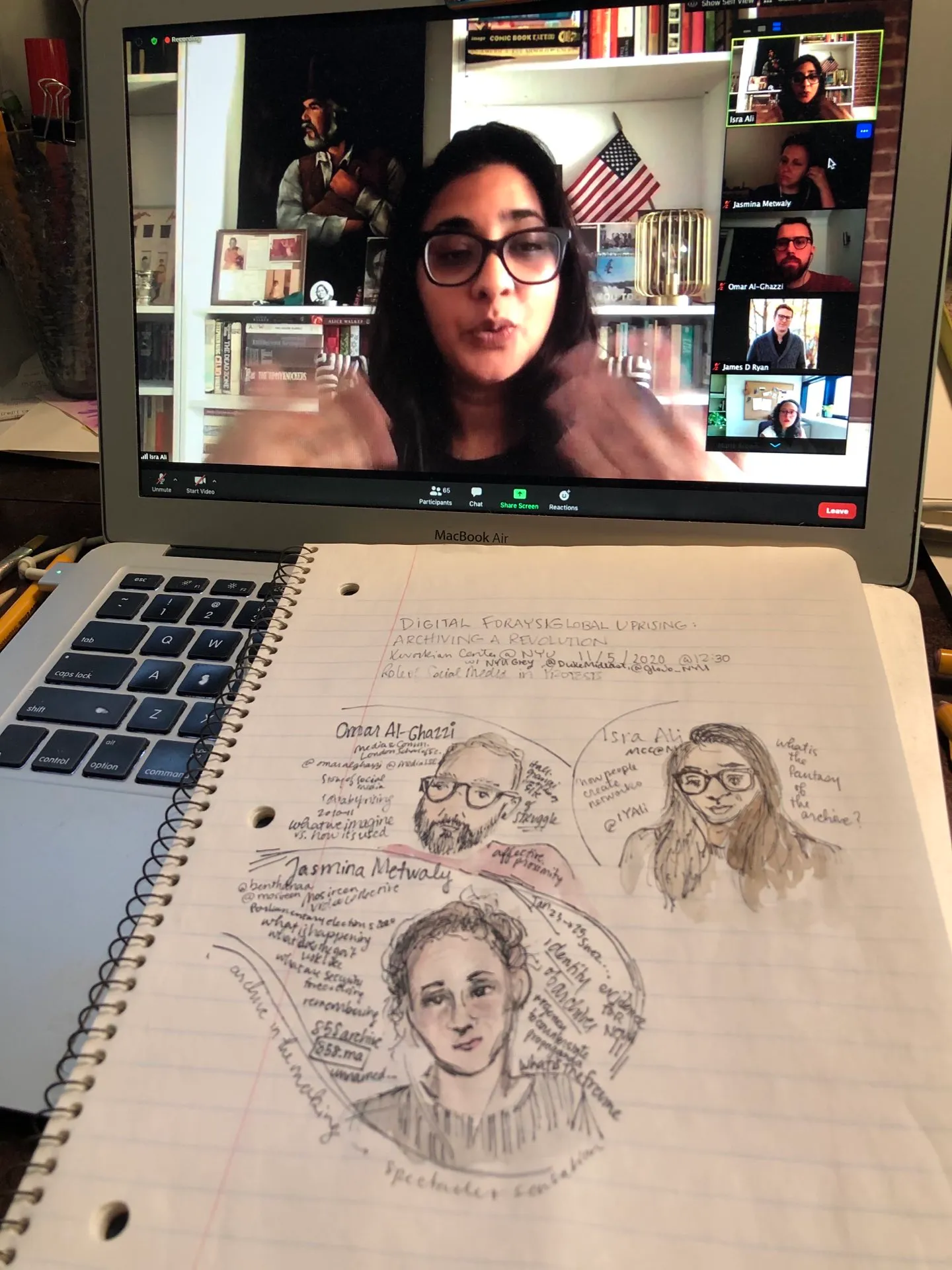
Group Saffron Vesper

Doge.
Grumpy cat.
Distracted boyfriend.
Tide pods.
In the digital era, it has become nearly impossible to step onto a social media platform without coming across a meme. Whether a cleverly captioned image on Instagram or a satirical clip on Tik Tok, the internet meme has become a universal phenomenon that allows people--regardless of distance or social boundaries--to make sense of, poke fun at, or speak back to a particular cultural moment. In this way, memes have come to serve two fundamental purposes: they are a form of participatory practice that has facilitated increased access to public discourse, as well as a tool for the meaning-making and negotiation of these very discourses.
What is a meme and where did it come from? Richard Dawkins first coined the term in his 1976 book, The Selfish Gene . Dawkins defines the meme as an emerging unit of replication - the cultural equivalent to a biological gene - whereby ideas or practices are transmitted from person to person in a process of evolutionary change. He says “Just as genes propagate themselves in the gene pool by leaping from body to body via sperms or eggs, so memes propagate themselves in the meme pool by leaping from brain to brain via a process which, in the broad sense, can be called imitation” (192). In simple terms, Dawkins’ meme is a spreadable idea.
How does this definition compare to what we think of today as an internet meme? Is a meme anything that goes viral? Shifman (2011) differentiates between viral content and memes: the former is something propagated from one person to another with little or no changes, while memes are altered through combined elements of imitation and “remix,” or alteration. Goriunova (2013) defines the internet memes as follows: “memes are digital images, often superimposed with text (known as an image macro), separate pieces of text, formulaic behaviours, animations and sometimes memetic hubs of videos (a viral video is not necessarily a meme unless it exhibits memetic features) which emerge in a grass-roots manner through networked media and acquire a viral character, becoming globally popular.” She posits that a meme owes its virality to two factors: its universality and its changeability. A meme only becomes popular if it can move through and be consumed by a diversity of online channels and contexts; concurrently, the meme must be adaptable and shapeable. In this way, Goriunova sees the meme not just as the object being shared, but as the human behavior or performance of sharing and adapting the content on a widespread, diverse scale. The meme’s very essence is how it is individualized by whoever creates or recreates it. By this definition and in concurrence with Shifman’s work, a meme is always viral, however viral content is not always a meme.
How are memes situated within the broader context of digital culture? Internet memes began circulating in the 1990s as more people started using the internet; by the 2000s, memes had become widely popularized, especially on sites like 4Chan and 9GAG ( Denisova 2019 ). What began as expressions of comedy, entertainment and parody have expanded to include any and all kinds of social and political commentary. Memes are remarkable both in their ability to exist and pass between various online spaces, and their capacity to bridge diverse contexts and narratives ( Esteves and Meikle 2015 ). The intertextuality of memes has become increasingly apparent: seemingly extraneous memes will relate to one another in complex and humorous ways (across cultures, languages, etc.), adding to political and cultural commentary and mixing dialogues (Shifman 2011). Memes are not merely a new medium of communication: they have become a genre of digital culture that operates with its own rules and behaviors which challenge the classic consumer-producer binary ( Wiggins 2019 ).

As the internet meme has increased in popularity since its inception in the 1990s, so, too, have the sources of content through which they pull inspiration from.
Perhaps the most unlikely candidate for proliferation by the humorous pop-culture phenomenon, politics, has in recent years been the meme’s most popular (and influential, for better or for worse) target. Indeed, with the onslaught of two “firsts” in the 2016 election cycle--the first female and first reality-TV star nominees for major political parties--the online community soon found the novelty of the race for the presidency to be a goldmine for memes . Politicians themselves, catching wind of the meme’s popularity with younger generations, used it as part of their marketing strategies; after a photo of Clinton wearing dark sunglasses and holding a Blackberry phone became a viral meme in 2012 (even getting its own website, “ Texts from Hillary ”), the former Secretary of State made the photo her Twitter icon during her campaign. Trump, on the other hand, was retweeting memes created by alt-right supporters. Whereas politics was once considered highly inaccessible to young adults, they now had an outlet for political expression--and their opinions held stake.
The enhanced notoriety of internet memes within the political sphere has led to a growing body of research in which academics debate their implications not only on the candidates themselves, but also the people they seek to represent. Questions of concern range from whether memes play a role in reducing the legitimacy of presidential nominees (Ross and Rivers 2017) to the dangerous potential of memes, as inherent modifiers of original content, to exacerbate the spread of misinformation (Bauckhage 2011). To this end, the 2020 election cycle was proof that political memes had not only advanced in numerical scale, but also in reach and influence. For perhaps the first time, young people across the globe, and particularly in the Middle East, were engaging with the outcome of an American election using culturally-specific references. The questions guiding our group’s inquiry into political memes, then, are specific to this multilateral phenomenon:

A friend sent me this. Apparently I made the cut as one of the Deplorables😂😂😂 All kidding aside I am honored to be grouped with the hard working men and women of this great nation that have supported @realdonaldtrump and know that he can fix the mess created by politicians in Washington. He's fighting for you and won't ever quit. Thanks for your trust! #trump2016 #maga #makeamericagreatagain #basketofdeplorables

1. To what extent do memes make American politics accessible to other parts of the world?
2. What do the memes that people abroad have made about the 2020 election say about their thoughts on the presidential outcome, specifically, and U.S. foreign policy in general?
3. What particular social media platforms are used to share political memes and what might be the significance, if at all, of these mediums?
4. What might the ephemerality of memes suggest about the potential for impact of political memes on domestic and global civic participation?
Our interest in memes, and the questions they inspired, cull from the November 5th joint Digital Forays and Global Uprising event, “Archiving a Revolution: Smartphones, Social Media, and Protest,” with Omar Al-Ghazzi, Jasmina Metwaly, Isra Ali, and discussant Marie Grace Brown. As the panelists examined the role of social media in the ways we experience and archive protests, we were particularly struck by Ali’s comments about the communal nature of archives and the role users have in taking ownership over particular narratives through their digital interpretation of events. Specifically, she suggests that the onslaught of phones has made it possible for archives to move across space and time, where they are no longer sights that must be visited but rather ones that come directly to us. In this vein, archives are increasingly dependent on the digital platforms whose users now have the power to circulate information through “informal and non-institutionalized” ways. She offers Muslim youth’s creation of memes about their experience as antagonized minorities during the “War on Terror” era as an example of the ways in which people can speak back to, and even mock, existing narratives.
As prolific consumers of memes ourselves, and the timely overlap of the presidential election with this panel, we were interested in analyzing Ali’s ruminations about archives and social media against the digital narratives circulated during this consequential political event.
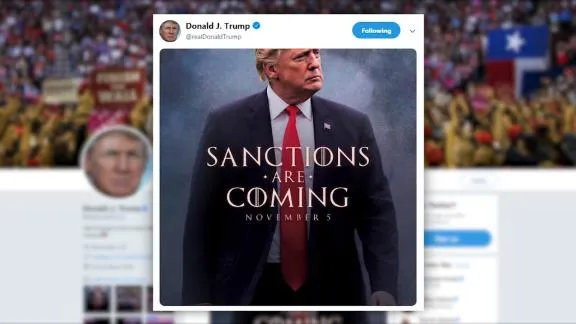
Memes, alongside their production and consumption, change banal reality into a fictionalized existence. Trump is a uniquely "memable" president, not only by literally a Game of Thrones meme when declaring the American withdrawal from the JCPOA , but also that he has had many moments that cross into the absurd. Take the infamous "glowing orb" photo , where Trump joined King Salman of Saudi Arabia and President Abdel Fattah el-Sisi of Egypt, in the opening of a new anti-extremist center. This appropriately generated endless discussions and image macros about its symbolism.
Yet this method of interpreting politics has exceeded Trump as well. Take Biden's statement of "inshallah" during the presidential debate . Endlessly debated on Twitter until the Biden campaign confirmed it, scholars, activists, Twitter pundits all piled on to offer their own interpretations of what it meant and the implications. Without meme culture, it's likely that Biden's usage would have been seen as something unique to the gaffe prone candidate. Yet the alacrity and the reach allowed the meme to exceed the original, suggesting that scale and speed are the two most important factors of a meme.
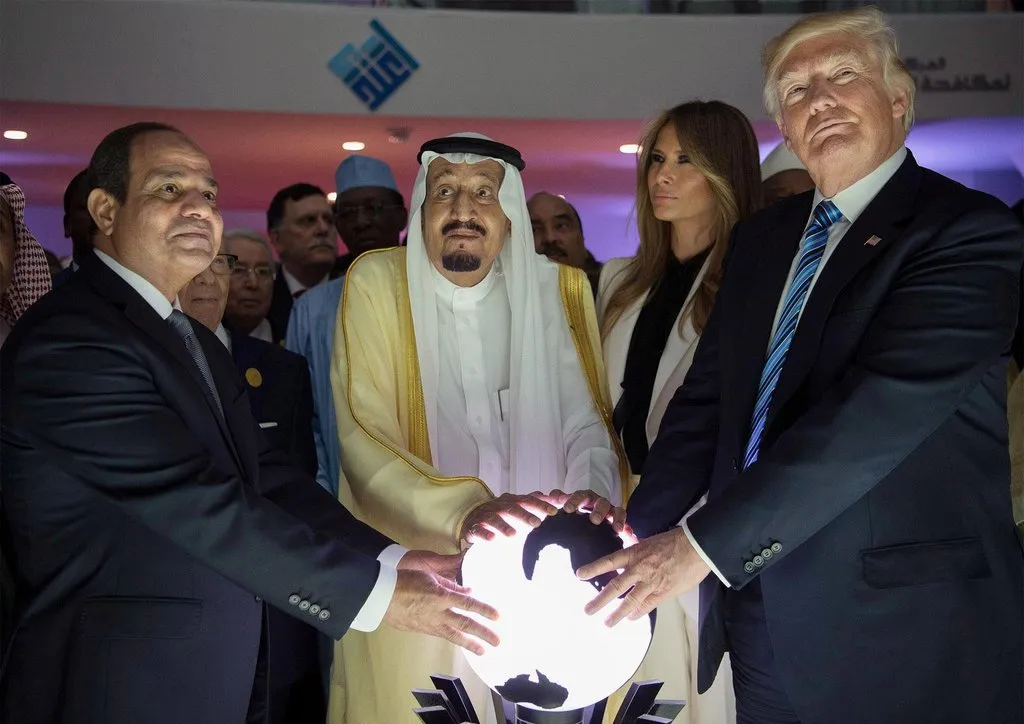
The production of memes is an inherently artificial process. This is not to say that the creativity behind memes are artificial, but rather they are artificial constructs and rely on a distinct "original". Memes are always about this "original", but add rich context. The humor of memes then arises from this context. It is unremarkable, for example, that a US president visit a civil service center in Riyadh, but to do it with King Salman, Sisi, and for that US president to be Donald Trump? The context here is the history and ideology of these three men, and it is the fusion of this context with the image that gives the meme its humor. Irony is created when the emotional, historical context fails to align with the rational reality. This is why humorous memes are almost always ironic and difficult to manufacture, the image macro and video itself are technically simple, but the ironic framing gives the meme its potency.
This compression of information into a single, low-quality image is what makes American politics so digestible. Non-Americans would never suffer through seasons of West Wing or House of Cards, but a single image is digestible. In this way, memes become universalized and transmitted, every day on the campaign trail becomes compressed onto a single tweet. The election, although in reality is a polarity contest between two parties, finds new life and new audiences through the meme as an interpretive structure.

To understand how foreign countries made the 2020 U.S. election legible through the meme, we can turn to Iranian Twitter as our case study.
To understand how foreign countries made the 2020 U.S. election legible through the meme, we can turn to Iranian Twitter as our case study. Iranian social media users were self-conscious about their political proximity to the course of the U.S. election. They knew the stakes were high: The Trump administration terminated its participation in the JCPOA in 2018 and implemented a stranglehold regime of sanctions which has gravely injured economic life in the country. Iran’s currency has plummeted and its oil revenues have contracted. Access to medications from Tylenol pills to chemotherapy drugs is scarce, as the United States continues to block vital imports. Basic goods have become too expensive across the country, as fruit sellers in the poorer neighborhoods of Tehran now stock discount aisles of rotting fruit for those who can longer afford fresh produce . Both state officials and regular Iranians looked to the 2020 election, and the possibility of a Trump defeat, as a potential lifeline.
As votes were being tallied in the United States, Iranian Twitter users discussed the election in nervous anticipation and excitement. Memes, unsurprisingly, emerged as some of the most noteworthy and effectively circulated content within the U.S. election discourse in Iran. The meme allowed for Iranian users to interpret and communicate their feelings concerning the election through humor—humor sometimes mocking, sometimes dark, always situated within popular culture references with wide currency among those who circulated them. To Iranian users, the meme made U.S. politics legible in the days following November 3 legible. These users hinted at the bitter humor of their investment in an election so far away, and they understood the anxieties of their own geopolitical situation vis-à-vis the turmoil ensuing in the United States.
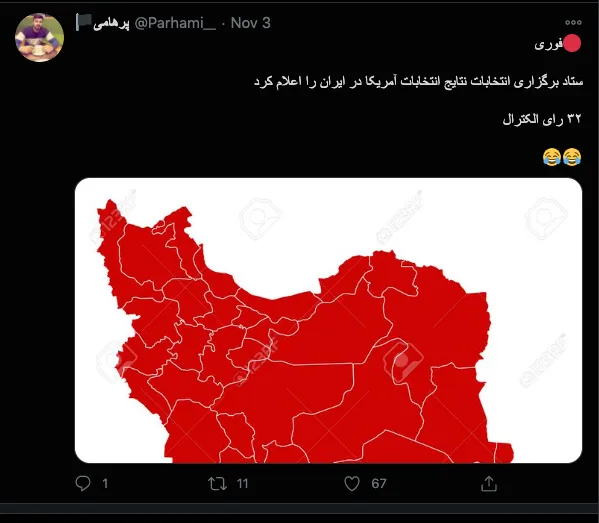
Many of the memes expressed optimism in the face of the high stakes of the U.S. election. The perceived importance of the outcome of the election led Iranian users to quickly acquire an intimate knowledge of U.S. electoral politics, and some poked fun at the American system’s antidemocratic distribution of electoral votes. Highlighting Iran’s investment in the outcome of the U.S. election, as well as his amusement with the electoral college, one user tweeted a monochromatic map of Iran’s provinces, joking that Iran’s 32 electoral votes had been called (see the image to the right).
After Biden had been declared the winner on November 7, Iranian users produced memes communicating their excitement and optimism for the future. One meme producer likened the magnitude of Trump’s defeat to Mohammad Reza Pahlavi’s famous departure from Iran during the 1979 revolution, after which a celebrator famously held up the newspaper headline reading: “The Shah has gone.” In this meme, the newspaper headline reads: “Trump has gone" (see below).
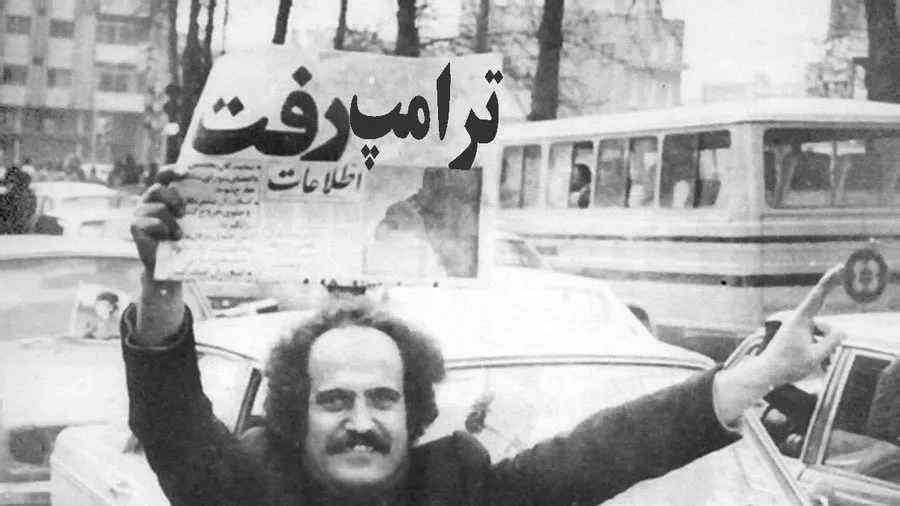
Another user turned Trump’s November 2018 Games of Thrones-inspired “Sanctions are Coming” meme against him. Here we see a side-by-side version of the meme with the text under Javad Zarif, the Iranian foreign minister and negotiator of the JCPOA, reading: “Sanctions are Ending.” The Trump administration’s belligerent approach to Iran had marginalized Zarif, who was now expected to bring about a renewal of diplomacy with the Biden administration. It remains to be seen how feasible the re-opening of diplomatic channels will be in the aftermath of the assassination of Mohsen Fakhrizadeh, Iran’s chief nuclear scientist.
Some took Trump’s defeat as an opportunity to mock him, achieving some catharsis for the past four years by poking fun at the man perceived on the international stage as a self-serious bully. Here Trump is portrayed as dutifully preparing nazri, or food distributed to guests with the intention of attaining religious blessings, in the hopes of salvaging victory in the face of inevitable odds. Melania Trump is also present, dressed in a black chador, helping decorate the sholeh-zard (saffron rice pudding). The meme translates Trump into terms legible within the Shi’i Iranian discourse, with the humor stemming from the irony of his positioning therein.
The meme above references the American film The Matrix and its concepts of the “blue pill” and “red pill,” respectively. It has become a common trope in English-language popular culture that “taking” the blue pill amounts to maintaining one’s blissful ignorance, whilst taking the red pill brings one face to face with harsh truths, which are a deliverance to a higher state of understanding. In this meme, “Iranians” seemingly are offered the choice of the blue and red pills, with blue representing Trump and red representing Biden. Taking the blue pill would yield more misery. But the red pill, the meme explains, would also bring about the same misery but this time with a strawberry flavor. The meme’s author alludes to a broader historical understanding that conditions in the Islamic Republic have suffered under both Democratic and Republican administrations, and that the arrival of Biden cannot be seen as a panacea, as Obama’s was in some circles 12 years earlier. Biden’s victory, then, offers only a superficial remedy to the country’s structural ailments.
The frustration conveyed in this Matrix meme is comparable to that within the November 24 viral tweet that read: “Would be kinda cool if Biden never actually did anything but instead just tweeted shit like ‘We are the people. This is us. This is America. We are back.’ for the next four years straight.” Under the cover of platitudes and identity politics, these tweets suggest, promises of real change will go unfulfilled by the self-celebratory Democratic elite.
One meme expresses such pessimism through religious imagery, depicting Biden in the embrace of what is assumed to be a bloodied Imam Husayn, the third Shi’i Imam whose martyrdom at the hands of the Umayyad caliph Yazid in 680 is publicly commemorated in Iran every year during the month of Muharram. The caption here also mocks viewing Biden as a panacea for Iran’s troubles. It reads:
Miraculously, one week after America’s elections and the ascendance of the old man [Biden], the Coronavirus vaccine has arrived and been approved by the World Health Organization, Nasrin Sotoudeh [the Iranian activist] has been released, the price of the dollar keeps falling, racial discrimination is fading away as blacks are being seen as whites, and I also think that the Mahdi [Messiah] is coming this Friday, what a turn of events!
The caption tries to capture a number of the social problems ailing Iran and the globe in sequence, with that sequence devolving into the absurd by its end. Biden’s victory, the meme caption artist suggests, is being seen in Iran as a triumph of sacred magnitude, with appreciation for the president-elect seemingly elevating him to the status of Shi’i sainthood. His election, he muses, is being seen as solving all of Iran and the world’s problems, from the COVID-19 pandemic to political imprisonment to economic crisis to global racism. The excitement is so pervasive that the meme artist likens it to anticipation of the return of the Twelfth Imam, a central doctrine in Twelver Shi’ism. Being that excitement, however, is a certain naïveté that the meme cautions against.
These memes provide a snapshot of political sentiments among Iranian Twitter users in the days following the election. They circulated within Iran on Twitter as well as other platforms, such as Telegram and WhatsApp. And they certainly made their way through international networks to members of the Iranian diaspora, including in the United States, attentive to the significance of the U.S. election for their perceived homeland. These memes gained so much traction that they were picked up by prominent outlets, including Ajam Media Collective, whose goal is to challenge conventional media perceptions of the Middle East in Euro-American discourse. The Washington Post also published a story about foreigners understanding the U.S. election through memes; their article foregrounds the Iranian coverage while underscoring the political stakes.
These memes should not, however, be taken as a comprehensive representation of Iranian political sentiments. Twitter remains banned in Iran, a fact made ironic by the presence of Iranian state officials on the platform, including Supreme Leader Ali Khamenei. Twitter usage in Iranian persists nevertheless, owing to access to VPN systems and “censor-breaking” (filter-shekan) software. These softwares are of course limited to those who can afford them, which remains a subset of the Iranian population. From this online Iranian population, we further reduce our enquiry to the subset who engage in memes, and it is through these users that we have suggested understanding this political event.

Memes, by nature, are ephemeral. Their reliance on another event as a gestation point creates a simulacrum of reality in the digital space. What was once a highly polarized contest acquires a raft of new audiences in this space, proliferating a series of new narratives. Take the election between the Democrats and Republicans, which without the digital space has only two audiences: democratic and republican voters. When the election is moved online, a series of new audiences is acquired, such as the Iranian meme creator participating in Twitter, forming new narratives along the way. These narratives have a democratizing effect by bringing new audiences into the debate, shifting the “center of gravity”.
Yet memes, in constructing alternative narratives, have an intoxicating effect. Unconstrained by the two party structure and the reality imposed by the US political system, memes acquire a certain mystical, quasi-religious quality, allowing people to shortly live in a different reality. Some Iranians used the meme to escape into the future—a future without sanctions, skyrocketing prices, and perpetual crisis politics. Others used the meme to reflect pessimistically on the present, highlighting the differences between what people feel on the ground and official discourses from above. The two party structure serves to channel and contain discussion within the frame of reality, but memes are unshackled from this. The rise of Trump, and communities like QAnon, alongside Shi’i religious memes are all but a small sample of the future.
RESOURCES
Even TeenVogue gets it: “if you take away imperial plunder, what else do you [the art world] have to offer?” Yet then how do we make sense of a 3D life-sized reconstruction of the arches of Palmyra, destroyed by ISIS, but now on a tour through Western Capitals as a spectacle reclaimed through digital methods? We lament the “loss” of this heritage - but we laude the tools that helped us “preserve” and recreate it.
The Middle East is continually framed as a space where archeological/heritage sites aren’t preserved.. All the while the past is being reconstructed, mediated, and circulated by new tools, models, visualizations - and digitized by what often amounts to new practices firmly grounded in the same shadows: Orientalist tropes and (neo)colonalist methods.
If we conceded that “digitization is not repatriation,” how might this work the other way in an increasing “post-custodial” model of Western Museums & Archives? If a large (resource rich) library goes to Yemen (“endangered archive”) to digitize a collection, but then extracts those files under terms of co-ownership, how do we understand and place this in histories of Colonialism, Orientalism, and the false premise of digitization=democratization? On the other hand, can this allow for meaningful preservation in archives that are falling into disarray?
This panel will open up a space to think critically about the digital tools and approaches of heritage making in the region. Digital technologies can shroud and conceal other profits, motives, and lurking tropes from eras’s past - this week we explore 3 perspectives on digital tools that are making possible what we mourn, preserve, and remember.
.
Saima Akhtar is an interdisciplinary designer and researcher with a background in architecture and urban studies. She focuses on questions at the intersection of technology, culture, and urbanism. Most recently, she worked on digital cultural heritage projects as a postdoctoral associate in the Yale University Department of Computer Science.
Morehshin Allahyari is an artist, activist, writer, and educator.
Roopika Risam is Chair of Secondary and Higher Education and Associate Professor of Secondary and Higher Education at Salem State University. Her research interests lie at the intersections of postcolonial and African diaspora studies, humanities knowledge infrastructures, and digital humanities. Risam is the author of New Digital Worlds: Postcolonial Digital Humanities in Theory, Praxis, and Pedagogy (Northwestern UP, 2018).
Nanna Bonde Thylstrup is Associate Professor of Digital Media and Communication at Copenhagen Business School. Her research and teaching focuses on aspects of datafication, technology and culture. She is particularly interested in how digitization and datafication are changing cultures, social and material relations. Her most recent book, The Politics of Mass Digitization, is published by MIT Press in Spring 2019. Nanna is on the editorial board of the Journal of Women, Gender and Research. She is active in several research collectives including the Uncertain Archives Research Group
This event was part of the Fall 2020 course: Problems and Methods in Middle Eastern Studies
Thank you, @nyukevo @MSSO_NYU, @NYUGrey & @DukeMideast for “REWIND, REPEAT, REHASH: HISTORY, MATERIALITY AND ‘DIGITAL COLONIALISM’” w/ @saimajakhtar (@yale), @morehshin, @roopikarisam & Nanna Bonde Thylstrup (@CBScph). #nyudh #jojodoodles #visualnotetaking
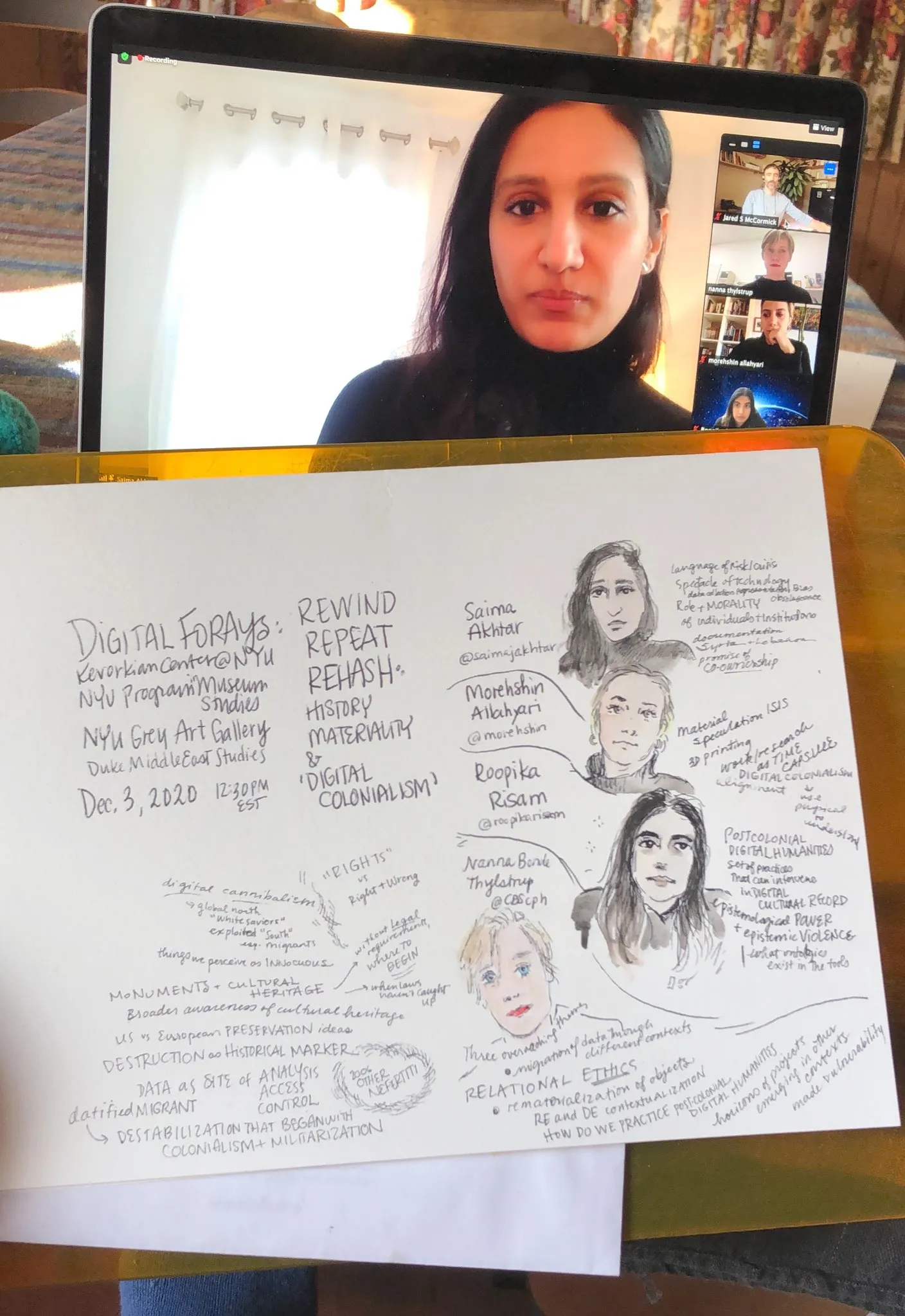
Group PAH
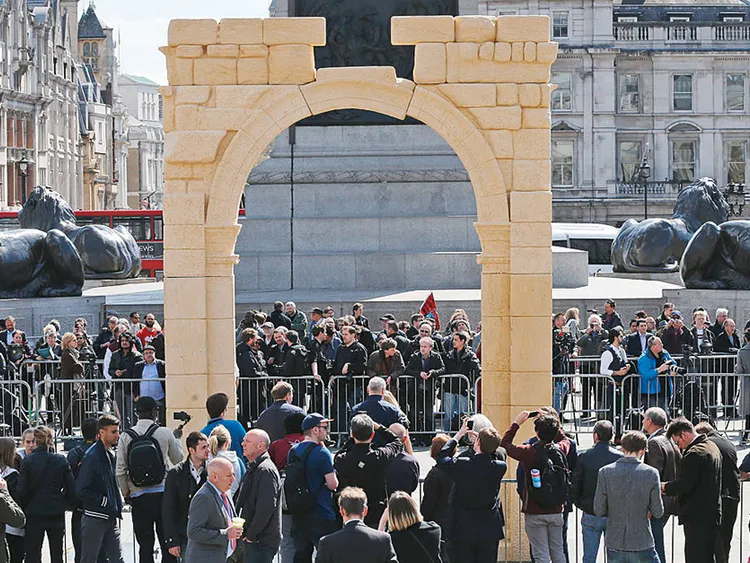

This extension aims to intervene in the conversation of digital colonialism, and the politics of naming and recognizing material heritage by putting forth a number of alternatives to the UNESCO World Heritage list . To do so, we look at three sites of intervention: Palestine and a conversation on digital colonialism, technology, and material violence and the possibilities for opposing it; music as a way to speak of heritage that evades the confines of physical space; and a critique of colonial limitations to our imaginaries of what is culture using the example of the portrait of Bush Sr. at the Rashid Hotel in Baghdad.
The event introduced the concept of ‘digital colonialism,’ a useful analytic for thinking about the role of technology in colonial projects, and the ways in which military practices are always changing and adapting to the conditions in which they are occurring. In other words, military technological advancements have long existed, and are in fact as old as any organized form of violence itself. They are not mere reflections or examples of colonial power, but practices of epistemic and material violence. Thus digital colonialism does not minimize older forms of colonialism, but rather, provides a framework for understanding its contemporary iterations.
In the context of Israel, the logic of occupation/settler-colonialism is embedded in Israeli technological development. Israel’s development and marketing of military weapons, surveillance apparatuses, and mapping technologies are part and parcel to its broader imperial ambitions in the region. A few contemporary illustrations of this are racializing surveillance technologies, blacklists, cybercide, or visual erasures on colonial maps.
These forms of digital colonialism have ideological purposes, in terms of legitimizing ongoing colonization, but also material purposes through the expansion of physical dispossession. Helga Tawil-Souri and Miriyam Aouragh’s piece “Intifada 3.0? Cyber Colonialism and Palestinian Resistance” helps to understand the relationship between technology and material violence through considering the materiality of both the digital realm and resistance.
Opposition to colonization then becomes one that includes the digital realm. This point is one which came up in the event, leaving the participants with some questions about the possibility of forms of opposition that can respond to the increasing iterations and expansions of colonialism via the digital sphere. Some examples are the invaluable resources and practices that counter the colonial imagination of Palestine. These practices can be read as opposing the epistemological violence of digital colonialism. Just as urgent to ask here, is how to counter the ways in which digital colonialism enacts and expands physical dispossession? What could a practice that simultaneously counters the colonial project’s ideological basis and its ongoing forms of material dispossession look like?
In an increasingly digital world, we ask what happens to heritage when it is not confined to a physical site.
In the case of hip hop, a genre characterized by the sampling and remixing of recordings, musical ownership becomes somewhat of a contested concept. To produce is to reproduce; perhaps music is a tricky site of heritage for this precise reason. After all, who gets to be the guardian of heritage when the heritage form itself refuses to be petrified and “preserved?” Does the mobility and reproducibility of music endanger it to co-option, or endear it to the creation of profound new meanings? Is heritage defined by historical distance, and if so, what does that mean for the potentiality (or lack thereof) of the present and future?
Al Nather is a Palestine based rapper/producer who uses samples from various forms of media from across the region. In 2016, he and Lebanese rapper/producer El Rass produced a joint album where most of the beats were organized around different samples. Some songs, like “Ishhar” and “Takwim”, are assemblages of samples remixed. Others, like “Karsaneh”, feature them rapping over tracks seemingly unrelated, in this case Zaki Nassif’s “Frasha Wa Zahra.” The pieces sampled take on a different life in the album in that they are recognizable past markers. Even if a listener cannot recognize the exact samples, they would still know that they were old and likely produced in a very different context than the original Palestinian-Lebanese rap album.
Outside of hip hop, musical heritage is still a malleable and rejuvenating avenue through which artists create. In 2010, Lebanese band Mashrou’ Leila’s released “Imbimbililah” as part of their self-titled album. The song uses the children’s song “Ami Bou Masoud (Uncle Bou Masoud)” as its structure. In the children’s song, kids are fascinated by Uncle Bou Masoud who has big black eyes and eat and eats and eats but is never satisfied. “Imbimbililah” reimagines the nursery rhyme; Uncle Bou Masoud is now a man who is constantly humiliated and disenfranchised by the state who turns to abusing his wife to feel powerful. Here, musical heritage is used as a site through which to advance commentary and critique. The familiar form of “Ami Bou Masoud” adds another, heavier dimension to the song. “Imbimbiliilah” is only one example of how music sampling allows for the re-imagination and even subversion of certain cultural symbols, allowing new meanings to be produced in the re-coding process.
In the case of American hip-hop music, and the necessary racial context it evokes, the re-imaginings involved have potentially revolutionary racial implications. The music of Black American rappers like Biggie and Ice-T, and the speeches of political leaders like Malcolm X and Barack Obama, have taken on new life as sampled and refereneced by local rappers in the unexpected context of “Arab Muslim” North Africa. As Cristina Moreno Almeida tracks in her chapter of American Studies Encounters the Middle East, titled “‘Race’ and ‘Blackness’ in Moroccan Rap: Voicing Local Experiences of Marginality,’ the work of artists like Drizzy DROS and Mobydick finds parallels between the urban ghettos of the United States and those of Morocco, as well as the experience of being Black in both contexts. The double lens of race and class allows the rappers to find powerful transnational throughlines that both pay homage to the birthplace of hip hop music in the 1970’s—1520 Sedgwick Avenue, a housing project in the Bronx—and recognize the same oppressive dynamics that can unfortunately be recognized in urban ghettos all over the world. The musical projects of rappers like Drizzy DROS and Mobydick becomes especially important in Morocco and other parts of the Middle East, which have historically ignored or erased elements of “Blackness” or indigenousness (exemplified by Amazigh populations) in their cultures and histories, tending to claim ethnic and religious homogeneity as “Arab Muslims” and disavow the existence of racism in their contexts altogether. The work of Moroccan rappers should thus be analyzed in tandem with the work of academics like Chouki Hamel, whose 2012 work Black Morocco brought to light the racist legacies of the Arab slave trade in Morocco, which have been ignored until recently.
In addition to highlighting the racial struggles that Black Moroccans—including sub-Saharan migrants, Sahrawwis, and other Black marginal groups—face, hip hop music in Morocco can serve as a valuable representation of these groups in popular culture. In this music, the word “nigga” is replaced by local counterparts, allowing derogatory terms like “‘azzy” (racial, meaning “Black person”) and “lmoutchou” (classist, referring to poor domestic workers imported from the countryside) to be reclaimed. By not only sampling Black American rappers but also figures like Malcolm X, Moroccan rappers like Dizzy DROS make it clear that they are not only sampling the music but the context it comes from, the message it carries, and the revolutionary project it invokes. In other words, their borrowings contribute to an international political project.
Dynamic musical reimaginings call back to recognizable heritages and political projects that listeners would already have an affective relationship with. There is still a past that includes the original life of the samples, but the reproducibility and malleability of music are factors that make it seem like heritage is not as limited, or as limiting, as physical sites make them out to be. It is precisely because music has the ability to transcend immovable sites and “fixed” racial identities that allows it to be related to and reproduced in significant ways.





















If you scroll through the UNESCO World Heritage website , you will first encounter a map, then a list of world heritage sites organized by the country they are found in. If you wanted to keep track of these sites on a daily basis, you could even order a “World Heritage List Wall Map,” available to curious shoppers in English, French or Spanish. The legend beside the map informs you that world heritage sites are either cultural sites, natural sites, or mixed sites. These categories are then further divided into sites that are in danger and sites that are not.
The categorization of UNESCO World Heritage sites is based on a dichotomous understanding of nature and culture—a construct of European modernity. As Anna Tsing writes in the prologue to The Mushroom at the End of the World , for Enlightenment philosophers, “Nature was a backdrop and resource for the moral intentionality of Man, which could tame and master Nature” (Tsing vii). European colonial projects presuppose the separation of Man from Nature. Nature is constructed as capitalism’s outside—the ever expanding frontier to be subsumed and exploited. Not only did nature function as the horizon of productive power in the colonial imaginary, but also, as David Arnold shows in The Tropics and the Traveling Gaze: India, Landscape, and Science, 1800-1856 , as the means through which the colony itself was imagined and constructed. Arnold examines how “‘the tropics’ were invented quite as much as they were encountered” through the production of scientific botanical knowledge; in other words, knowledge about nature (Arnold 5).
Is it too much to reflect so extensively on the way that UNESCO categorizes its sites? Maybe. But UNESCO’s use of the binary of nature/culture extends its logic to its definition of heritage. Most of the web pages for individual world heritage sites include a “Statement of Significance” or a heading that proclaims, “Outstanding Universal Value” followed by numbered criterion that explain what the site has that is of value to “World Heritage.” By “World Heritage” UNESCO means sites that “belong to all the peoples of the world, irrespective of the territory on which they are located.” The notions of heritage, value, and belonging are entangled with property, possession, acquisition, and birth rite. What then does it mean for all of humanity to have ownership of, for example, the six World Heritage sites listed in Iraq? Or of Palmyra, as discussed in the event?
The answers to this question are varied and open to the imagination and your own skepticism. One answer is that the sites become new frontiers for profit through tourism and the high value Western gaze. Another answer is that they become entangled in liberal notions of humanity and equality that erase histories of domination to paint rosy pictures of the unified contributions of all cultures to the imperatives of progress. What happens if we attempt to imagine world heritage sites that are not entangled in colonial narratives of progress? Certainly, we are not looking to have additional sites recognized within this capitalist order, but are refusing the order itself.
For these sites we propose what we call anti-monuments—places that are complex in their truthful depiction of the histories, presents, and futures (there are always many) of the place they are in. One example is the mosaic of George Bush Sr. at the Rashid Hotel in Baghdad. The original mosaic was commissioned by the Iraqi government after an American missile destroyed the lobby of the hotel in the 90s. It depicted Geroge Bush Sr., a scowl on his face, with the caption: “Bush is Criminal.” Positioned at the entrance of the lobby, the mosaic ensured that hotel guests, which included many international visitors and reporters, stepped on Bush’s face as they walked in. Leila al-Attar, the artist believed to be behind the mosaic was killed by another American missile ordered by the Clinton administration. In 2003, with the American occupation of Iraq, American forces entered the hotel and destroyed the mosaic, replacing it with a portrait of Sadam Hussein.
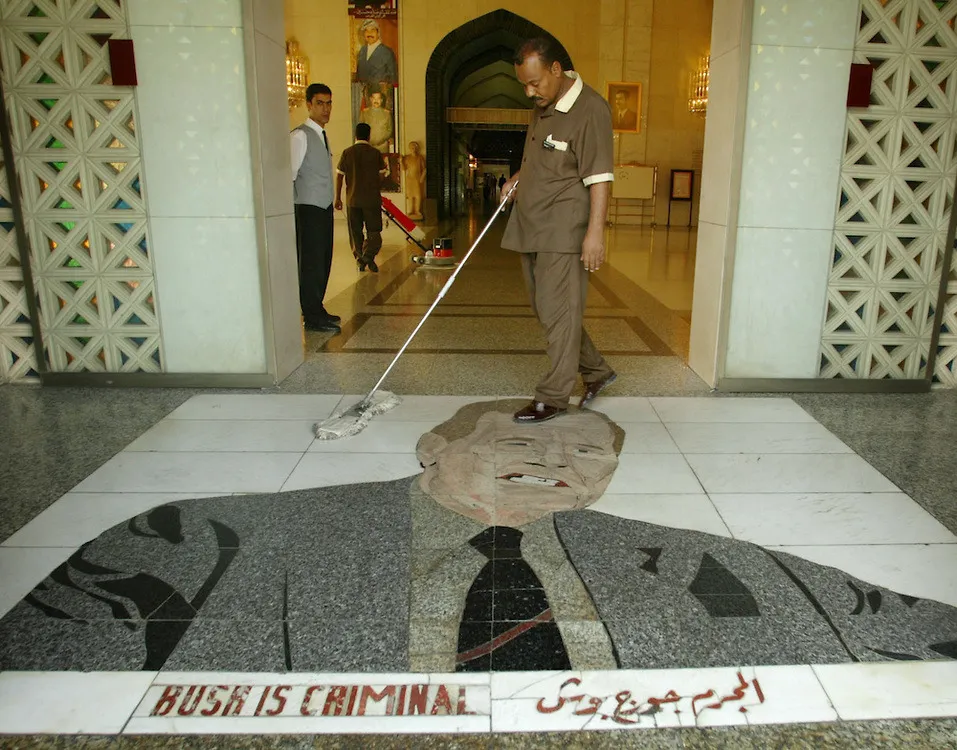
The mosaic of Bush Sr. is of outstanding universal value to humanity. It reminds us of the continued violence of American imperialism and the wit of resistance to it. Against the colonial logic of UNESCO World Heritage sites, the new sites we imagine show how these “relics” of colonial knowledge production are not things of the past, but are carried through and preserved through neoliberal logics that obliterate collectivity, except for when it becomes useful to perpetuate productive myths like heritage and multiculturalism. Part of our aim is to acknowledge the historicizing nature of such projects that want us to envision a break between a colonial past and a post-colonial present that inhibits imagination of liberated futures.
RESOURCES
On the coattails of increasing surveillance are wider digital data gathering capabilities: “open data,” user generated images, cell phone tower pings (to prove presence & proximity to a protest)...etc. Many of these are used by states and corporations, but on smaller scales, people are harnessing the surfeit of data we produce - and that which surrounds us - in order to make claims and show “proof.” How are researchers & activists collecting, aggregating, and processing what we digitally capture, as well as the digital shadows that are captured about us? Take for instance a webcam, wikipedia, or photographs of munitions from a rural field in Syria. All allow new scales of involvement and intervention that change the scope of citizen participation - but also alter the definitions of witnessing, proof, and the role of “being there.” In a quickly changing landscape of disinformation, distortion, and “fakes,” how are certain projects compiling information to question: how do we know what we know/prove/remember in this digital age?
Hadi Al Khatib has been working since 2011 on collecting, verifying, and investigating citizen-generated data as evidence of human rights violations in order to expose and draw attention to human rights violations committed by all sides in the Syrian conflict, and to make sure that activists, journalists, and lawyers are able to use the verified data for their investigations and criminal case building. Hadi has previously worked with Tactical Technology Collective for the last 5 years to support journalists and news agencies in securing their data, devices, and communications online. Hadi worked as a part-time open source investigator with Human Rights Watch and Bellingcat.
Samira Koujok is a human rights researcher from Lebanon who documents and investigates human rights abuses and developments in the MENA region. Most recently, she has been working on the issue of missing persons related to the Syrian conflict and has been tracking the evolution of the conflict since it began in 2011.
She works closely with Syrian family associations and civil society organizations to gather evidence and advocate for the rights of missing persons’ families by identifying key community stakeholders and building capacities of local organizations. Samira also develops advocacy campaigns to draw attention to the rule of law and the role of women in the future of Syria. Ultimately, the mission of her work is the adoption of a feminist lens in the investigating of disappearances and promoting of justice in Syria.
Lorenzo Pezzani is an architect and researcher in the Centre for Research Architecture , where he currently convenes the MA studio in Forensic Architecture. His work explores the spatial politics, visual cultures and political ecologies of migration and borders.
Since 2011, he has been working on Forensic Oceanography, a collaborative project that critically investigates the militarized border regime in the Mediterranean Sea and has co-founded the WatchTheMed platform. Together with several NGOs, scientists, journalists, and activist groups, he has produced maps, videos, installations and human right reports that attempt to document and challenge the ongoing death of migrants at sea. He has held postdoctoral positions in the Department of Politics at the University of York and at the Kent Law School. His work has been used as evidence in courts of law, published across different media and academic outlets, as well as exhibited and screened internationally. “Agitated Waters: Migration, Borders and Activism in the Wake of the Mediterranean Spring” is the title of his forthcoming monograph, co-authored with Charles Heller and published by Zone Books.
Discussant: Jillian C. York is EFF 's Director for International Freedom of Expression and is based in Berlin, Germany. Her work examines state and corporate censorship and its impact on culture and human rights, with an emphasis on marginalized communities. At EFF, she leads Onlinecensorship.org and works on platform censorship and accountability, state censorship, the impact of sanctions, and digital security. Jillian's writing has been featured in Motherboard, Buzzfeed, the Guardian, Quartz, the Washington Post, and the New York Times, among others. She is also a regular speaker at global events. Prior to joining EFF, Jillian worked at Harvard's Berkman Klein Center for Internet & Society, where she managed the OpenNet Initiative and worked on other projects including Herdict and research into DDoS attacks. In a previous life, she lived in Morocco and worked as an English teacher and travel writer.
This event was part of the Spring 2021 course: Digital Methods of Middle Eastern StudiesThe class session was Class 6, Digital Data Gathering: Documents, Objects, & Images #1
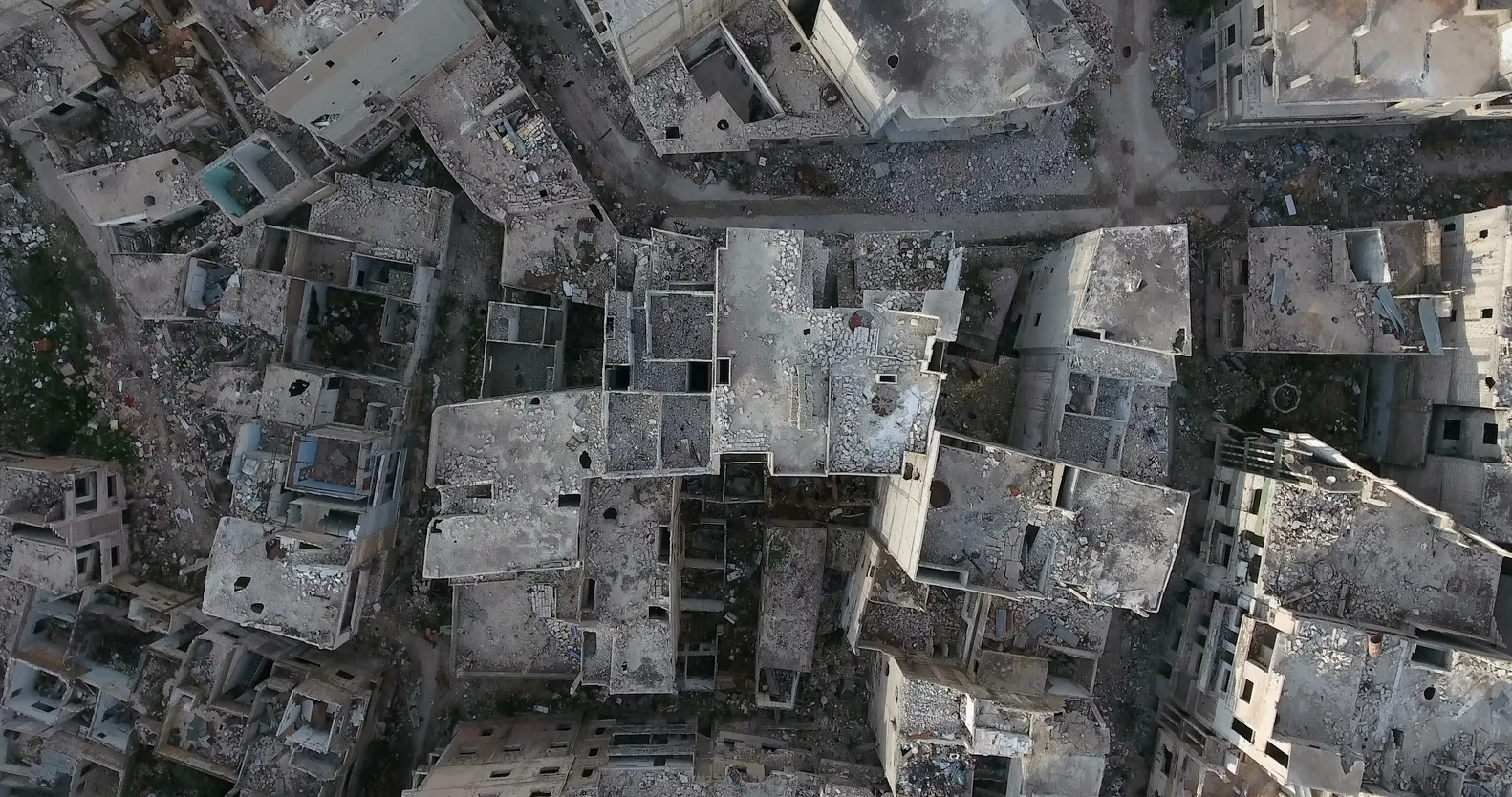
Samira Koujok (Columbia University) began this virtual event by highlighting the silences and gaps in memories and history generated by the trauma of the Lebanese Civil War. She stressed the importance of having the families of missing persons/those affected by conflict and their needs be at the center of data collection.
Lorenzo Pezzani (Goldsmiths, University of London) showcased technologies of surveillance on Mediterranean migration can also be used to document and map instances of injustice in the absence of images. He concluded thinking about the ways in which images and data can often flood information pathways, creating the obfuscations behind this so-called post-truth era.
Hadi Al Khatib (Syrian Archive), one of TIME’s 100 emerging leaders, detailed the ways in which the Syrian state has made invisible their human rights violations. With his archive, he explained how geo-mapping and data collection brought to light the intent and calculated nature of state-sponsored violence.
Jillian York (EFF) posed questions on the uneasy relationships the speakers have with the tech giants that house their data, as all as interrogated the nature of truth. The group reflected on how their projects speak to a relation of the past and future. They concluded on the ways in which a collective truth not afraid of fractures and fissures can coalesce in a sustained manner that does not solely rely on the energy of a viral moment.
This event was co-sponsored by the Global Journalism program at NYU’s Arthur Carter Journalism Institute .
Talking taking back ownership and visibility in data practices with Samira Koutok, Lorenzo Pezzani, Hadi Al Khatib and Jillian York @nyukevo @GloJo_NYU @KoujokSamira @GoldsmithsMADJ @syrian_archive questions of verifying and securing personal data #jojodoodles #visualnotes
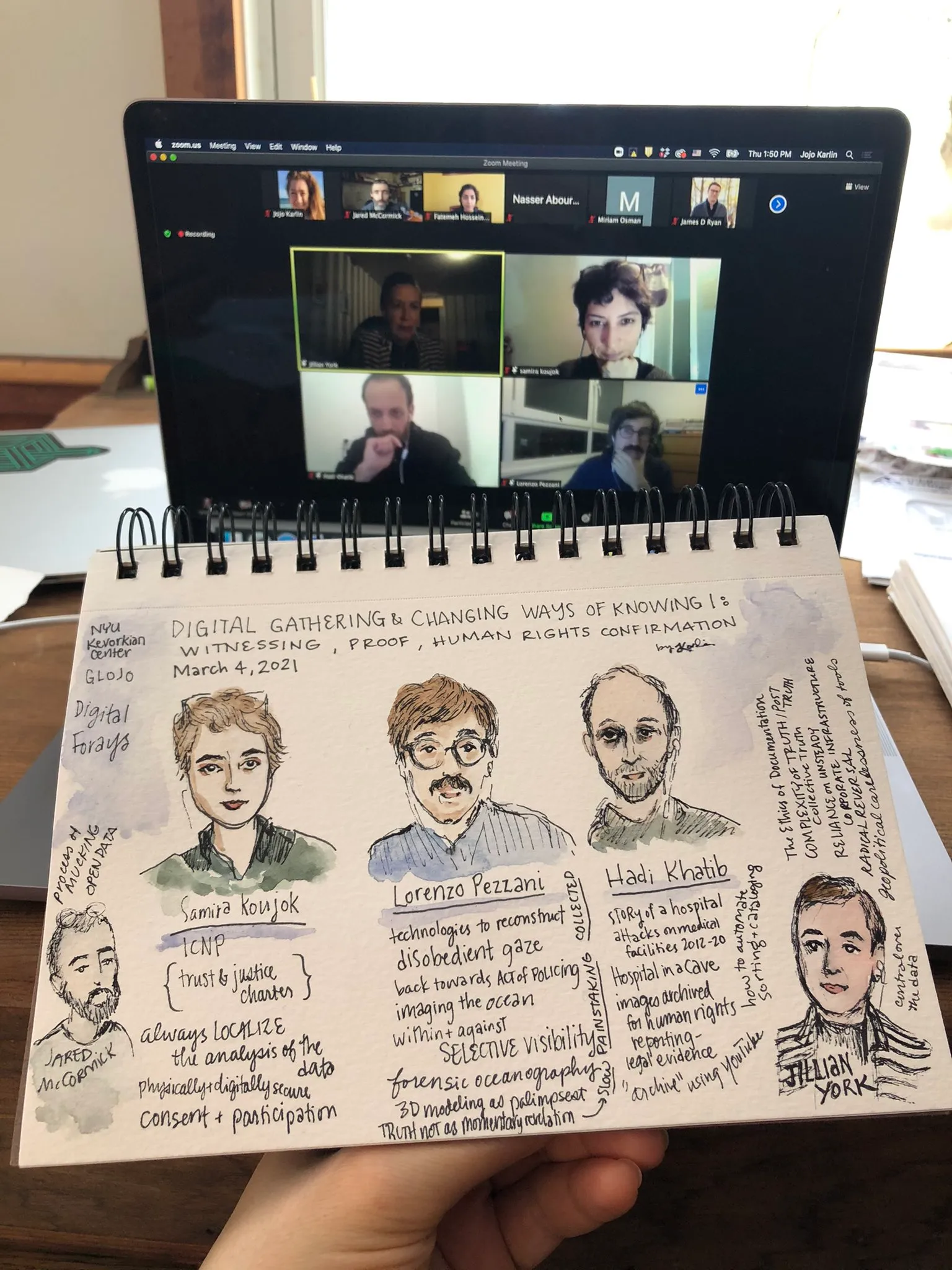
At the time of writing, the US Capital was just stormed by Trump supporters. Americans are glued to TikToKs, Tweets, Live Streams, & social media posts that nearly synchronously take millions into the events as they unfold. Yet these posts are also being saved, aggregated, cross referenced, processed by computer vision - and will linger on as evidence.
This panel assembles social media researchers & scholars to speak about data collection and the afterlives of what happens across social media once hitting post/upload. Researchers may mine Twitter, others might do sentiment analysis, or utilize location data - yet how are these applications, which become siphon and sleeves of our digital social lives, also changing how/what we know in various MIddle Eastern countries? What insights can we glean from the afterlives of social media that constructs a digital background of our lives? This is not just to address usage and penetration, but the social implications and deeper entwinements of these media into layers of society. This panel is about longevity, ephemerality, and the digital afterlives of moments, photos, and phrases which “prove,” “show” and “create” realities.
Dr. Yakein Abdelmagid has over 10 years of experience as an academic and corporate researcher focusing on technology, innovation, and entrepreneurship. Yakein holds a doctorate in Cultural Anthropology from Duke University, a MA in Sociology from The American University in Cairo, and a BE in Computer Engineering from Cairo University. At Big Sky, Yakein is leading research that examines the impact of Covid-19 on migrant entrepreneurship in The Greater Philadelphia Region, providing digital maturity assessment and strategies for digital transformation. Driven by a passion for diversity, equity, and inclusion, Yakein leverages grounded research for strategic outcomes to promote the growth of small businesses with disadvantaged populations.
Before joining Big Sky, Dr. Yakein Abdelmagid founded the Media Ethnography Lab at The Center for Advanced Research in Global Studies at the University of Pennsylvania; led research projects at The Department of Cultural Anthropology at Duke University; and managed cross-cultural research at The Danish Egyptian Dialogue Institute in Egypt. He leveraged research outcomes to design business strategies at Vibe Studios leading business growth that transformed the studio into the flagship of the indie music scene in Egypt. Driven by curiosity that leverages research and analysis for transformative change, Yakein is passionate for grounded knowledge that leads to deeper empathetic understanding. As a seasoned cultural broker, Yakein excels in bringing together diverse people to collaborate in global, cross-functional, and cross-cultural teams. As an educator committed to collaborative learning, Yakein organized 12+ international academic workshops and conferences; taught undergraduate and graduate seminars on global economies, creative industries, and qualitative research at Duke University, Bryn Mawr College, University of the Arts, and George Washington University. He is an avid gardener and plant lover: Yakein believes that we can learn a lot about growth, hope, collaboration, and resilience from fellow plants!
Marc Owen Jones received his BA in Journalism, Film and Broadcasting from Cardiff University in 2006, and a CASAW-funded MSc in Arab World Studies from the University of Durham in 2010. Following this, he completed his PhD (funded by the AHRC/ESRC) in 2016 at Durham, where he wrote an interdisciplinary thesis on the history of political repression in Bahrain. His thesis won the 2016 AGAPS prize.
He spent much of his childhood in Bahrain, and has also lived in various parts of the Middle East, including Saudi Arabia, Sudan, and Syria. Prior to joining HBKU, he won a Teach at Tubingen Award at Tuebingen University’s Institute for Political Science, and worked as a Lecturer in the History of the Gulf and Arabian Peninsula at Exeter University’s Institute of Arab and Islamic Studies. He has edited two books, and recently published a monograph on political repression in Bahrain with Cambridge University Press. His current work focuses largely on disinformation on social media in the Middle East, and he is currently working on his next book, Digital Authoritarianism in the Middle East, published with Hurst/OUP (2021). In addition to his academic work, he enjoys communicating his research to broader audiences, and has bylines in the Washington Post, New Statesman, CNN, the Independent, PEN International, and several others. He has also appeared frequently on the BBC, Channel 4 News, and Al Jazeera.
Marlene Schäfers is a social anthropologist and British Academy Newton International Fellow at the University of Cambridge. Her research focuses on the impact of state violence on intimate and gendered lives, the politics of death and the afterlife, and the intersections of affect and politics. She specializes in the anthropology of the Kurdish regions and modern Turkey.
She holds a PhD in Social Anthropology from the University of Cambridge and was Marie Skłodowska-Curie Fellow at the Middle East and North Africa Research Group at Ghent University, Belgium. Her work has been published in Comparative Studies in Society and History , the Journal of the Royal Anthropological Society , the Journal of Middle East Women's Studies and Social Anthropology . She is co-editor of a special issue on loyalty and critique in resistance movements ( Comparative Studies of South Asia, Africa and the Middle East , 2020) and associate editor of the journal Kurdish Studies . In May 2021 she will deliver the Evans-Pritchard Lectures at All Souls College, Oxford.
Discussant: Adel Iskandar is an Assistant Professor of Global Communication at Simon Fraser University in Vancouver/Burnaby, Canada. He is the author, co-author, and editor of several works including Egypt In Flux: Essays on an Unfinished Revolution (AUCP/OUP); Al-Jazeera: The Story of the Network that is Rattling Governments and Redefining Modern Journalism (Basic Books); Edward Said: A Legacy of Emancipation and Representation (University of California Press); Mediating the Arab Uprisings (Tadween Publishing); and Media Evolution on the Eve of the Arab Spring (Palgrave Macmillan). Iskandar's work deals with media, identity and politics; and he has lectured extensively on these topics at universities worldwide.
This event was part of the Spring 2021 course: Digital Methods of Middle Eastern StudiesThe class session was Class 8, Digital Data Gathering: Documents, Objects, & Images #3
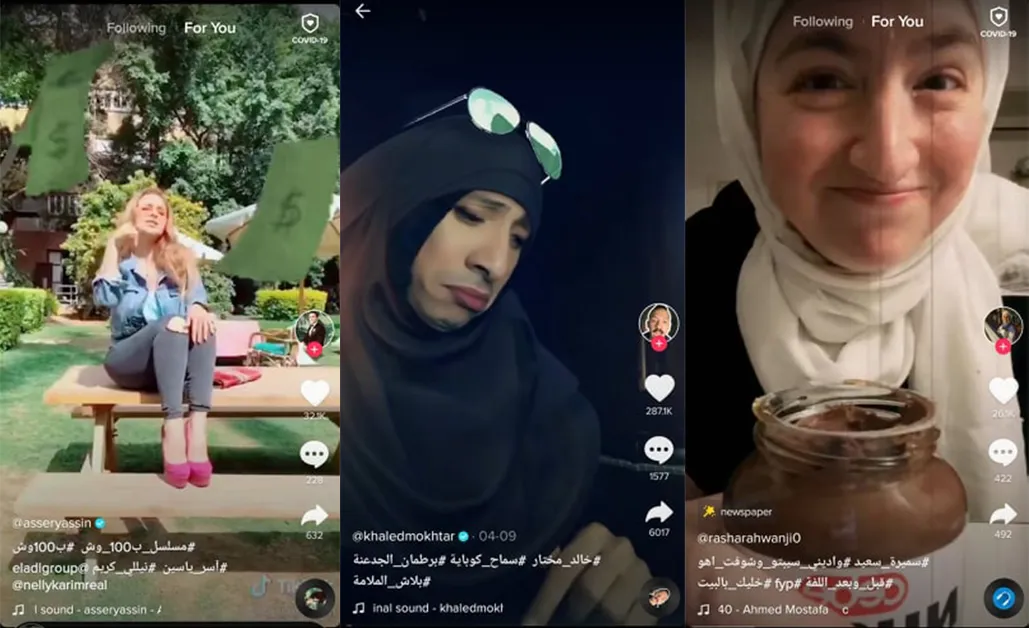
Yakein Abdelmagid (Research Strategist) opened up this virtual event with a discussion of digital and social media afterlives in terms of new waves of scalability operating off an interplay of repetition and difference.
Marc Owen Jones (HBKU) continued by expanding on the multiscalar ethical implications of Twitter data collection. Looking at harassment and disinformation campaigns, his queries centered around what happens when data is extracted from a public moment in time and then rendered private by downloading it. He raised critical questions about the use of this data and who/what has access to it and can control it.
Marlene Schäfers (University of Cambridge) used the social media afterlives of Kurdish freedom fighters to argue that the oscillation between individuation and aggregation in commemorating them as martyrs–as well as the Turkish state’s attempts to disappear these accounts–indicates spaces where power is made and unmade.
Adel Iskandar (SFU) noted throughout the discussion that what we choose to consolidate, curate and employ in the digital is exactly what gives it an afterlife. The ephemeral nature of social media renders important questions on immortality, memory, and corporeality, as well as an intriguing topography of consent-making, knowledge production, and present absence.
Afterlives, remembering & forgetting, zombies, corporeal corpora texture @nyukevo Digital Gathering and Changing Ways of Knowing II: Social Media Afterlives with @YaqeenF @marcowenjones @MarleneSchafers and discussant Adel Iskandar @GloJo_NYU #jojodoodles #visualnotes
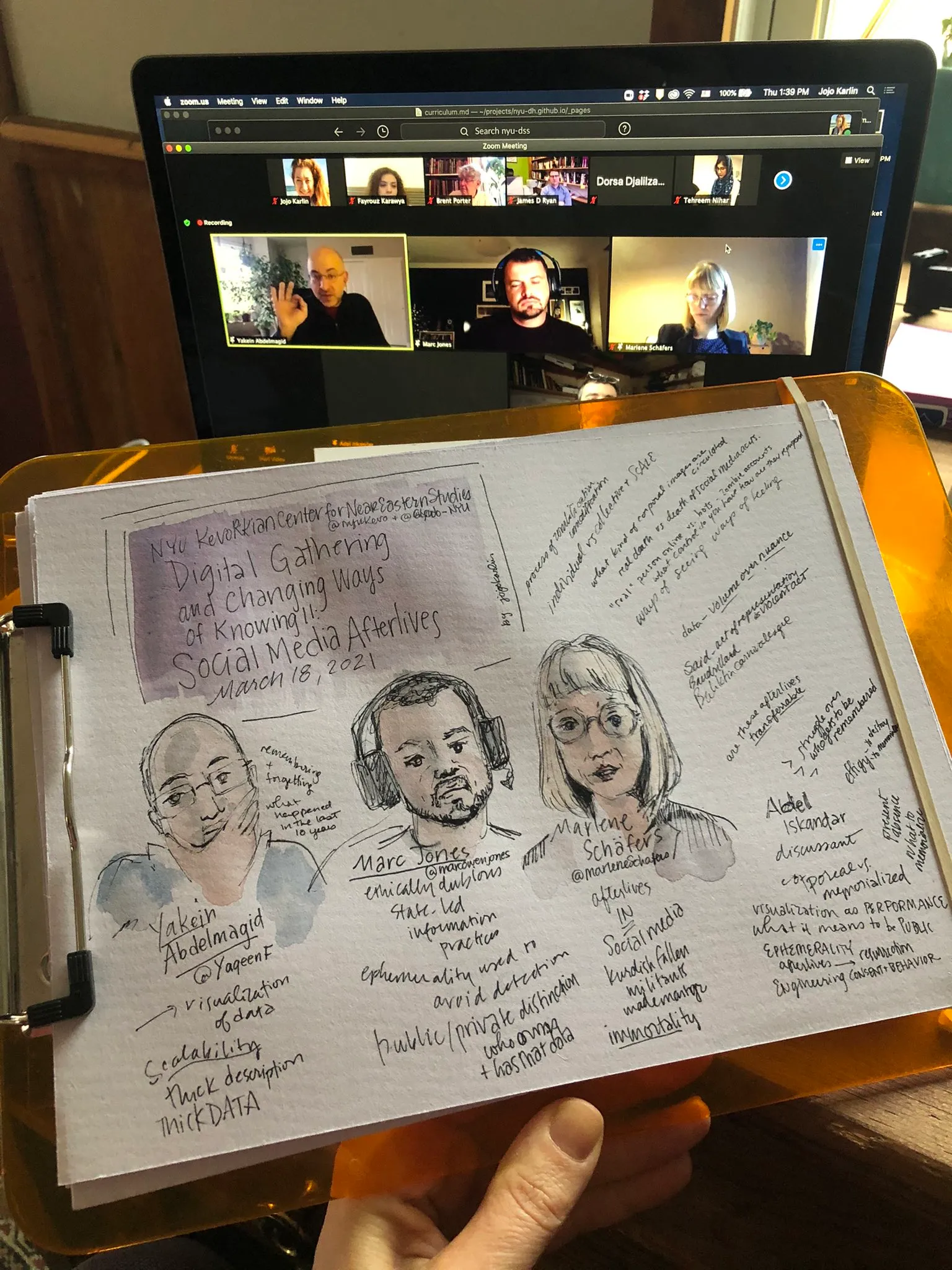
Critical mapping is thought of as a practice that presents maps “against dominant power structures, to further seemingly progressive goals" (Hodgson 2002). How are scholars, practitioners, and activists in the region using digital spatial practices to disrupt, pushback, and flip narratives and think of spatial issues anew? Through questions of history, urbanism, and place these three practitioners illustrate individual & collaborative initiatives currently being realized. Their projects push new boundaries of regional critical/counter/alter/collaborative/re- mapping practices. Through their work - and looking forward - what issues face scholars & activists for future counter spatial representations & research in the region?
Majd Al-Shihabi is a systems design engineer, and an urban planner based in Toronto, applying the craft of systems thinking to as many fields as he can reach. He works with a wide range of academic and cultural institutions and archives in the region to build openness into their information systems. He is interested in knowledge production outside of traditional institutions, and knowledge dissemination to wider audiences. His most recent project is Palestine Open Maps , a platform for open sourcing historical maps of Palestine.
Nermin Elsherif is a PhD candidate of cultural studies in the University of Amsterdam (UvA), and part of Marie-Skłodowska Curie project CHEurope . Her dissertation project falls at the intersections of critical media studies and memory studies. It examines nostalgic discourses of the “ideal nation” emerging over Egyptian social-media. She is working on tandem on the project “Social-Media after the Arab Uprisings: From Emancipation to Serving the Nation” funded by the Global Digital Cultures (UvA). Her earlier project, The Other Maps of Egypt was awarded the GERSS-DAAD traveling grant. In an earlier life, she taught for five years between the German University in Cairo and the Arab Academy for Science and Technology.
Ghazal Jafari is an award-winning designer, spatial historian, and environmental humanities scholar in exile, originally trained as an architect and urban designer. Her research and teaching focus on spatial and environmental justice, racialized geographies, infrastructural systems, feminist theories, immigrant narratives, and non-Western spatial discourses.
Originally of Persian/Azeri descent and currently living in the United States, Dr. Jafari left Iran in 2007 in a mass exodus of Iranian youth due to geopolitical struggle and socioeconomic violence. With a co-commitment to relations between cultural sovereignty, self-determination, and the future of land, she has been researching and documenting the complex, multi-dimensional, and transnational dimensions of systemic dispossession and colonialism that prevail in the Middle East and the Americas, while simultaneously documenting trajectories of cultural and political resurgence in the Middle East through women’s resistance and indigenous ecological praxis. She is a founding Director of OPEN SYSTEMS, a nonprofit research organization dedicated to opening systemic knowledge related to complex, socioecological challenges and geopolitical conflicts. She is currently an Assistant Professor of Landscape Architecture at University of Virginia School of Architecture .
Discussant: Timur Hammond is an Assistant Professor of Geography and Environment in the Maxwell School of Citizenship and Public Affairs at Syracuse University. Prior to joining the Maxwell School faculty, Timur was an adjunct lecturer in the Department of Geography at the University of Vermont, Fall 2016 to Summer 2017. From Fall 2008 to Spring 2016, he was a graduate student in the Department of Geography at the University of California, Los Angeles.
Prof. Hammond’s primary research interests include the Middle East, Turkey, cultural geography, urban geography, religion, and identity. Prof. Hammond’s scholarship has been recognized with several awards and honors. In 2013, he won the doctoral student paper competition in multiple specialty groups of the Association of American Geographers. For his doctoral research, Prof. Hammond was awarded Fulbright funding and a fellowship from the American Research Institute in Turkey. To complete his dissertation, he received a writing grant from the Institute of Turkish Studies, in addition to multiple fellowships from the University of California, Los Angeles. Prof. Hammond is a member of many specialty groups in the Association of American Geographers, as well as the Middle East Studies Association.
This event was part of the Spring 2021 course: Digital Methods of Middle Eastern StudiesThe class session was Class 10, Maps, Space and Visualizing Place I
In this virtual event, Majd Al-Shihabi (Systems Design Engineer) discussed his work on Palestine Open Maps, highlighting the process of layering maps from different historical periods to show how representations and geographies have changed and how they are remembered through counter-mapping. Al-Shihabi also spoke about the work of translating colonial ontologies to Open Street Maps and the disparity between translated and original Arabic Wikipedia articles as a way to show how local knowledge is no longer attached to the spaces where it is produced.
Nermin Elsherif (CHEurope) discussed the common threads between mapping projects she created and participated in: creating counter-maps of Port Said, Alexandria, and Cairo that challenge the colonial knowledge embedded in cartography by attempting to represent personal, literary, musical, and other stories. A driving force of her work has been negotiating the tensions and translations between the analog and the digital.
Ghazal Jafari ’s (University of Virginia) work interrogates how design and spatial processes are complicit in maintaining colonial power structures. She shared her recent project on the development of the Khuzestan region along the border of Iraq and Iran in the late 1950s, where the histories and practices of the region were erased by Point Four modernizing discourses and technologies whose dams have led to environmental degradation.
Timur Hammond (Syracuse University) asked participants to think through the questions of translation, temporality, and layering in their work. He continued the discussion by asking about the solidarities and successes fashioned over the course of Al-Shihabi, Elsherif, and Jafari’s projects.
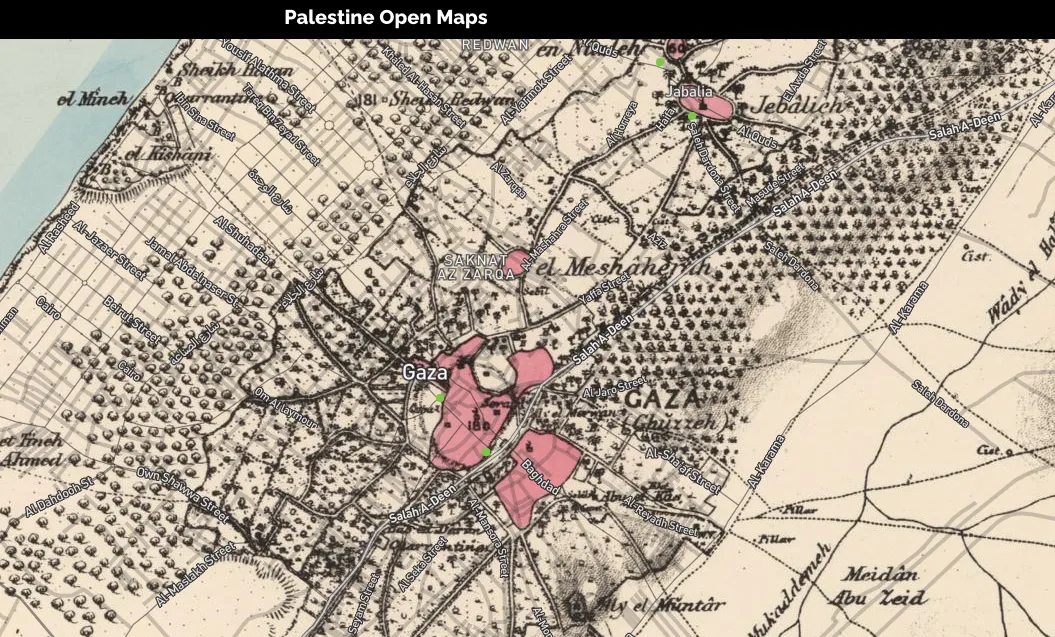
More scholars and activists across the region are finding ways to use infographics, visualizations and novel techniques of digital storytelling to explore lived experience, push our perspectives, and flip current imaginations of space and place. How are individuals/initiatives expanding the collaborations creating new visual narratives around social issues? How are these visualizations and digital stories becoming a part of research and teaching? How do we account for “data” in these backstories?
Ahmad Barclay is an architect and UX designer engaged in projects involving data visualization, visual storytelling and learning through play. Barclay has led award winning infographics projects as a partner with Visualizing Impact, initiated the open data project Palestine Open Maps , contributed to a range of publications, and facilitated courses and workshops based on his practices in Beirut, London, Lisbon, Amman and Bangalore. He is presently leading data visualization work for the 2021 Census at the Office for National Statistics in the UK.
Ahmad El-Gharbie' is Assistant Professor of Graphic Design at the American University of Beirut (AUB). His scholarly work explores mapping as a method of researching, representing, and analyzing socio-spatial phenomena. He is co-founder of Beirut Urban Lab, a collaborative and interdisciplinary research space where he is Director of Critical Mapping.
Fabiola Hanna is a new media artist, software theorist, and Assistant Professor of Emerging Media at the School of Media Studies at The New School . She is a hybrid theory/practitioner whose work engages the theory of digital media with a focus on software that interfaces with archives of memories of the past. Fabiola holds a PhD in Film and Digital Media from UC Santa Cruz where she also completed an MFA in Digital Arts & New Media.
She has several forthcoming publications on these topics including a chapter on how non-Western contexts can help rethink software studies. Her work has been published in Feminist Media Histories and Sounding Out. She is working towards a special issue on activist interactive documentary in the non-Western world. Her work has been exhibited at the Museum of Art and History in Santa Cruz, the New Children’s Museum in San Diego, the SubZero Festival in San Jose, the Digital Arts Research Center in Santa Cruz, and the MakerFaire in San Mateo.
Discussant: Hatim El-Hibri is an Assistant Professor of Film and Media Studies at George Mason University . His research and teaching interests focus on global and transnational media, visual culture, Lebanon and the Middle East, critical theory, and the historical entanglement of media technology and institutions with the production and contestation of urban space. His first book, titled Visions of Beirut: The Urban Life of Media Infrastructure, is forthcoming from Duke University Press (2021).
This event was part of the Spring 2021 course: Digital Methods of Middle Eastern StudiesThe class session was Class 12, Digital Storytelling: Text/Image/Sound/Video I
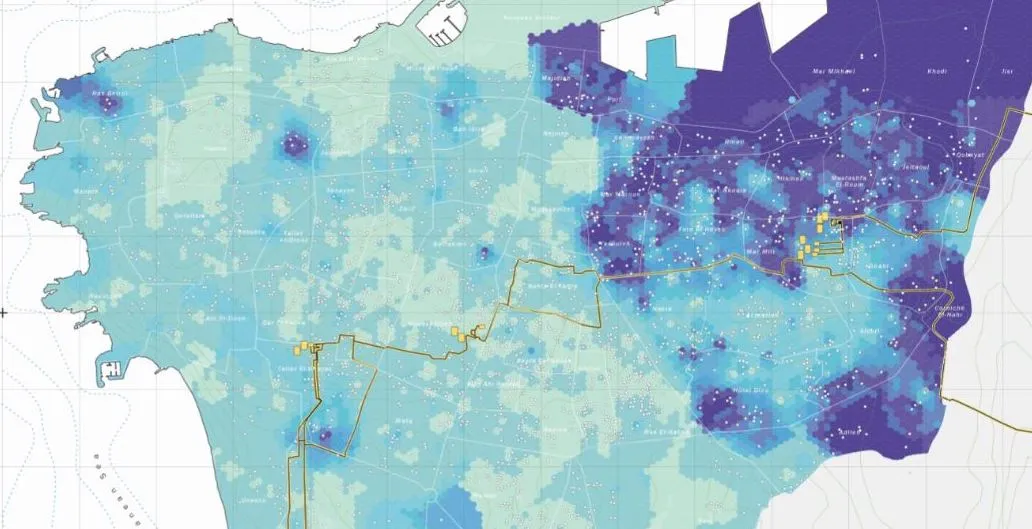
Ahmad Barclay (Architect) shared his work on Palestine Open Maps and the need to find ways to make the maps a guided experience for users. This need led to the creation of Palestine Today, the Palestine Oral History Map, and multiple art projects that integrate storytelling into the maps to engage users.
Fabiola Hanna (The New School) discussed going beyond critiques of humanitarian language to begin thinking through software as a medium for historical justice for marginalized narratives. She shared her work on the platform, We Are History: A People’s History of Lebanon, which aimed to provide a bottom up history that encourages dialogue and conflicting memories, shaking the certainty of traditional narratives of Lebanese history.
Ahmad El-Gharbie’ (American University of Beirut) emphasized the need to contest “hard-line boundaries,” or the perceived inflexibility of neighborhood boundaries in official maps of Beirut. Projects such as a map of Beirut neighborhoods based on the perspective of delivery drivers, or of neighborhoods based on how much water they receive, demonstrated the gap between official boundaries and the lived experience, resources, and memory of residents.
Hatim El-Hibri (George Mason University) asked panelists to think about the process of data selection in these projects, as well as the positive and negative outcomes that might have been instructive in their work.
This virtual event was co-sponsored by Media Studies at The New School and George Mason University .
Today’s Digital Forays: Space & Place II: @nyukevo @TNSmediastudies & @GeorgeMasonNews: Visualization & Digital Storytelling w/ @bothness, Ahmad El-Gharbie, @FabiolaHanna & Hatim El-Hibri discuss the making, translation, adaptations of data. Who do we map? #jojodoodles #nyudh
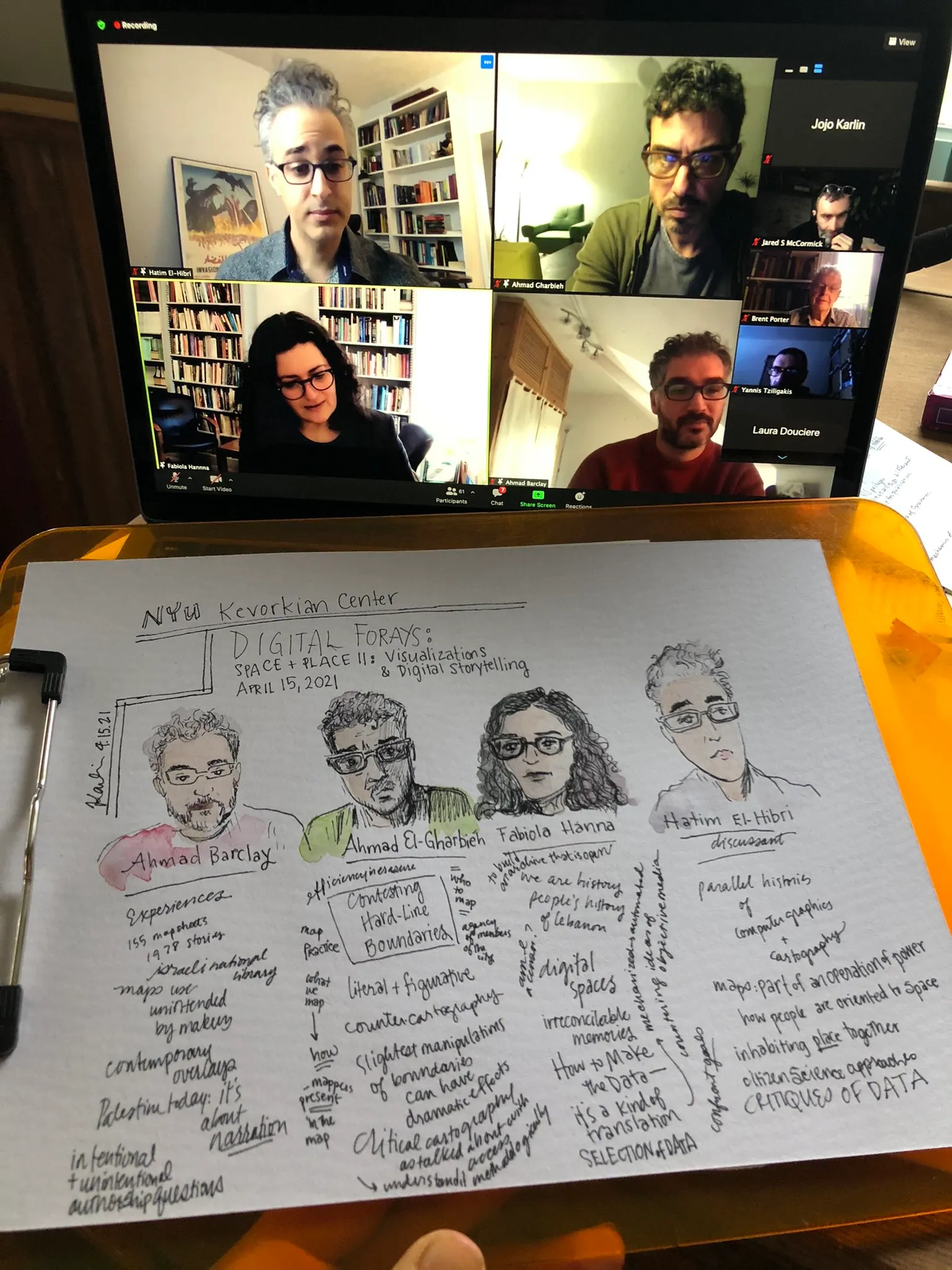
What is the state of digital scholarly research on/in/from the Middle East? What challenges and opportunities fill our present - and what will the next 5-10 years of digital research on the Middle East look like? This roundtable event will examine the present in order to look forward to digital scholarship yet to come. Some motivating questions
How to speak of the difference between digital work produced within the region, rather than about it? What challenges/opportunities are facing graduate students/junior faculty as they try to imagine, conceive, and realize digital projects on/in/from the region? A backbone of digital projects are infrastructures of collaboration. How are projects being developed beyond disciplines, beyond the university, and even national boundaries? Universities’ acceptance of digital scholarship in the humanities (and social science) is uneven. What work is being done to address the scope of supporting larger projects, academic units, and ways of producing individual scholarship? How does this relate to the perils & promise of funding? How can we think beyond the University as the gatekeeper, or walls, where digital scholarship is fostered, produced, and made accessible?
Dr. Akram Khater is University Faculty Scholar, Professor of History , and holds the Khayrallah Chair in Diaspora Studies at North Carolina State University where he also serves as the Director of the Khayrallah Center for Lebanese Diaspora Studies .
A native of Lebanon (born 1960), he earned a B.S. degree in Electrical Engineering from California Polytechnic State University, and holds M.A. and Ph.D. degrees in History from the University of California, Santa Cruz, and University of California, Berkeley, respectively. His books include Inventing Home: Emigration, Gender and the Making of a Lebanese Middle Class, 1861-1921 , and A History of the Middle East: A Sourcebook for the History of the Middle East and North Africa , and Embracing the Divine: Passion and Politics in the Christian Middle East . He has produced Cedars in the Pines , a PBS documentary on the history of the Lebanese community in North Carolina, and is the senior curator for a museum exhibit on the same topic. He also curated the traveling exhibit, The Lebanese in America , which has toured 10 US cities, and will continue to tour through 2020. He has just completed a new award- winning documentary titled The Romey Lynchings , that narrates the history of racial violence against early Arab immigrants. In addition, he is the senior curator for Turath: An Exhibit of Early Arab American Culture . He has published a substantial number of articles and reviews, and has made conference presentations throughout the United States and internationally. Through the Khayrallah Center, Khater has launched several digital humanities projects, these include Legacies of Labor: Lebanese Factory Workers in Lawrence, Massachusetts, 1890-1950, and Syrians in New York: Mapping Movement, 1900-1930 . Most recently, he has been collaborating with colleagues from Statistics and Computer Science to develop the first Arabic OCR for historical publications, and the largest repository of digitized Arabic archive. He has delivered over 300 talks in the past 20 years on topics relating to the Middle East. Professor Khater has been awarded a number of teaching accolades (Outstanding Teacher, Outstanding Junior Faculty and Outstanding Extension Faculty) and grants during his tenure at N.C. State, and has also obtained fellowships from the National Humanities Center, American Philosophical Society, National Endowment for the Humanities, Fulbright Foundation, Council of American Overseas Research Centers, among others. His professional affiliations include the Middle East Studies Association, Arab-American Studies Association, American Academy of Religion, and the American Historical Association. He is past editor of the International Journal of Middle East Studies , and current editor of Mashriq & Mahjar: Journal of Middle East and North African Migrations , and sits on the editorial board of a book series on immigration studies.
Marina Rustow is the Khedouri A. Zilkha Professor of Jewish Civilization in the Near East at Princeton University . She directs the Princeton Geniza Lab , a database of documents from medieval Cairo, and, as of February 2021, co-leads an NEH-funded initiative on teaching with manuscripts, rare books and archives. Her most recent book is The Lost Archive: Traces of a Caliphate in a Cairo Synagogue (Princeton UP, 2020). In 2015, she was named a MacArthur Fellow.
David Joseph Wrisley is a comparative medievalist and digital humanist. His research straddles the domains of late medieval court culture, Mediterranean studies, multilingual corpora analysis and the spatial humanities. He founded and organized the first digital humanities training institute in the Middle East in Beirut in 2015.
Jared McCormick 's larger research explores issues of tourism and imaginations of place across the Middle East. Digital scholarship/methods are central to his teaching and personal work. He is very interested to push the boundaries of how we conceptualize, use, and make visual/digital materials central within our research process. He completed his Ph.D. in Social Anthropology, and a secondary degree in Critical Media Practices, at Harvard University and his MA from the American University of Beirut. He was a Visiting Assistant Professor at the University of Pittsburgh and Virginia Commonwealth University in Qatar before joining NYU.
Jared is working on the book manuscript of his dissertation which joins a historical analysis of the tourism/leisure industry in Lebanon with an ethnography of queer mobility since 2004. He also has been carrying out a parallel project concerning tourism in the Arabian Gulf (Qatar, Kuwait, UAE, and Bahrain) centered on “tourism” to explore state making, affective speculation, and new ways to understand infrastructures.
This event was part of the Spring 2021 course: Digital Methods of Middle Eastern StudiesThe class session was Class 13, Digital Storytelling: Text/Image/Sound/Video II
Akram Khater (NC State) began with describing his experience and challenges with building an archive of the stories of Arab immigrants, stressing how an archive must follow both the lives of the immigrants and the lives of those who they left. He ended by asking how we address the silences of the archive: the absence of people who were not privileged enough to write, record, and leave things behind.
Marina Rustow (Princeton) emphasized the need for digital works to be accessible in the places they originally come from. However, for her digitization is not a magic solution. Rather, it is an opening to formulate new ways of workflow and collaboration that often do not map onto the infrastructural demands of traditional academic institutions worldwide.
David Joseph Wrisley (NYU Abu Dhabi) first focused on how ‘with’ is largely missing in the area studies lexicon. He stressed the need for fostering modes of transnational collaboration while also addressing the possible uneven relations. He identified infrastructural difference as a new site of privilege, asking how do we center new infrastructures and ways of working with information?
Jared McCormick (NYU) concluded by asking the scholars to think through the preposition ‘with’. The speakers discussed the challenges of institutionalizing new understandings and standards for academic labor for faculty and students. They also stressed infrastructure as a modelling process that can allow for others worldwide to work with us, thus creating new possibilities.
This virtual event was co-sponsored by 19 Washington Square North and the Duke-UNC Consortium for Middle East Studies .
Today’s Digital Forays: Future Digital Research ON/IN/FROM the Middle East @nyukevo w/ Akram Khater @KhayrallahNCSU, Marina Rustow @mrustow @PrincetonDH, David Joseph Wrisley @DJWrisley @NYUAbuDhabi & Jared McCormick @jark____ @nyuniversity #jojodoodles #nyudh #academicdrawing
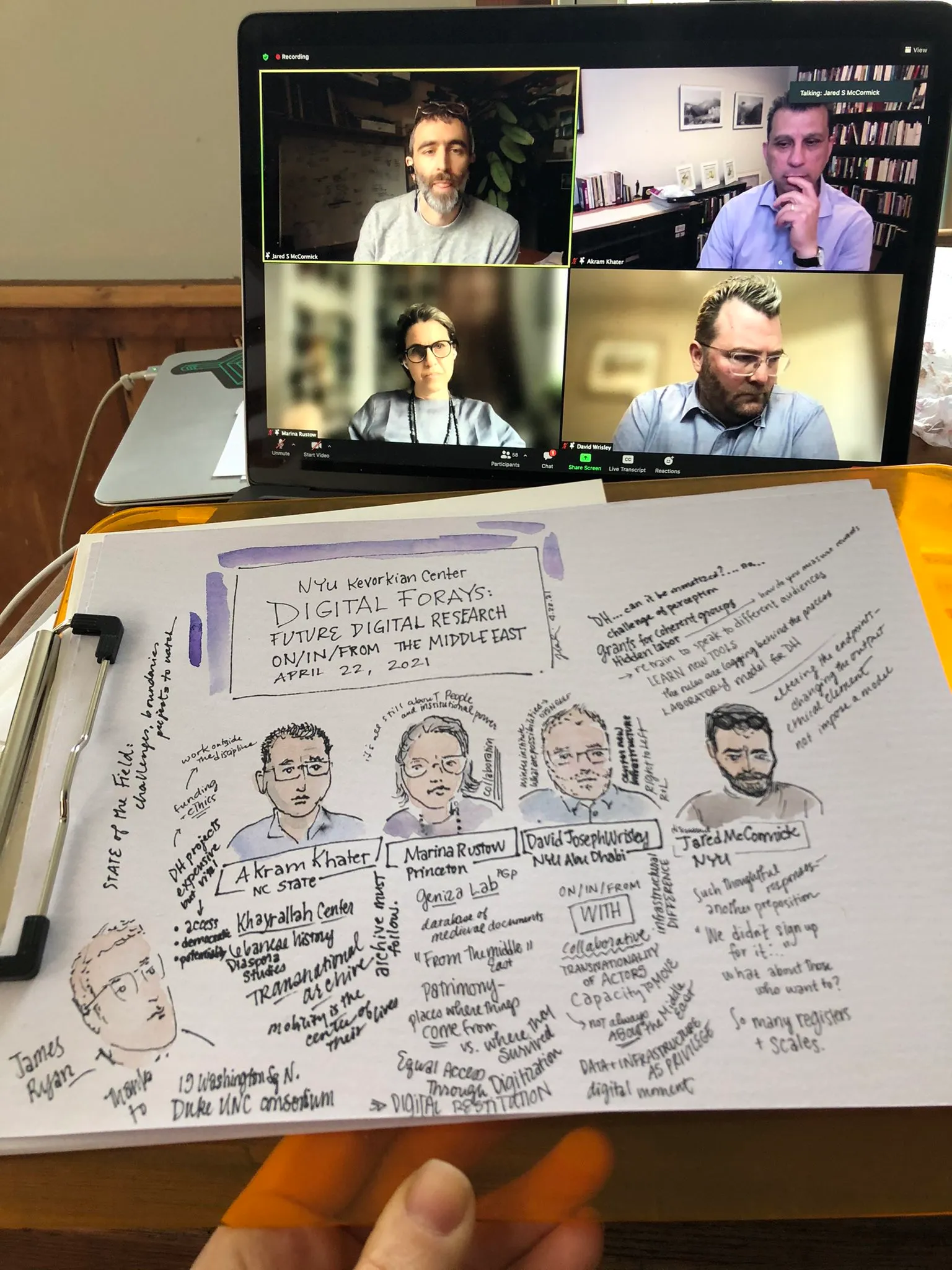
Through an open call, we invited PhD/MA Candidates, junior faculty, and independent scholars to apply to present iterations of their developing digital projects. We were interested to find projects that are pushing the norms, boundaries, and forms of Middle Eastern Scholarship through adopting new tools, methods, and modes of dissemination. Through these 7 LIGHTNING TALKS we hope to connect, model possible directions, and foster a conversation for those who are feeling frustrated, lost, and limited in academic/disciplinary silos!
Kylie Broderick is a student in the Department of History at the University of North Carolina, Chapel Hill.
She presents: "Utilizing Digital Humanities in Engaging K-12 Educators on Learning and Teaching the Middle East"
How can scholars demystify and de-orientalize the ways the public learns and talks about the Middle East, beyond the channels of higher education? In this presentation, I will discuss a course that I helped to construct and teach through a non-profit, which is geared toward introducing K-12 teachers to the modern Middle East. The course works to expand teachers’ ability to understand the region in ways that go beyond shallow and harmful readings of the region perpetuated in popular discourse, as well as works with them to integrate their new knowledge into their own classroom instruction. This project is concerned with identifying how to effectively reformat teaching about the Middle East from the first moments K-12 students are introduced to the region.
Rachel A. Rosenbaum (she/her/they) is a PhD candidate at the University of Arizona, School of Anthropology.
They present: "Regenerate Hub: Building cross-sector connectivity between crises and collaboration"
Rachel's digital and non-digital scholarship is motivated by two overarching questions: 1) How is inequality and violence maintained by our natural and built environments? 2) How do people attempt to improve the well-being of their communities through changing these environments? This talk will introduce a collaborative digital research project, Regenerate Hub, that is exploring these questions in Lebanon through data aggregation, visualization, and creating new tools for resource sharing.
Timothy Y. Loh is a PhD candidate at the Massachusetts Institute of Technology / History, Anthropology, Science, Technology, and Society (HASTS).
He presents: "Access and Allyship: Deaf-Hearing Relations in a Jordanian Facebook Group"
What might interactions on digital networking sites shed light on recent social and cultural transformations in the Middle East? How might new kinds of technologically-mediated communication shape not just the content of contemporary social discourses but the forms they take as well? I examine questions of access and allyship through virtual ethnography of a Facebook group focused on deafness, sign language, and inclusion in Jordan.
Tess Waggoner presents: "Tracking Snow Plows in Ankara"
Earlier this year, the Ankara Metropolitan Municipality unveiled a mobile web application that allows users to track snow plows in operation around the city. What does this technological development offer discussions about the “slipperiness” of digital ethnographic research?
Melinda M. Cohoon (she/her) is a PhD candidate in Interdisciplinary Near and Middle Eastern Studies at the University of Washington-Seattle.
She presents: "Mapping the Digital Iran Project: Reimagining Collaboration and Theory using Twitch.TV"
For the multiplatform "Digital Iran" project, collaborators and I analyzed the construction of narratives and counternarratives of Iranian culture and identity in video games through the theoretical lenses of affect and feminist theory. Enacting our goals posed the following questions: (1) how can we disrupt and reimagine traditional paradigms through collaboration and (2) how do the different collaborators and publics experience video games through modes of representation and power? While these questions are still ongoing processes and discussions, we witnessed through our journey of live streaming game play on Twitch.TV and creating video essay shorts the entangled relationship of critical digital pedagogy and our viewers' discourse.
Marjan Moosavi is the Roshan Lecturer in Persian Studies at the University of Maryland.
She presents: "Digital Guide to Theatre of the Middle East"
Is creating a digital database an impossible task, a labor of love, a transnational collaboration, or all of that? How and from whom can we get help?
Zena Agha is a PhD candidate at Newcastle University.
She presents: "Colonial Cartography in Palestine-Israel and the Decolonising Potential of Counter-Maps"
My work examines historical and contemporary practices of mapping in Palestine-Israel within the frameworks of critical cartography, settler colonialism and decolonisation. It interrogates such questions as, how is Palestinian space represented in cartography since 1850? What role does technology play in the cartographic decolonisation of Palestine? What does decolonisation look like in Palestine-Israel?
Jared McCormick is Acting Director + Director of Graduate Studies & a Faculty Fellow at the Kevorkian Center for Near Eastern Studies at New York University.
Helga Tawil-Souri is Associate Professor of Media, Culture, and Communication and Associate Professor in the Department of Middle East and Islamic Studies at New York University.
Guy Burak is Librarian for Middle Eastern & Islamic Studies at New York University.
This event was part of the Spring 2021 course: Digital Methods of Middle Eastern StudiesThe class session was Class 14, Digital Storytelling: Text/Image/Sound/Video III
The seven junior scholars joining us are:
Kylie Broderick: "Utilizing Digital Humanities in Engaging K-12 Educators on Learning and Teaching the Middle East"
Zena Agha: "Colonial Cartography in Palestine-Israel and the Decolonising Potential of Counter-Maps"
Timothy Y. Loh: "Access and Allyship: Deaf-Hearing Relations in a Jordanian Facebook Group")
Rachel A. Rosenbaum: "Regenerate Hub: Building Cross-sector Connectivity Between Crises and Collaboration"
Melinda M. Cohoon: "Mapping the Digital Iran Project: Reimagining Collaboration and Theory Using Twitch.TV"
Tess Waggoner: "Tracking Snow Plows in Ankara"
Marjan Moosavi: "Digital Guide to Theatre of the Middle East"

We hope to hold this event in Fall 2021